
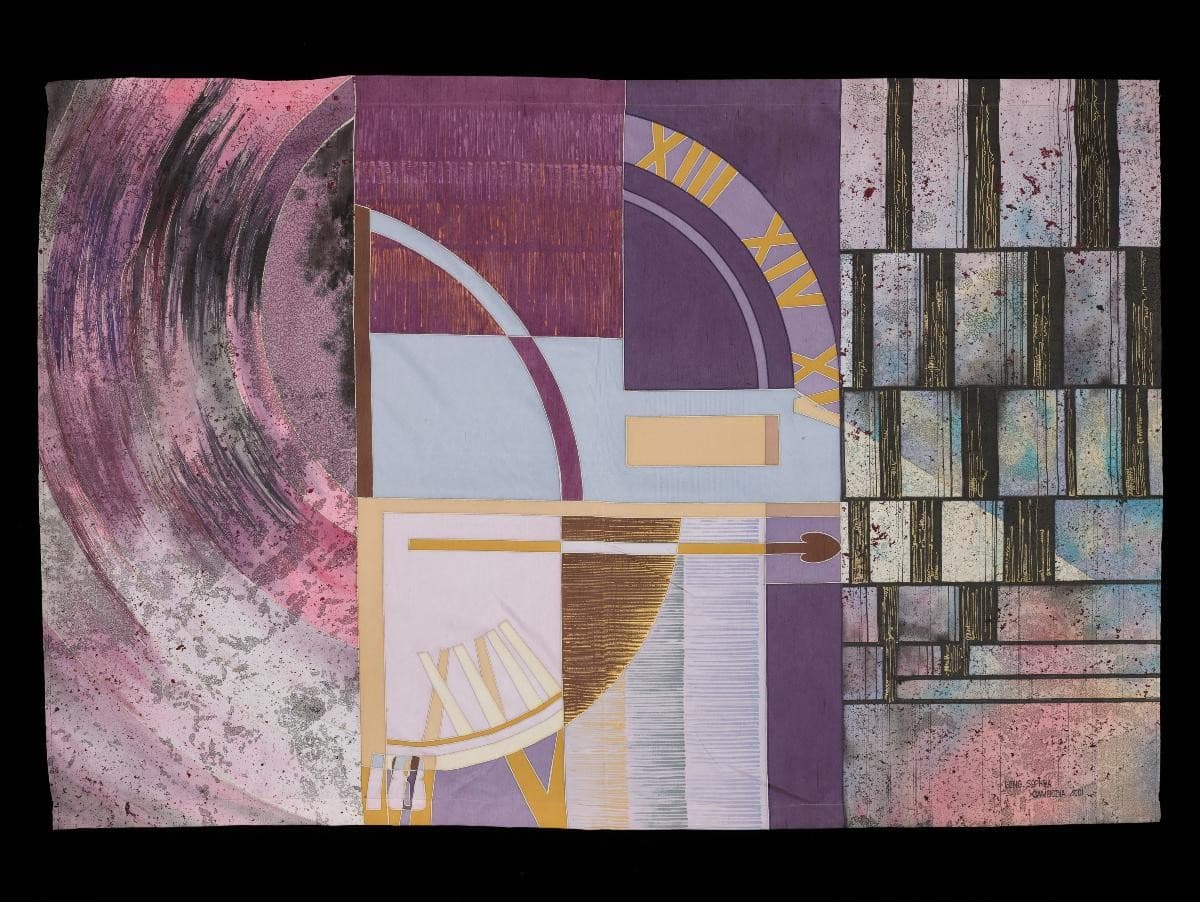
Long Sophea was among the most prominent and influential artists in Cambodia during the late 1990s and early 2000s, a period which saw the emergence of new artistic approaches (“contemporary art”) there, as well as the re-entry of Cambodia into regional and global networks for art, such as biennales, after decades of isolation due to civil war and genocide. During this period, Sophea was the only exhibiting artist in Cambodia working in textiles, and also the most prominent artist in Cambodia who was a woman. Sophea was also one of the only women among a group of around 25 Cambodian artists sent for postgraduate study in the former Soviet Union. She studied in Moscow, writing a Masters dissertation in Russian on aspects of textile arts and Khmer aesthetics, and graduating from the from the Moscow Institute of Industrial and Fine Arts in 1992. For Whom Does the Watch Have Value is part of a series of work produced for two major projects: an unrealised public art commission in Phnom Penh planned by Reyum during the early 2000s and the 2nd Fukuoka Asian Art Triennale in 2002. The work uses a deconstructed image of a clockface to explore visual representations of differing conceptions of time and chronology, and to consider the inescapability of time for human beings. The clock, which connotes a rational, linear and Western sense of time – which the artist refers to as the realm of humans whose life is regulated by measured time – dissolves, in the left side of the work, into swirls of purples and blacks highlighted in white outline, which suggests an otherworldly reality, which is free of measured time, but in which people cannot live. As in Long Sophea’s other works of the period, such as The Value of Life, the artwork rewards a slow viewing from multiple vantage points. The symbolism of the composition can be perceived from a distance, but at close range, the work shifts into a riotous play of different textural treatments of planes and lines of colour, including brushstrokes, crackles from wax, and delicately applied highlights.