
Frame size: 207.0 x 122.6 x 3.4 cm
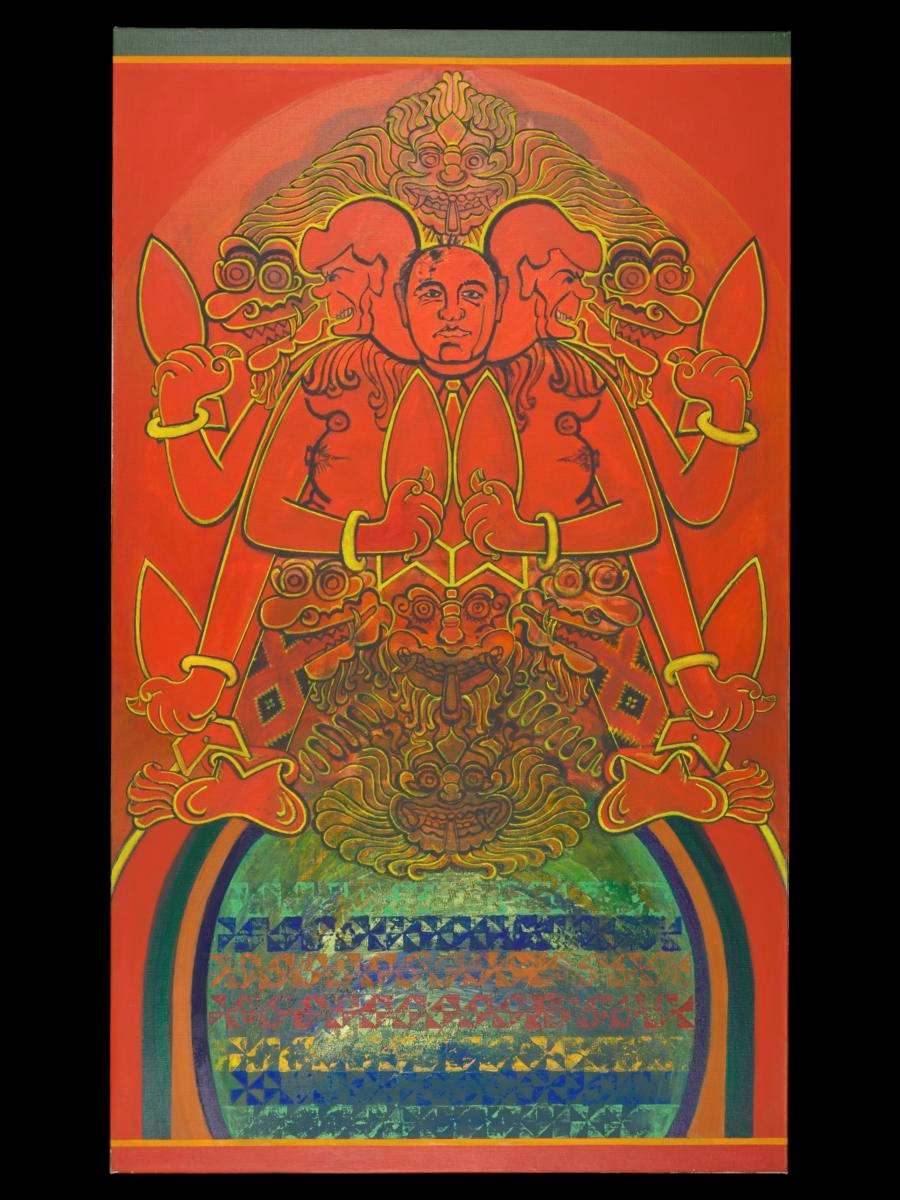
Nirmala Dutt (b. 1941, Malaysia) was one of the most prominent artists to have emerged in Malaysian art scene in the 1970s. After her relocation from Penang to Kuala Lumpur in the early 1960s, Dutt attended painting classes with artists of Angkatan Pelukis Semenanjung (APS) founded by Hoessein Enas. In a lifelong pursuit of education spanning across decades, Dutt studied art, art history, psychology and printmaking in various art schools in the U.S. and UK. Eschewing the dominant abstract expressionist and minimalist tendencies amongst her peers in post-independent Malaysia, Dutt cultivated a practice that included painting, photography, silkscreen, and collage. During the 1980s, there is a shift in Dutt's practice where she adopted a new narrative strategy, in which political events play out like a wayang kulit story. She studied traditional art forms particularly wayang kulit in the 1980s, spending time in Jakarta and Bali learning from a master puppeteer, and it becomes a distinctive motif in many of her works to reinforce her position on global war and political events. Dutt remarked: "we associate social criticism with the West (…) but there is a tradition of social criticism in the East. Wayang Kulit is another example." This large-scale painting features the figures of Ronald Reagan and Gorbachev atop a globe, surrounded by wayang kulit figures and is made in 1988, during a decade of heightened fears of nuclear conflict. It demonstrates the artist’s way of marking and placing key events of the 20th century into a historical and mystical narrative of good and evil.Throughout her practice, Dutt was committed to making works that stir the viewer’s conscience to sociopolitical struggles locally and globally—war and conflict, domestic violence, environmental destructions, urban poverty—often spotlighting the plight of women, children and indigenous groups.