
TL;DR
In recent years, arts-based interventions have been increasingly recognised for their role in supporting health and wellbeing. Research in the field of Arts and Health has shown that engagement in the arts – such as music, visual arts, dance, and writing – can bring a range of health benefits. In comparison, the intersection of heritage and health is a more nascent area of study. A toolkit helping the sector to evaluate the wellbeing impact of heritage work will help the sector in the quantification and articulation of impact.
Whereas many arts-based programmes are now designed with wellbeing as an explicit aim, heritage engagement is more often rooted in the celebration of shared history, culture, and identity. Common examples include museum visits, cultural festivals, traditional performances, and craft practices. Although these activities are not usually framed as health-related, early research suggests that heritage engagement may support aspects of health and wellbeing, including social connection, a sense of belonging, and potentially broader outcomes such as wellbeing and quality of life. However, the range of outcomes associated with heritage participation, and how these should be defined and measured, are not yet well established across studies. This gap highlights the need to better understand how heritage-based activities contribute to health and wellbeing, and how such impacts can be meaningfully captured.
Local Case Studies
In Singapore, this growing recognition of the links between the arts, heritage, and health is reflected in how they are increasingly connected through programmes and partnerships. National priorities such as healthy ageing, youth mental wellbeing, and social cohesion have helped shape a more coordinated ecosystem in which cultural engagement is increasingly seen as part of broader wellbeing efforts. This emphasis is reflected in the National Arts Council’s Our SG Arts Plan (2023-2027), which seeks to embed arts experiences across key areas of life, including wellbeing. Within this context, several local studies and initiatives have begun to explore how heritage-based activities may support health and wellbeing.
One such example is the intergenerational museum-based intervention led by Andy Ho and colleagues (2021) at the National Museum of Singapore. Designed as a shared experience between older adults and youth, the programme brought participants through guided artefact tours, storytelling sessions, and art-making activities. Evaluated through a randomised controlled trial, the intervention was associated with improvements in resilience and life satisfaction, as well as reductions in loneliness. Participants’ reflections also highlighted greater empathy and deeper intergenerational understanding. In another study by Tam and Wu (2022), a narrative and reminiscence intervention invited older adults to reflect on personal milestones alongside Singapore’s socio-historical development. Participation in the intervention was associated with improvements in life satisfaction.
Taken together, these local examples illustrate the potential for heritage activities to serve not only preservation and education aims, but also to support social connection and wellbeing. At the same time, they highlight some of the challenges involved in evaluating such initiatives. Heritage-based programmes may influence multiple, overlapping outcomes across emotional, social, and psychological dimensions of wellbeing, while differences in evaluation approaches and methods can make findings difficult to compare across programmes and studies. Limited funding, research training, and evaluation capacity may present further challenges for organisations seeking to assess their impact and communicate it effectively to funders, policymakers, and partners. Building evaluation capacity and adopting more consistent evaluation methods are therefore important steps toward strengthening the evidence base for arts and heritage initiatives that aim to support health and wellbeing. In Singapore, there is increasing interest among organisations such as the National Heritage Board (NHB), alongside other stakeholders in the arts and heritage sector, in better understanding and evaluating the outcomes of heritage activities. As a result, there is growing recognition of the need for shared frameworks, tools, and methodologies that can support more consistent and reliable evaluation across the field.
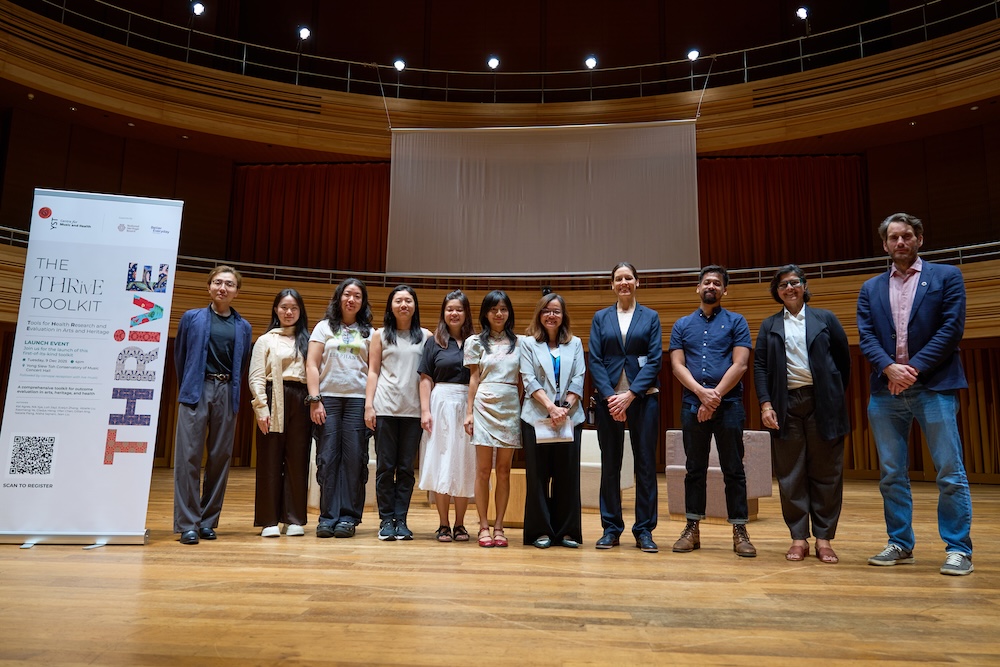 Authors of The THRivE Toolkit (from left to right): Chen Yifan, Ye Xiaomeng, Evelyn Zhang, Abielle Liu, Dr Gladys Heng, Loh Jiayi, Prof Natalie Pang, Prof Kat Agres, Nik Ilya, Prof Nisha Sajnani, and moderator of the panel of the launch, Dr Nils Fietje
The THRivE Toolkit
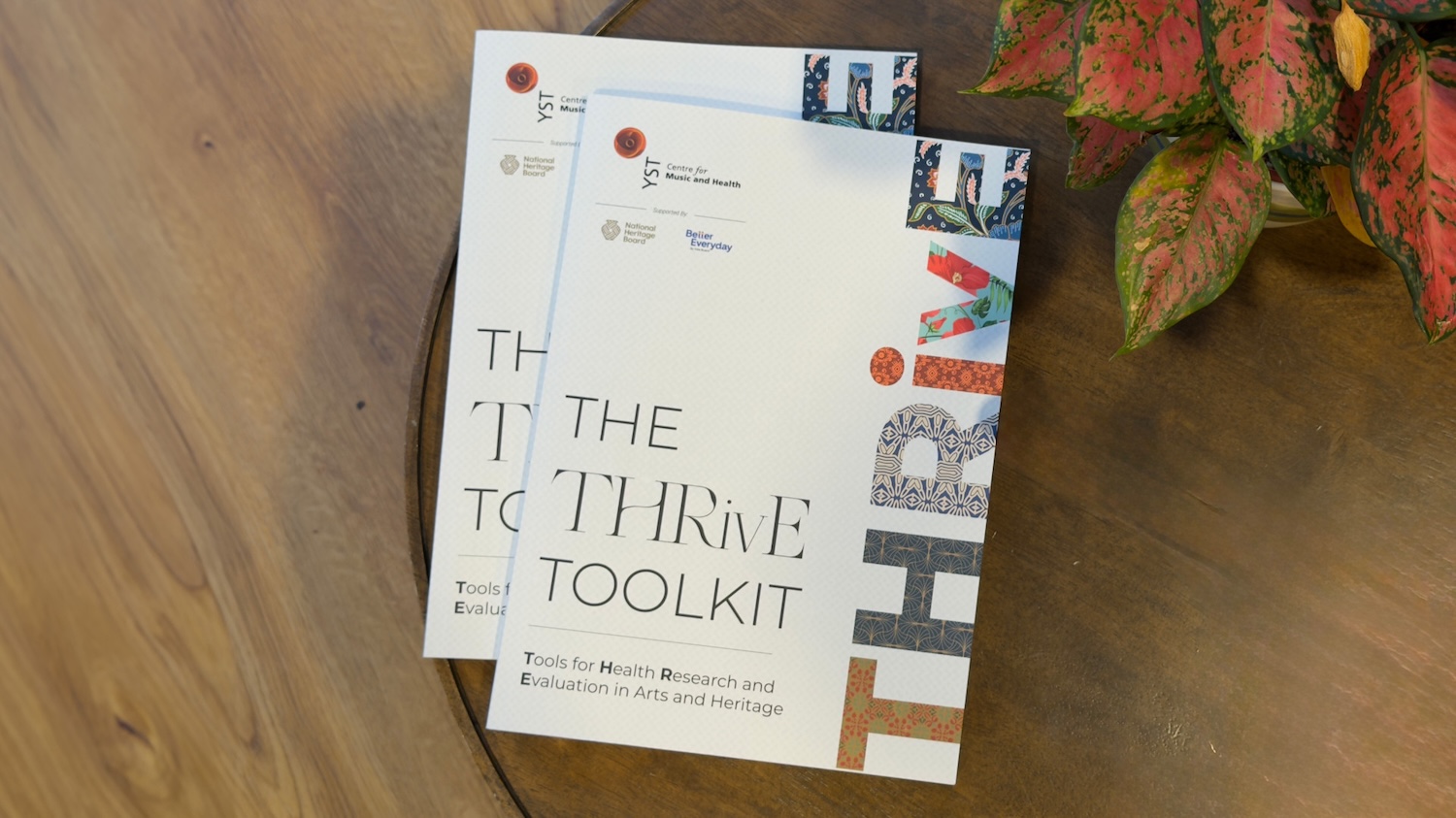
It is within this context that The THRivE Toolkit: Tools for Health Research and Evaluation in arts and heritage was developed. The toolkit was launched at Healing Arts Singapore (HASG) on 9 December 2025 by the Centre for Music and Health. It responds directly to the need for more consistent and credible research and evaluation by providing practical, accessible guidance for arts and heritage practitioners, researchers, and organisations. This includes support in planning, implementing, and evaluating programmes with health and wellbeing outcomes in mind. It also offers practical guidance on evaluation methods, including recommending validated tools for assessing outcomes such as physical and mental health, emotional responses, social connection, and broader wellbeing indicators. The toolkit also discusses approaches for data collection and analysis, as well as communicating and disseminating findings. More than a methodological guide, the THRivE Toolkit is designed to bridge practice and research, helping practitioners not only demonstrate impact, but also reflect on and strengthen their programme design over time.
Over the course of 2026, the Centre for Music and Health is providing complimentary consultation sessions with local arts and heritage organisations and practitioners to support their implementation of the toolkit within the context of their own programmes and goals. These sessions offer tailored, one-on-one guidance as organisations put the toolkit into practice.
The development of the THRivE Toolkit was undertaken by the Centre for Music and Health, with Dr Kat Agres as the Principal Investigator, in collaboration with Dr Jean Liu, Dr Natalie Pang, and Dr Nisha Sajnani, and was supported by the National Heritage Board (NHB) and Tote Board.
The toolkit can be accessed for free via the Centre for Music and Health website.
Notes
References:
- Agres KR, Ilya N, Loh J, Zhang P, Liu ASH, Ye X, Heng JG, Chen Y, Ang GR, Pang N, Sajnani N, & Liu J. The THRivE Toolkit: Tools for Health Research and Evaluation in Arts and Heritage. Singapore: National University of Singapore, Yong Siew Toh Conservatory of Music; 2025. doi:10.5281/zenodo.17746692.
- Ho AHY, Ma SHX, Tan MKB, Bajpai RC. A randomized waitlist-controlled trial of an intergenerational arts and heritage-based intervention in Singapore: Project ARTISAN. Front Psychol. 2021;12:730709. doi:10.3389/fpsyg.2021.730709.
- Tam W, Wu V. Narrative reminiscence intervention. In: Kua EH, Mahendran R, editors. Age with dignity: a 10-year study on positive ageing and dementia prevention in Singapore. Singapore: Write Editions; 2022. p.17. ISBN: 9811841594.