
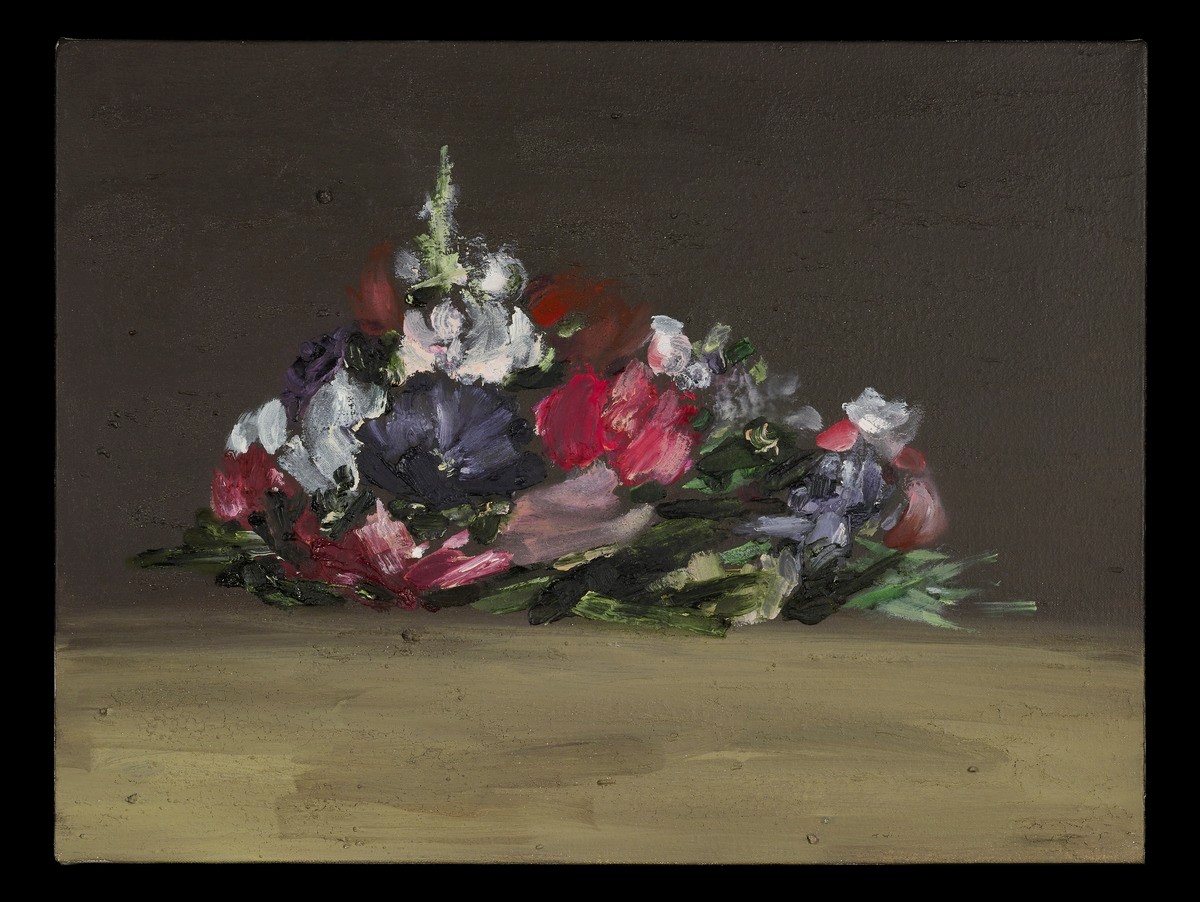
Guo-Liang Tan started with making videos and this interest in the notion of image and time in moving images eventually led him to painting which allowed him to think about time and space in very different ways. Untitled (Burrows) belongs to an early series of paintings of flowers created by Tan based on images of works by the nineteenth century French artist Fantin-Latour and Dutch painters. Using low resolution images sourced from the internet, the inaccuracies of the source images created a distance from their original context (historical, representational). And it is this distance that produces a closeness to the image, also reflected in the relatively small size of the paintings. In this process, several tensions/contradictions arise. Here, the interest is not in what is represented but how. Tan’s practice of painting explored his fixation with distance and closeness through which he enquiries into the relation between movement (in time and space) and painting. In this process, the artist discovered and began to apply paint on an aeronautical fabric. This a very thin, translucent but durable material does not absorb paint well and hence, allowed Tan to play with paint and their movement across the surface of the fabric. The process of painting becomes much more animated and results in surfaces that embody bodily movement and time, physics and materiality. Elements, such as frayed fabric, rubber, Arabic gum, etc. are introduced to interact with (or impede) the flow of paint, leaving marks that accentuate the materiality of colour. This extends his interest in exploring how the physical ground of a painting is not only a space to contain gestures of mark making but also serves as a “a screen for imaginings and haunting”. Recalling his interest in the moving image, here, Tan directs paint across the surface through pouring and tilting. Maneuvering laws of physics and material properties, the artist’s body establishes a durational relationship with the painting, now both surface and object while colour and gradient is produced through time and space.