
TL;DR
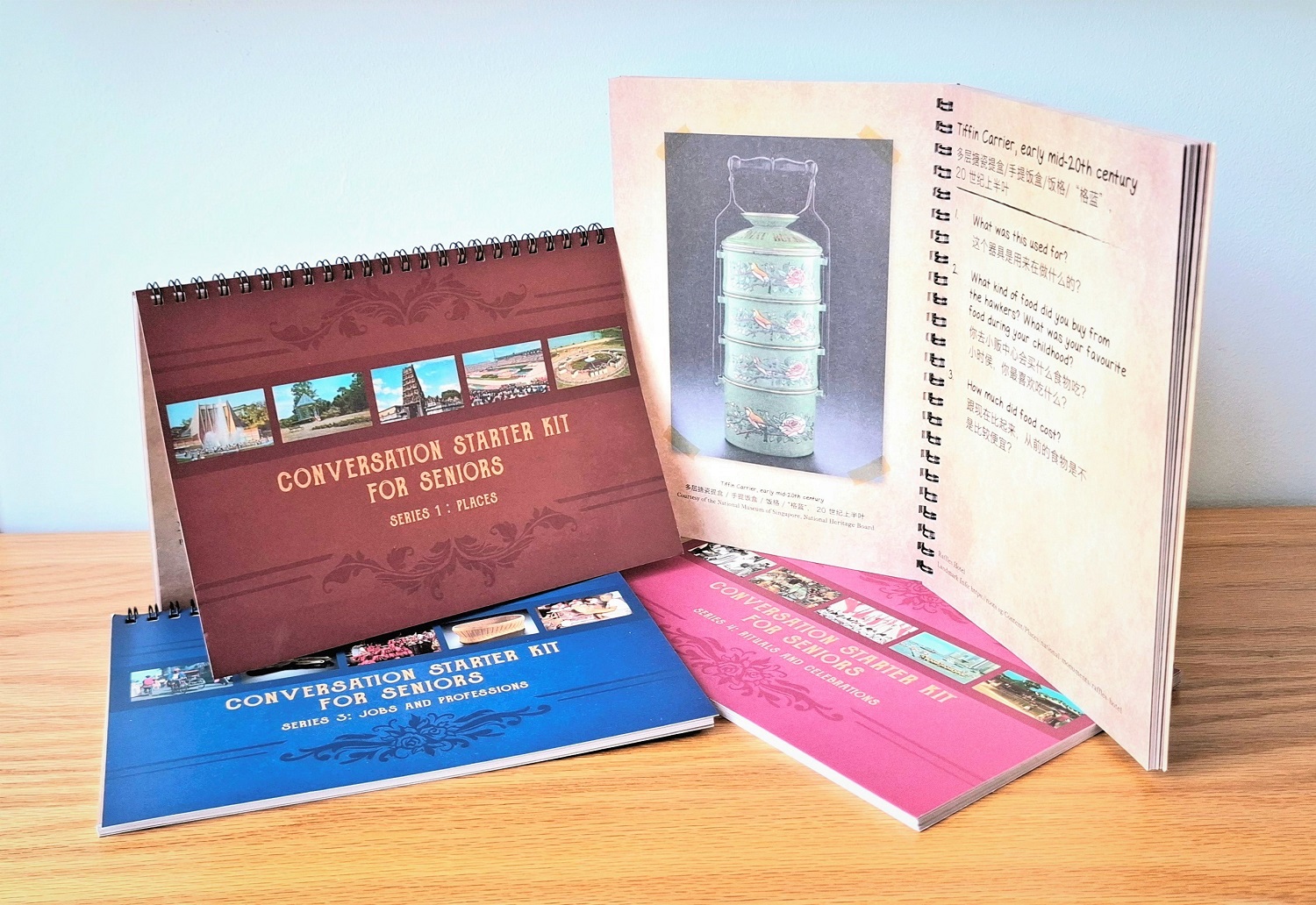
How can heritage objects and their embedded personal stories create meaningful connections for people living with dementia? The National Heritage Board partners with the Geriatric Education and Research Institute to evaluate a pilot Dementia Engagement Programme and discover the transformative potential of heritage-based interventions.The National Heritage Board’s Conservation Starter Kits for Seniors. Image courtesy of the National Heritage Board.
Insights from the Dementia Engagement Programme
A photograph of a satay seller appears on the screen during an activity session at a senior day care centre. Almost immediately, someone laughs.
“When we bakar the satay,” she recalls, using the Malay word for grilling, “the ashes would fly everywhere. My classmates would pinch their noses and say, ‘Who bakar satay ah?’”
Another participant responds by gesturing animatedly with his hands, mimicking the careful turning of satay sticks over a charcoal fire. A third participant soon joins in, re-enacting the motion of flipping the sticks.
“You must keep turning the sticks,” he explains. “If the fire is too strong, the stick will burn and the meat will drop.”
What began as a simple image quickly becomes a lively exchange of gestures, laughter, and shared knowledge about a familiar street food tradition.
Such moments illustrate the kinds of interactions that the Dementia Engagement Programme (DEP) seeks to support—using heritage materials to stimulate conversation, shared remembering, and social engagement among older adults living with dementia.
Bringing Heritage into Everyday Care
The Dementia Engagement Programme was co-created with dementia practitioners from NTUC Health, researchers from the Geriatric Education and Research Institute (GERI), and clinical partners from Khoo Teck Puat Hospital (KTPH). Funded by the National Heritage Board (NHB), the programme also drew on heritage resources curated by NHB—including the Heritage Trunks, Conversation Starter Kits, and the House of Memories mobile application. The initiative explores how these heritage materials—images, objects, and stories drawn from Singapore’s past—can be meaningfully integrated into everyday activities in senior day care centres.
Instead of the large-group activities typically conducted across the entire centre, DEP sessions are organised in small groups, creating space for more interactive engagement with heritage materials. Participants are invited to look at historical photographs, handle familiar objects, or explore digital collections. These resources act as entry points into conversation, allowing individuals to connect personal experiences with shared cultural memories.
To better understand how heritage materials shaped interactions during these sessions, researchers from the Geriatric Education and Research Institute adopted an ethnographic-focused approach across four NTUC Health day care centres where the programme was piloted. Over eight weeks at each site, the team observed heritage-based sessions involving small groups of clients and conducted interviews with centre managers, care staff, and dementia practitioners who facilitated the activities.
Because the programme was implemented in real care settings, the study focused on how heritage materials were used in practice—how participants handled objects, interpreted images, responded to one another during the sessions, and how facilitators navigated these interactions as they unfolded.
Across the observations, a consistent pattern emerged: heritage resources often became shared points of reference that encouraged participants to interact with one another. These interactions frequently began with everyday objects from Singapore’s past.
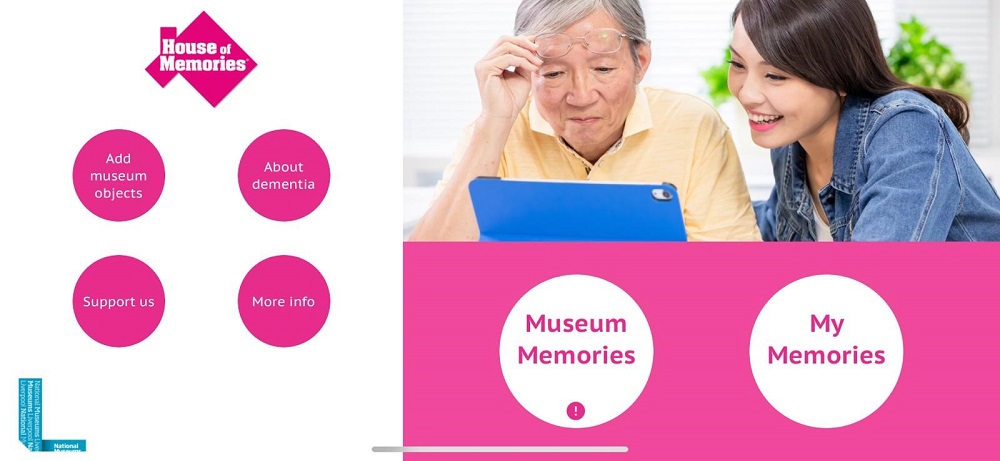 The House of Memories App. Image courtesy of the National Heritage Board.
Objects That Sparked Stories
In many sessions, everyday objects from Singapore’s past quickly became catalysts for conversation.
When an image of traditional wooden clogs appeared during one activity, participants began discussing how they were used.
One participant explained that such clogs helped keep feet dry on rainy days and could still sometimes be found in Chinatown. Others joined in, comparing the designs worn by men and women.
“If it’s straight, it’s for men,” one participant remarked. “If it’s shaped like an hourglass, that one is for ladies.”
Another added that women’s clogs were often patterned and worn during rainy weather because they were less slippery.
As participants examined the object together, the conversation moved naturally into memories of everyday life—wet market streets, rainy afternoons, and the small details of daily routines from decades past.
In another session, a sewing machine image prompted a participant to share memories of her own machine at home.
She immediately recognised the brand: Singer.
“In the past, when we got married, the sewing machine was part of the dowry,” she explained.
She returned several times to this topic, reflecting on how sewing had once been an essential skill for women of her generation. At one point, she even stood up and walked to the front of the room to demonstrate how the sewing machine would be switched off.
Recalling its cost, she noted that a sewing machine in those days could cost three to four hundred dollars.
“At that time, that was very expensive,” she remarked, comparing it to the cost of a car today.
Through this conversation, the sewing machine became more than a household object. It opened a window into past social customs and expectations.
Memory Through Sensory Experience
Some artefacts appeared to evoke particularly vivid recollections through touch and sensory familiarity.
During one session, a vinyl record was passed around the group. One participant began describing how it was played.
“Last time we used to play it. Put on the table, then it will spin—turn, turn, turn. The song comes out. There’s a small needle that goes round and round.”
Although he struggled to recall the name of the record player, he remembered in detail how it worked, pointing to the numbers on the record and explaining that some records played at “33” rpm while others were “45.”
These moments suggest that memory does not always surface through names or labels. Sometimes it emerges through remembered actions—the steps involved in using an object—or through the sensory familiarity of handling something from everyday life.
Conversations That Continued
Facilitators who led the sessions observed that heritage materials often encouraged participation from individuals who were usually quieter.
“Some of them don’t usually talk much,” one facilitator noted. “But when the old photos came out, they started sharing stories straight away.”
These conversations often extended beyond the activity itself. Participants continued discussing objects during breaks or returned to earlier conversations later in the day.
More importantly, the sessions encouraged interaction among participants, with conversations often moving beyond the objects themselves. Individuals guessed at the uses of unfamiliar objects, corrected one another’s explanations, and sometimes stepped into teaching roles—demonstrating how something had once been used.
In one session, a participant shared a story about surviving a workplace accident. As he recounted the near-death experience, another participant—who came from a different ethnic and religious background—turned to him and tapped his arm gently in encouragement.
“But you haven’t die,” she said. “Since God still love you, you need to pray, pray, pray.”
The exchange was received with warmth, reflecting the ease with which participants responded to one another’s stories.
Humour and laughter were common during these exchanges. Participants playfully challenged one another’s answers or joked about past experiences.
Participants also supported one another in communication. In some sessions, individuals helped translate between languages so that everyone could follow the discussion. Others helped peers with word-finding difficulties to complete their sentences or elaborate on memories that were difficult to express.
These small acts of co-operation created an environment where participants not only remembered the past but also actively engaged with one another.
Observations across the centres suggested that heritage materials did more than prompt reminiscence. They often functioned as social anchors—objects or images around which conversation, participation, and shared recognition could take shape.
Heritage in the Present Tense
The Dementia Engagement Programme offers insights into how heritage can take on new roles within community and care settings.
Rather than remaining behind museum glass, images and artefacts can enter everyday spaces—handled, discussed, and experienced together.
When thoughtfully introduced, heritage materials do more than prompt recollection. They create moments of recognition and connection: a story shared, a memory clarified, a familiar object passed from hand to hand.
In these moments, heritage operates in the present tense.
It allows people not only to remember the past, but to participate in a shared experience of remembering—together.
Seen in this way, reminiscence may not always be something that is simply retrieved from memory. Instead, it can emerge through interaction: through the shared handling of objects, the exchange of stories, and the small moments of recognition that unfold between people.
As museums and community organisations continue exploring new ways to support ageing populations, this interaction-centred approach suggests that heritage materials can serve as catalysts for conversation—creating environments where remembering unfolds collectively through engagement with objects and with one another.