
 by Latiff Mohidin, 2020.png)
TL;DR
In 1983, Tumadi Patri joined a Saturday batik class run by APAD (Angkatan Pelukis Aneka Daya), a society of Malay artists founded in 1962. More than 40 years later, his wayang kulit installation Our New Home hangs in the revamped Malay Heritage Centre (MHC). In a cosmopolitan Singapore, the Malay population has long been made up of many communities. Among them is a large group of Javanese origin, who came through merantau and settled — which is why Javanese heritage is accepted as part of Malay identity here. These communities first organised by place of origin, and later around shared purposes and a wider Malay identity. APAD is one such association. MHC's galleries trace this history, and Tumadi's work shows that a tradition survives by being taken forward and evolved.
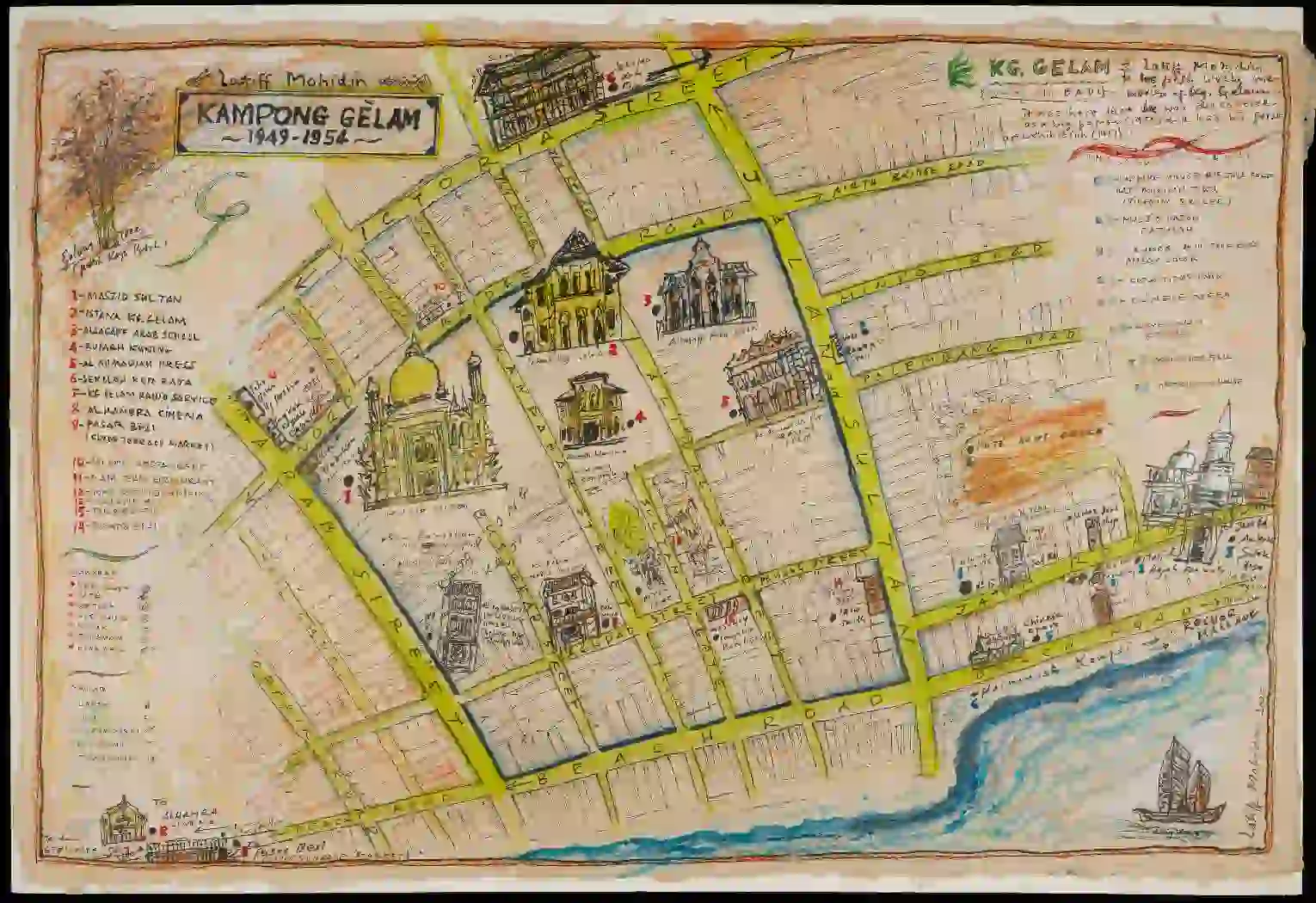
Figure 1. Kampong Gelam (1949–1954) by Latiff Mohidin, 2020. Map of Kampong Gelam in the early 1950s, marking its landmarks and streets. Collection of Malay Heritage Centre.
Associations in Singapore's Cosmopolitan Setting
Merantau is the practice of leaving home to look for knowledge and a livelihood. In the early 20th century, new roads, railways and steamship routes made it easier to do so. The permanent galleries at the Malay Heritage Centre group the reasons people came to Singapore under three headings: demi iman (for faith), mencari rezeki (to earn a livelihood) and menuntut ilmu (to pursue knowledge). Pilgrims bound for Makkah stopped here to arrange passage, and some stayed. Others came to trade, or to study and publish.
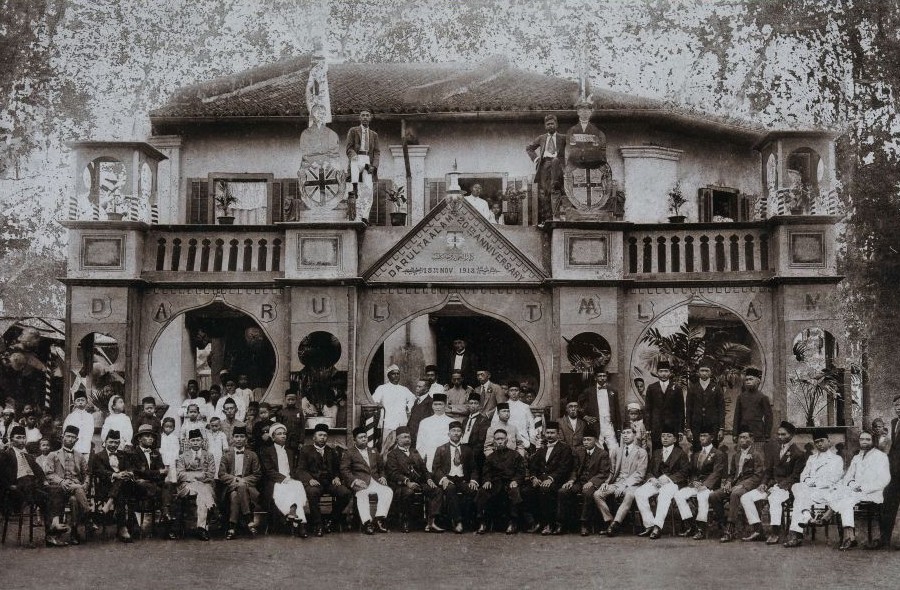
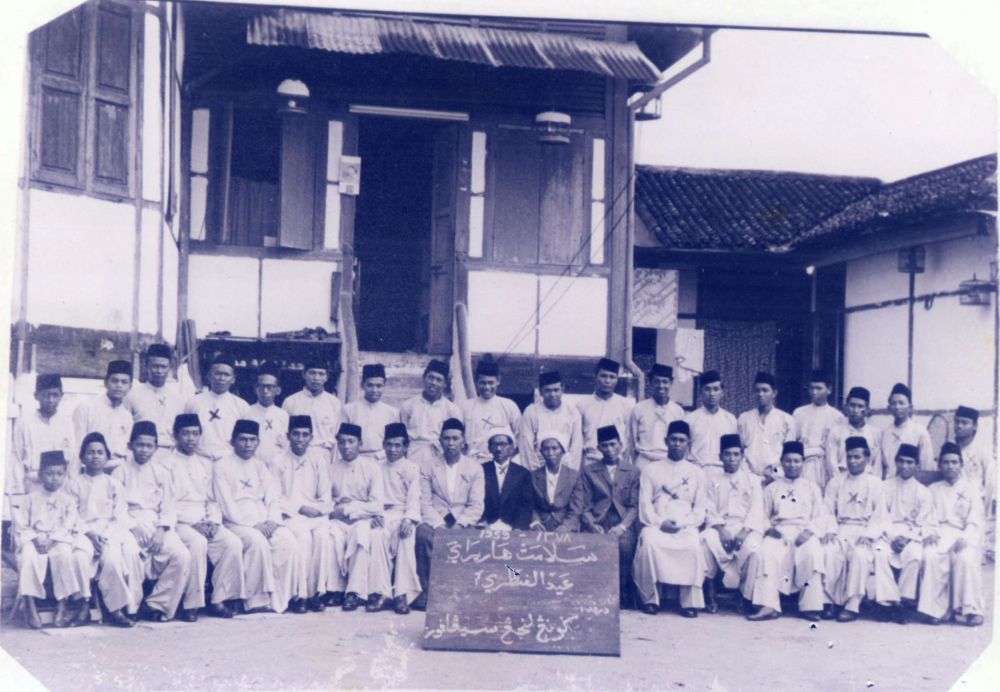
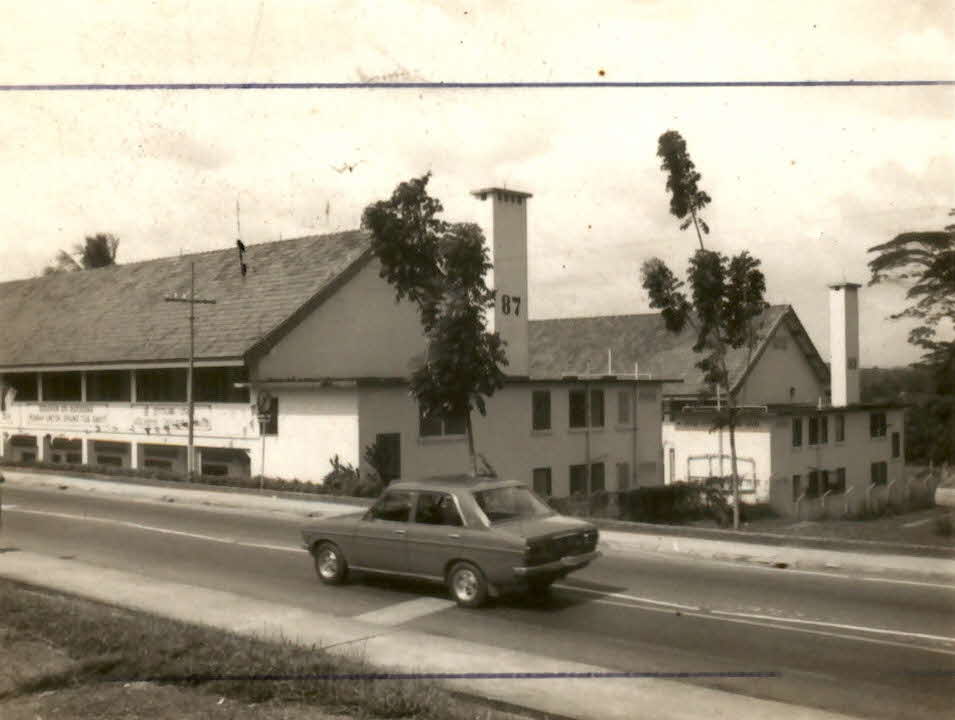
These communities first turned to those from their own place of origin, and the settlements in and around Kampong Gelam took their names from who lived and worked there: Javanese pilgrims and settlers in Kampong Kaji and Kampong Jawa, Javanese coppersmiths in Kampong Tembaga, Banjar gem traders in Kampong Intan, and Bugis boatbuilders in Kampong Bugis. The Baweanese lived in pondok (also spelt ponthuk), lodging houses similar to Chinese clan associations. Men from the same villages shared rooms, a kitchen, and a place to pray, and looked after new arrivals.[1] Others formed clubs. The Darul Ta'alam Club on Sumbawa Road, founded in 1893, counted Banjar merchants among its members and, by 1913, was patronised by people from other groups as well.[2]
By the 1930s, "Malay" was a broad label. It covered Muslim communities from across the Malay Archipelago, for whom Malay served as a shared language, but who came from different places and kept different identities. The 1931 census shows this. About 65,000 people in Singapore were counted as Malay, and the census recorded them in groups: 57.5 per cent as Malay, 24.5 per cent as Javanese and 14.4 per cent as Baweanese, with 1.2 per cent Bugis, 0.7 per cent Banjar and a small remainder in other groups.[3] The Javanese share was probably too low, because many Javanese were recorded simply as Malay[4]
![3bundefined. S N 28] Pc D0174 091](/api/media/8236f4e4-e156-46b8-ac31-89bf8c00efa2/)
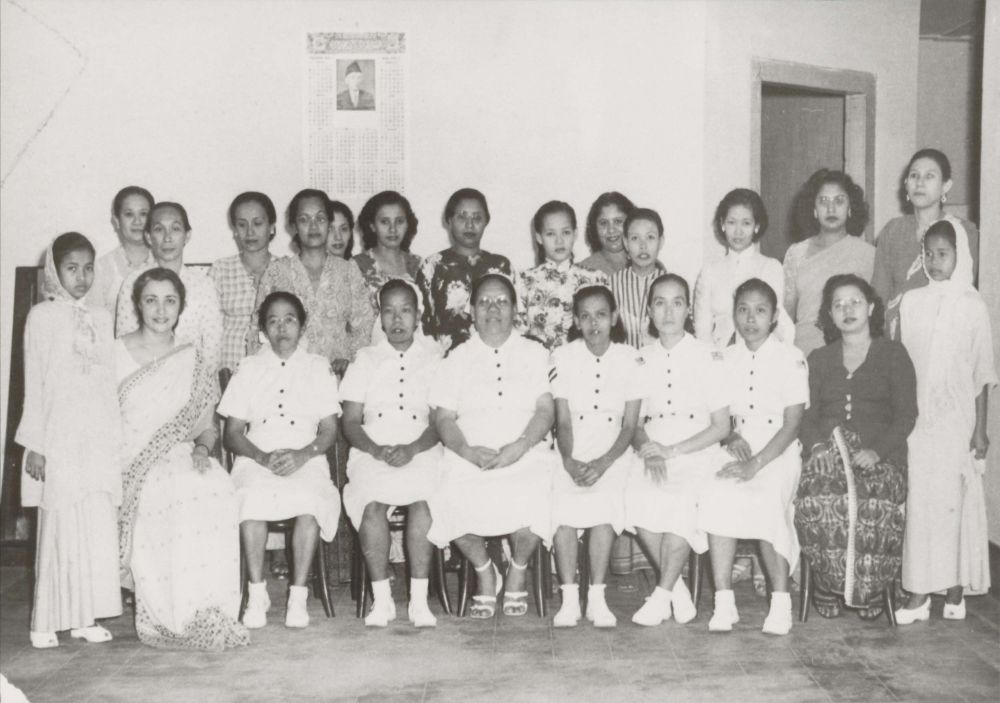
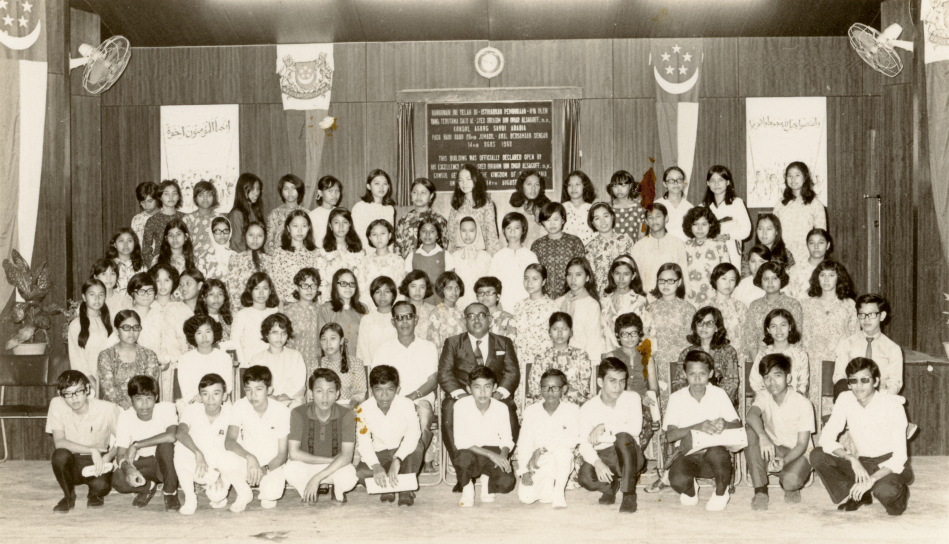 Figure 3. Left to right: Mrs Taj Namazie with St John Ambulance Brigade committee members, 1950s; Jamiyah-led fundraising for mosque construction, 14 March 1958; LBKM award presentation with Syed Ali Redha Alsagoff, 1960s. Credits: Khatijun Nissa Siraj Collection and Singapore Press Holdings, courtesy of National Archives of Singapore; Lembaga Biasiswa Kenangan Maulud.
Over time, the lines between these groups blurred. By the post-war period, various associations had been formed to serve communities beyond their place of origin. The Singapore Muslim Women’s Association (PPIS), founded in 1952, worked with medical and volunteer services to improve social welfare.[5] Jamiyah, founded in 1932 as the All Malaya Muslim Missionary Society, raised funds for mosque construction.[6] The Prophet Muhammad’s Birthday Memorial Scholarship Fund Board (LBKM), launched in 1965 with the backing of 73 Malay and Muslim organisations, supported students pursuing higher education.[7] Each turned shared values into collective action, and each gave members a way to picture a wider Malay community, a bangsa, with a shared Malay identity.[8]
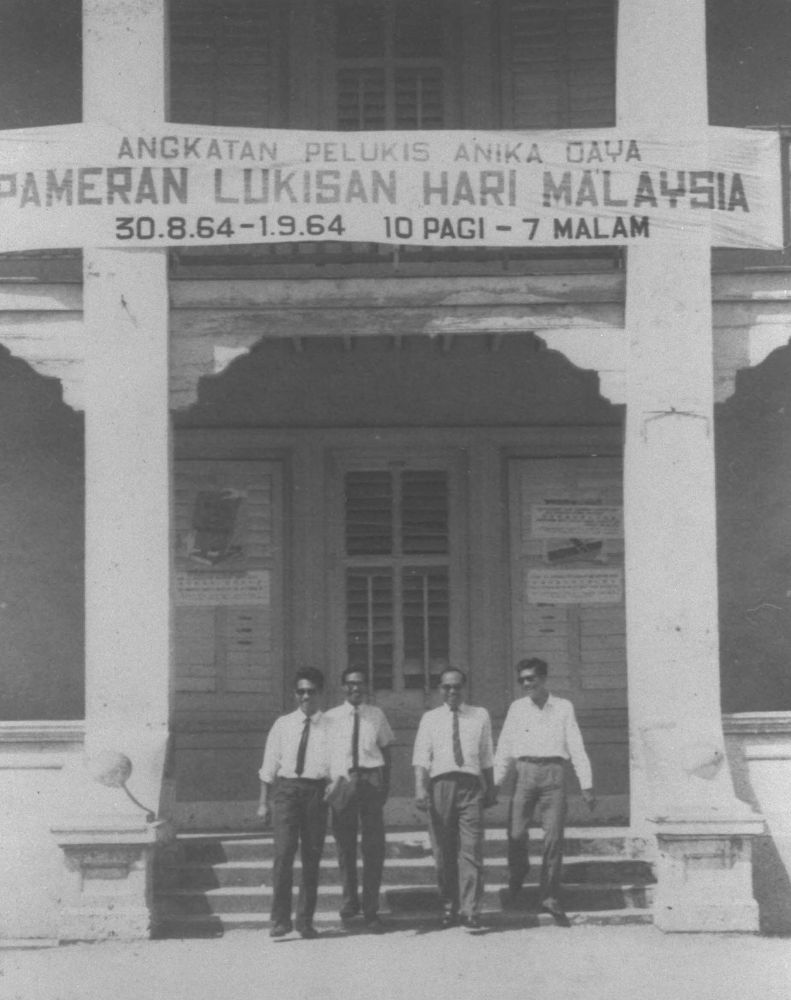 Figure 4. Art exhibition for Malaysia Day by Angkatan Pelukis Aneka Daya (APAD) at Kota Raja Malay School, 30 August 1964. Abdul Ghani Hamid Collection, courtesy of National Archives of Singapore.
APAD, a non-profit society of artists, was founded on 29 July 1962 by a group of artists and writers and belongs to this generation of organisations. Abdul Ghani Abdul Hamid, one of its co-founders, was its first elected president and served until 1983. Earlier Malay art groups, such as the Persekutuan Pelukis Melayu Malaya (1949) and Angkatan Pelukis Muda (1956), did not last, and APAD is one of the few art societies in Singapore to have survived to the present. It began formal art classes in July 1964, when formal art education was not widely open to the community.[9] Its award, the Pingat APAD, was already being given in 1974, before the Cultural Medallion was instituted in 1979, and it went to artists from other communities as well, among them Wee Beng Chong and Ng Eng Teng. Wee later received the first Cultural Medallion for art.[10]
Tumadi Patri: Our New Home
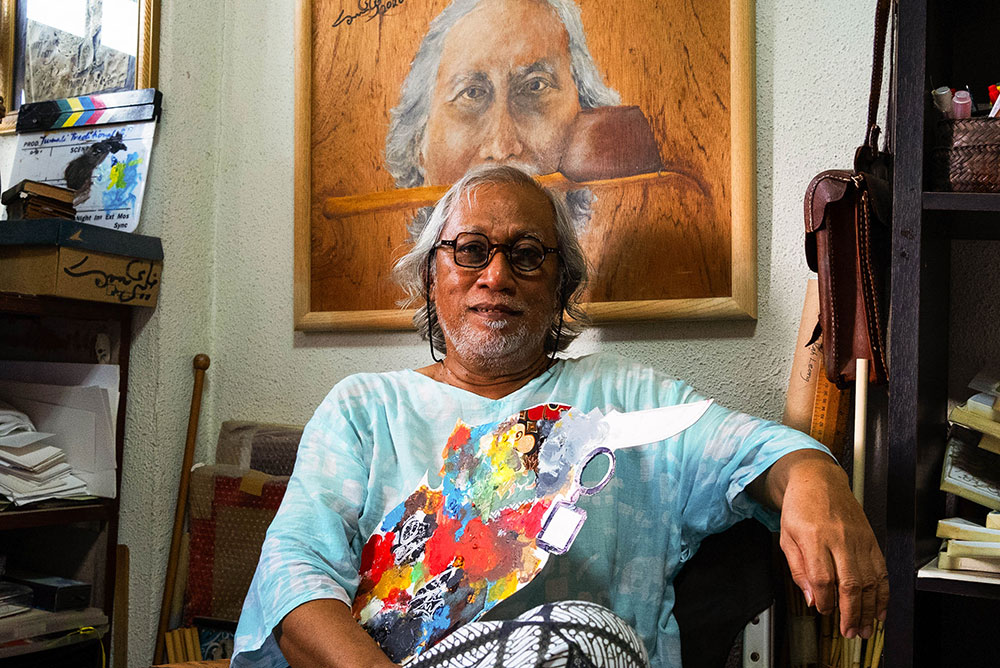
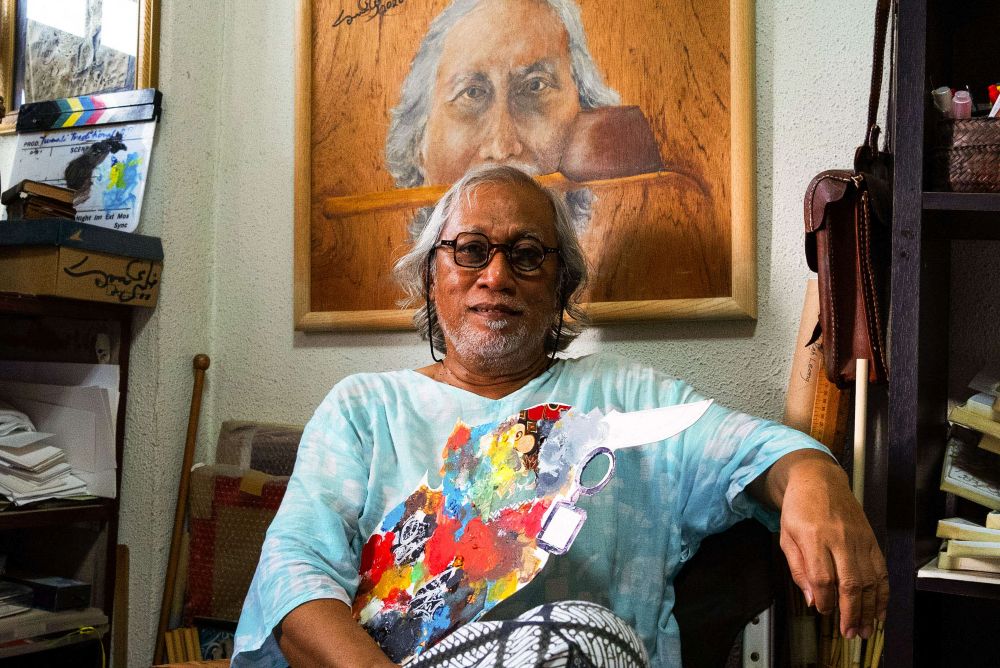 Figure 5. Tumadi Patri in his studio, 2025. Photograph: Malay Heritage Centre.
Tumadi Patri (b. 1959) is a Singapore batik artist who has practised for more than four decades. His work draws on material culture from the Malay >Archipelago, and he has been a member of APAD since 1984.[11] Cik Tumadi’s journey as an artist cannot be easily separated from his Javanese heritage. He grew up in Lim Chu Kang and Choa Chu Kang from the 1960s, in an area with a Kampong Jawa where Chinese and Baweanese residents lived alongside Javanese families.[12] He learned Javanese there, which tied him to his family’s roots. The sights and sounds of that world included gamelan at weddings in his grandfather’s kampong in Pontian, kuda kepang at community gatherings, and the distinctive visual language of wayang kulit.[13]
Before batik, Cik Tumadi had tried wood carving and copper craft at school. In 1983 at the age of 24, he saw an APAD advertisement in the newspaper. Every Saturday he took a bus from Choa Chu Kang to Haig Road for the class. The class started at 2pm, but he arrived by noon.[14] Teaching the class were artists Mohamed Abdul Kadir (S. Mohdir), one of APAD's co-founders, Sarkasi Said and Sujak Rahman.[15] Sarkasi, a batik painter, received the Pingat APAD in 1974 and the Cultural Medallion in 2020.[16] Cik Tumadi went on to graduate from the Nanyang Academy of Fine Arts in 1986 and from Pa Lin School of Art in 1991.[17]
That training was, by his account, foundational, not just technically, but in terms of how he came to understand batik’s place within a wider cultural system. As he has put it, batik and wayang kulit are inseparable: where there is batik, there is wayang kulit; where there is wayang kulit, there is gamelan; where there is gamelan, there is dance. Each element, according to Cik Tumadi, is part of a chain of cultural expression that signals, collectively, a Malay identity rooted in the Javanese world.[18]
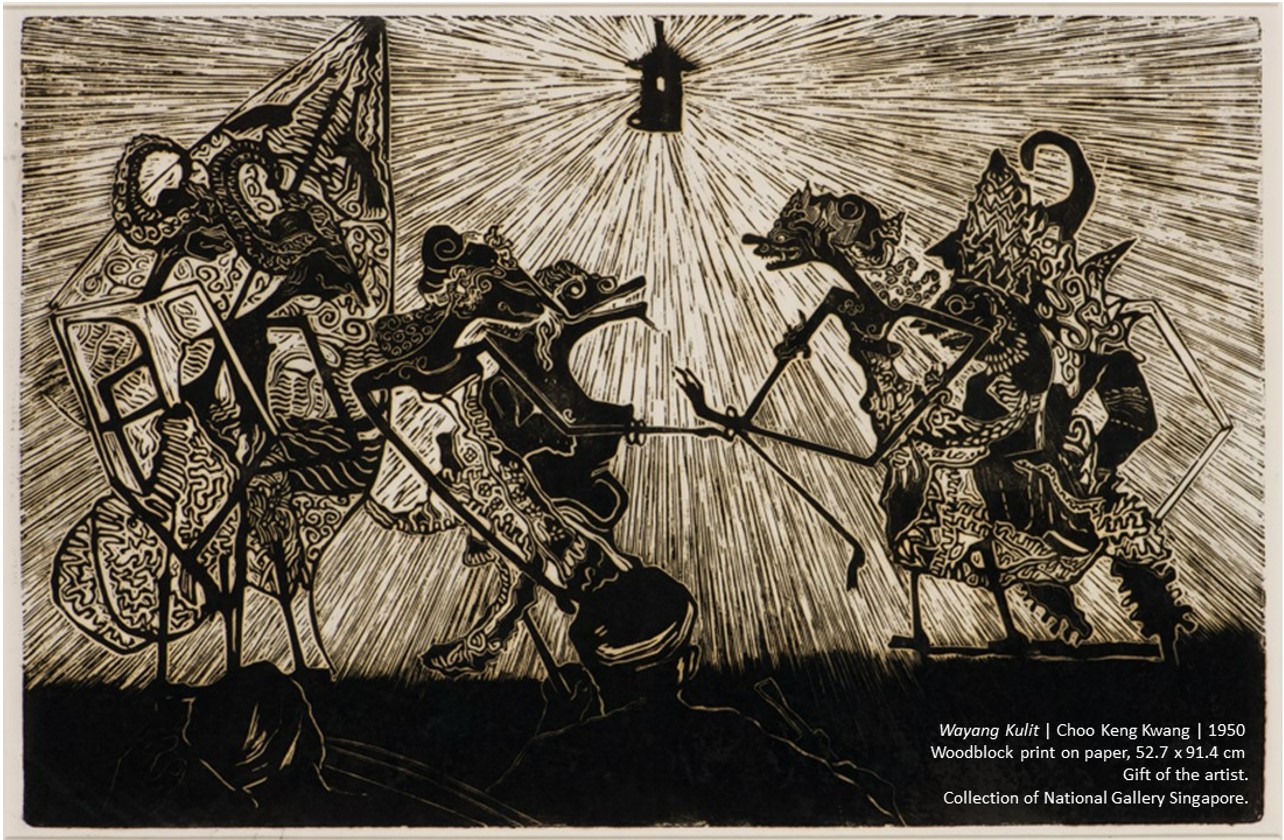
His father told him to paint wayang kulit figures specifically, rather than flowers or landscapes, set the direction of his practice.[19] What followed was decades of immersion: attending multi-night wayang performances, studying the characters and their symbolic roles, and gradually developing a body of work in which wayang kulit imagery became, as he describes it, his trademark.[20] To deepen his knowledge of motifs and wayang kulit characters, he travelled to Malaysia and to Solo and Yogyakarta, studying the philosophy behind both.[21] The pattern matches the galleries’ theme: knowledge gathered in the wider Malay world and brought home to Singapore.
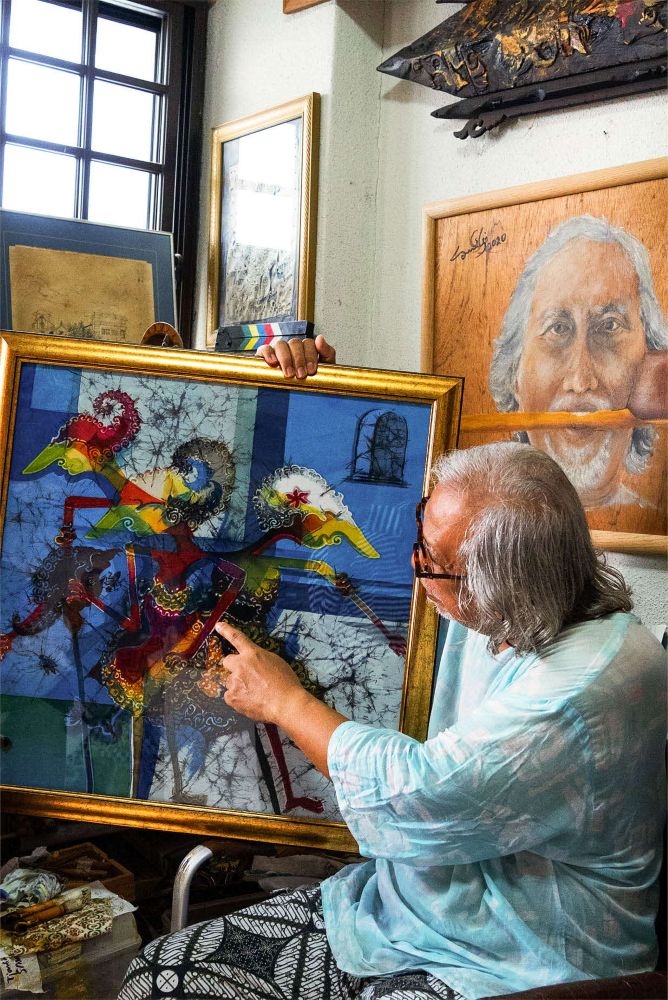 Figure 6. Tumadi Patri showing wayang kulit imagery in one of his batik paintings, 2025. Photograph: Malay Heritage Centre.
Cik Tumadi did not practise art full time. As equipment was costly and full-time practice unprofitable, he worked as a machine clerk at a Dutch drum-making company for more than 30 years,. He recalls taking time off work to attend batik workshops and complete orders. In the early 1990s he sold small batik paintings for $5 or $10 to earn extra money.[22] Even so, after 40 years, he has said, batik has become his blood, his identity as much as his medium.[23]
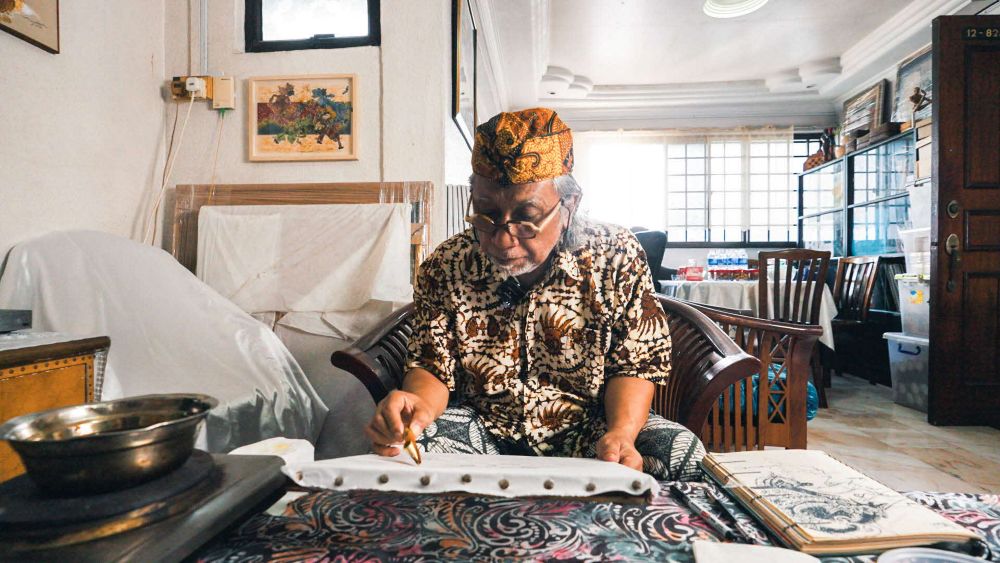 Figure 7. Tumadi Patri applying hot wax with a canting while working on a batik, 2025. Photograph: Malay Heritage Centre.
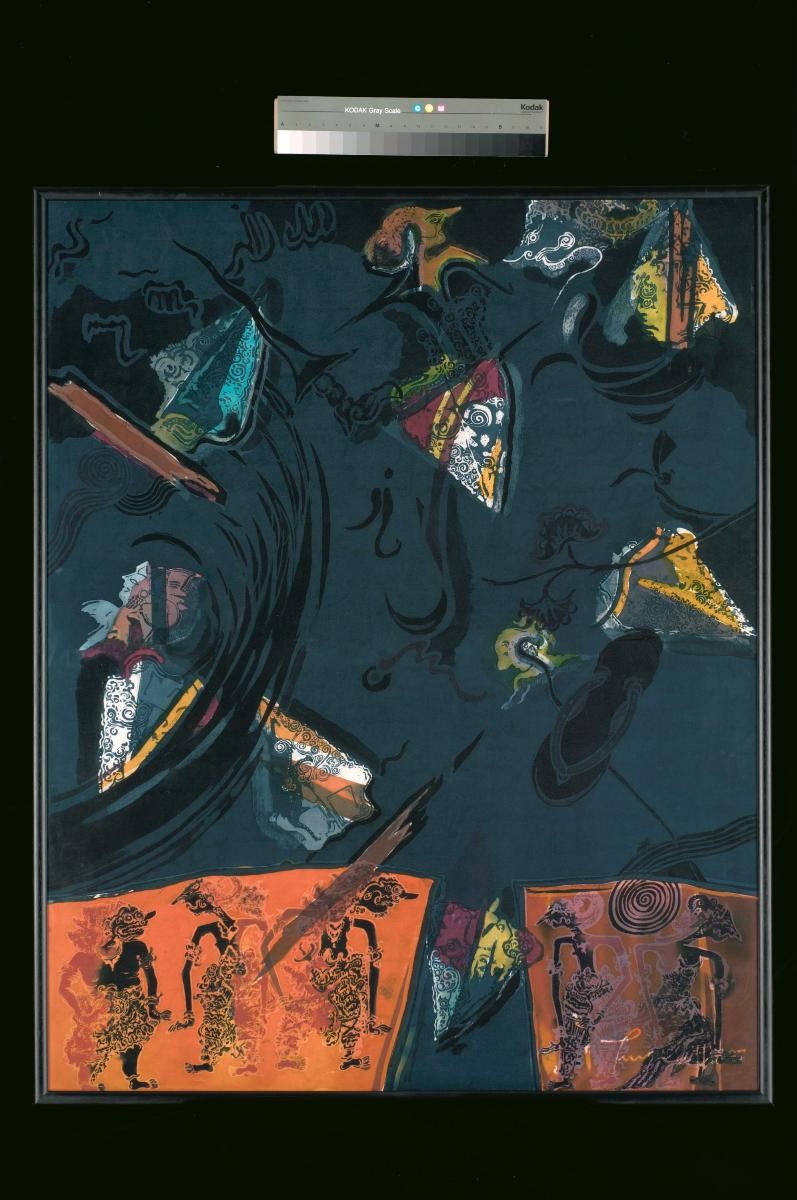
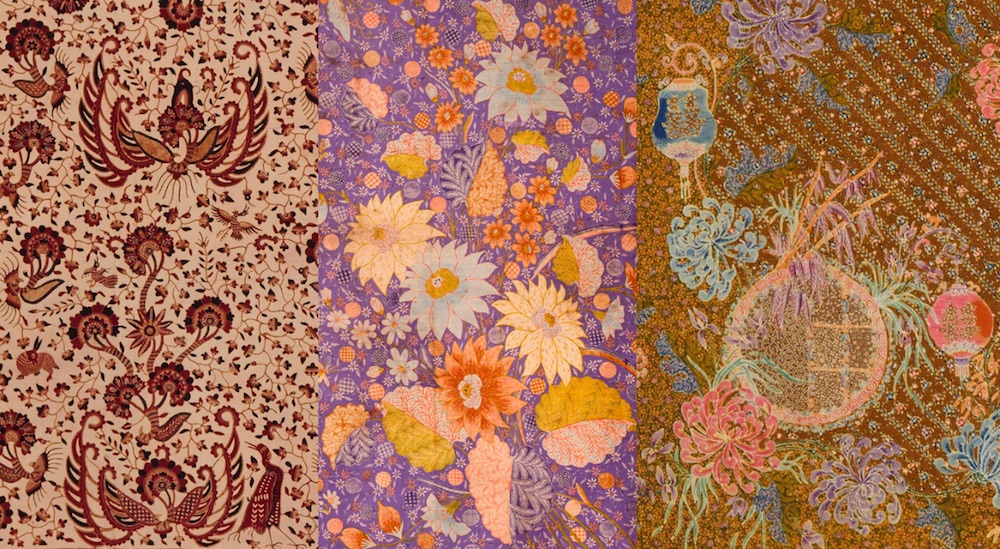
His method stays traditional, while the surface and colour change. Cik Tumadi still works with a canting and hot wax. He rejects machine-printed batik made with cold wax, which he says weakens the value and heritage of the craft.[24] His practice departs from tradition in other ways. Wayang kulit puppets are usually carved from buffalo or cow hide, which he says is why they can last for centuries. Hide is impractical in Singapore, so he makes his puppets on reinforced cardboard or canvas, and uses bright colours where both batik and wayang traditionally use earthy tones. He has said that a painting has no dalang to narrate it, so colour has to tell the story.[25] Our New Home extends that idea. Its puppets are decorated on both sides so that they can be seen from all angles, and the artist takes the role of Pak Dalang himself.
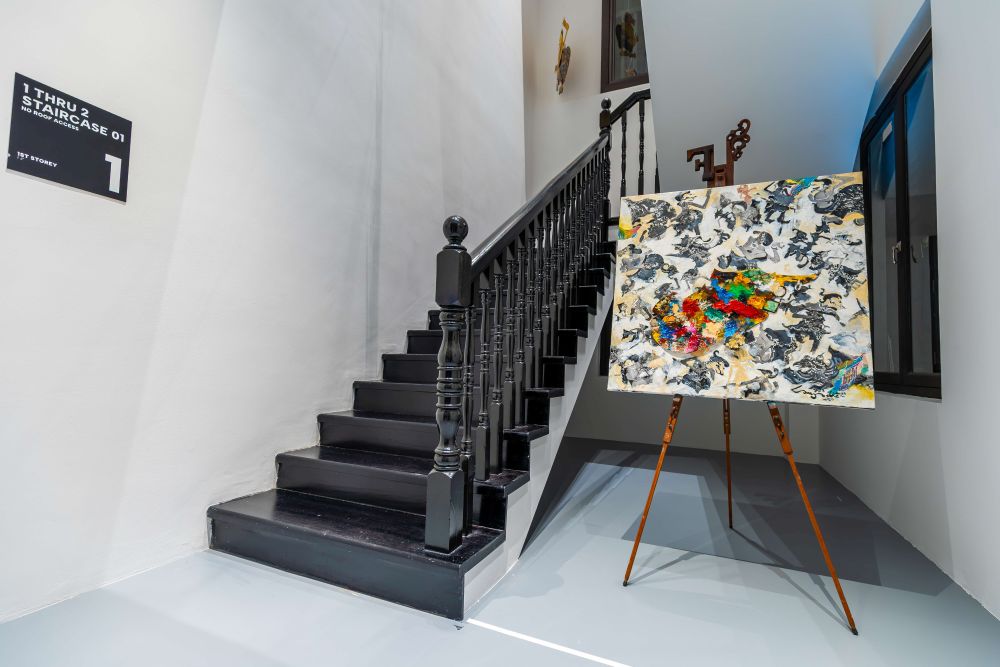
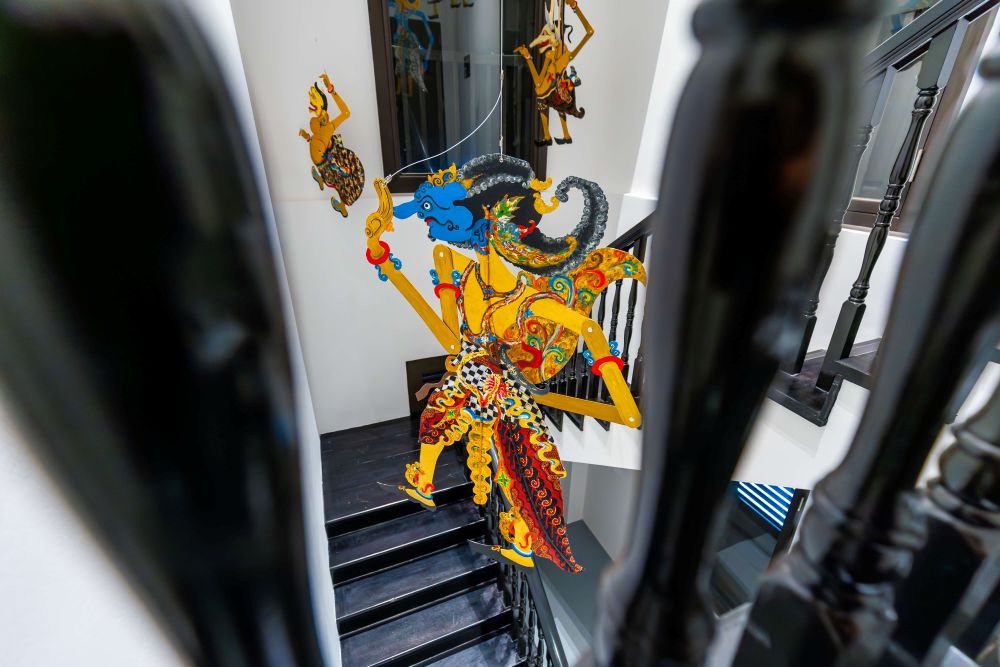
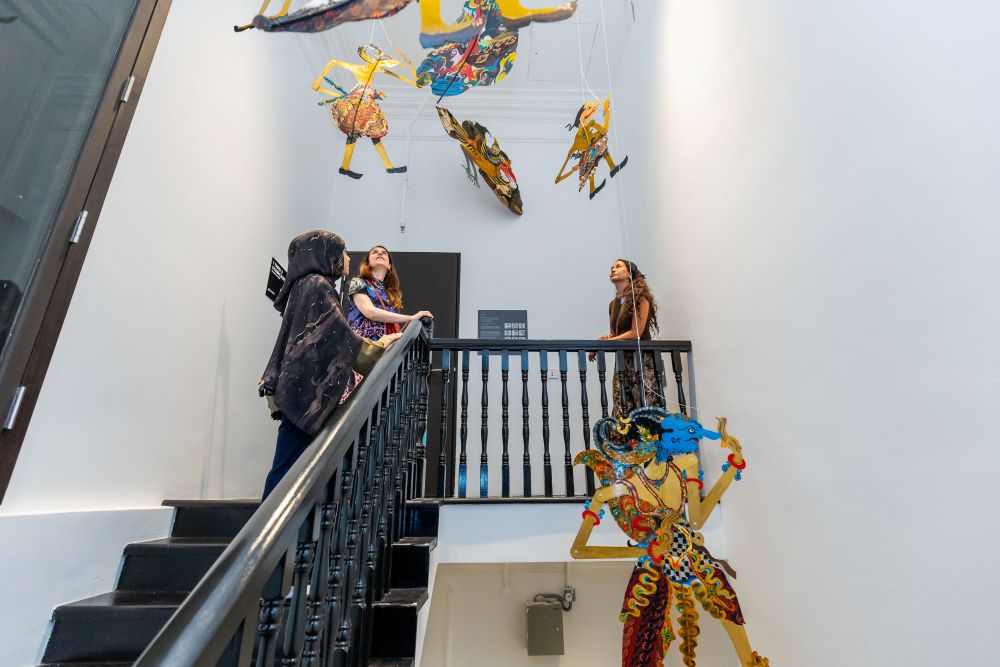
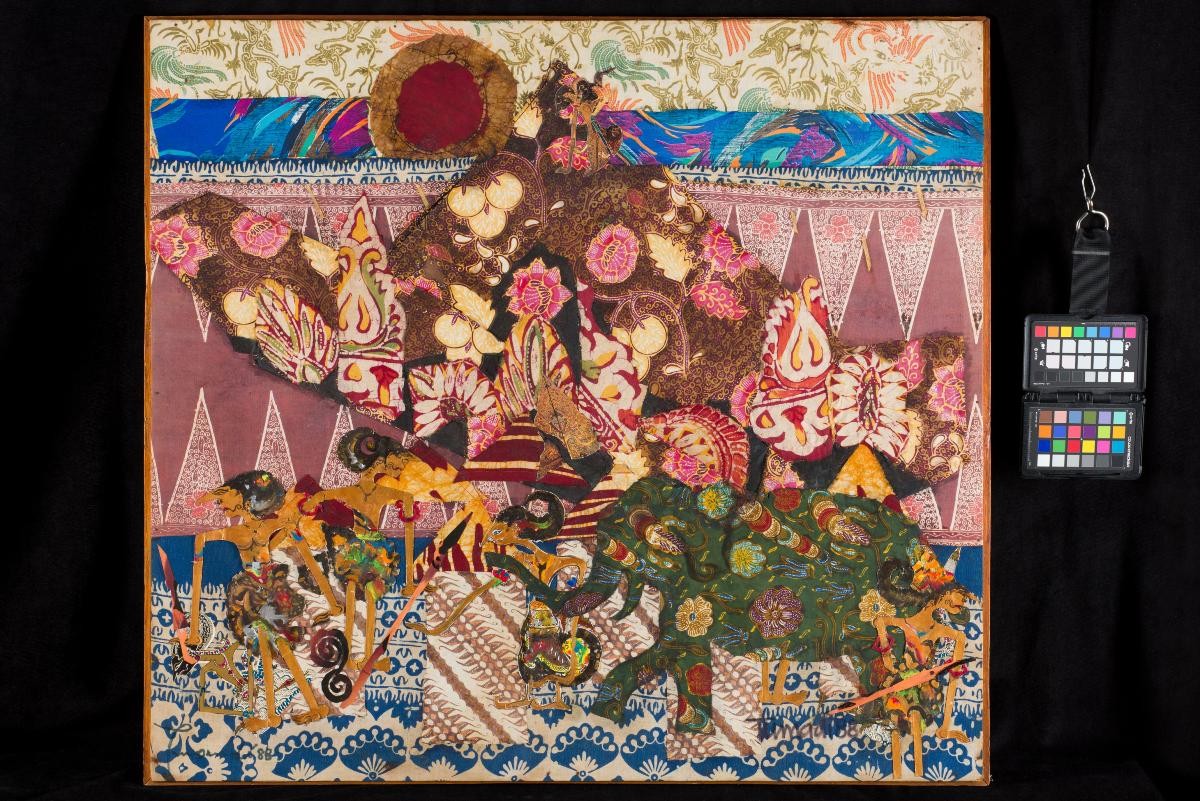
Our New Home, Rumah Baru Kami, was commissioned by MHC as part of the permanent gallery revamp Dari Rantau ke Rumah and is an expression of that practice. It centres on the Pak Dalang. The work comprises ten wayang kulit figures: Semar, Gareng, Petruk, Togog, Arjuna, Sri Kandi, Dewi Kunti, Antaraja Gagrak, Garuda, and the Gunungan, suspended from the ceiling, each painted in acrylic and batik collage. Cik Tumadi has described the work’s concept as imagining a new Kraton: a housewarming gathering, where the wayang characters come together as guests in a new home. MHC, as a space to showcase Malay heritage, is that home, and the commission presents the Javanese wayang tradition as a constitutive part of that heritage.
Cik Tumadi is candid about the stakes he attaches to this work. He sees wayang kulit and traditional batik as under pressure from digital aesthetics and commercial alternatives, and speaks of a responsibility to continue what those before him began. “Kita harus meneruskan perjuangan” (“we must continue the struggle”), he has said.[26] The commission is, in that sense, not just a display of traditional skill but a statement that these forms have a place in contemporary institutional space, and that the Javanese contribution to Singapore’s cultural fabric deserves to be seen, named, and carried forward.
Closing
The Malay Heritage Centre reopened with Dari Rantau ke Rumah, a gallery narrative that takes up the question of what communities choose to carry forward. Associations like APAD are part of the answer to that question, as the infrastructure through which heritage is sustained, transmitted, and given new form.
Cik Tumadi is clear that continuing a tradition does not mean copying it. He recalls that combining batik with wayang kulit was unconventional in the 1980s and met resistance. In his words: “There are no prohibitions or boundaries (in art), so I tried.” He also holds that the next generation must learn the philosophy and symbolism behind batik, which he calls its heart.[27] He now runs batik workshops open to anyone who wishes to learn.[28]
This article is part of Malay Heritage Centre’s Dari Rantau ke Rumah Series. It explores the themes, objects, and stories that shape its galleries, tracing the movements, connections, and inheritances that define Malay identity in Singapore and the wider region.
About the Authors
Dr Hadi Osni is Curator at the Malay Heritage Centre, National Heritage Board. Trained as an architectural historian, he holds a PhD in Architecture from the National University of Singapore. His work focuses on Malay material culture, memory, diasporic narratives, and the built environment.
Zulfadhli Hilmi Mohamad is Curator (Art) at the Founders' Memorial, National Heritage Board. He holds a Master of Arts from the National University of Singapore. His curatorial work spans contemporary and modern Southeast Asian art, with a focus on Islamic art, cultural heritage, and the intersections of spirituality and nationalism in artistic practice. He has previously held roles at the National Gallery Singapore, Asian Civilisations Museum, and Malay Heritage Centre.
Watch Malay Heritage Centre's Intangible Cultural Heritage Conservation Episode
In this episode of MHC's Intangible Cultural Heritage Conversation Series, Tumadi Patri discusses his practice as a batik artist and teacher, his APAD training, and his lifelong commitment to wayang kulit as a living cultural form.
Notes
[1] Nor-Afidah Abd Rahman and Marsita Omar, "The Baweanese (Boyanese)," National Library Board, October 2020, https://www.nlb.gov.sg/main/article-detail?cmsuuid=1c347e28-5925-4992-8dad-e2d702bfe634; "Pondok Peranakan Gelam Club," Singapore Infopedia, https://www.nlb.gov.sg/main/article-detail?cmsuuid=04f07f59-93e1-4d3e-bcd0-1a6e3ecf90db
[2] Zinnurain Nasir and Nasri Shah, "Urang Banjar: From South Kalimantan to Singapore," BiblioAsia 17, no. 2 (July 2021), https://biblioasia.nlb.gov.sg/vol-17/issue-2/jul-sep-2021/urangbanjar/
[3] Arumainathan, Report on the Census of Population 1970, vol. 1, 254.
[4] Anthony Milner, The Malays (Chichester: Wiley-Blackwell, 2011), 197. In 2020, the Malay resident population was about 545,000. Of these, 67.9 per cent were recorded simply as Malay, up from 57.5 per cent in 1931, with 17.3 per cent as Javanese, 11.1 per cent as Baweanese and 3.7 per cent in other Malay groups. See Department of Statistics Singapore, "Malay Resident Population by Age Group, Detailed Ethnic Group and Sex (Census of Population 2020)."
[5] “About Us,” PPIS, https://ppis.sg/aboutus/
[6] “History,” Jamiyah Singapore, https://www.jamiyah.org.sg/our-history/
[7] “About,” LBKM, https://lbkm.org.sg/about/
[8] Department of Statistics Singapore, “Malay Resident Population by Age Group, Detailed Ethnic Group and Sex (Census of Population 2020).”
[9] Nadia Ramli, “Creative Collectives: Abdul Ghani Abdul Hamid and His Contemporaries,” BiblioAsia 14, no. 4 (January 2019), https://biblioasia.nlb.gov.sg/vol-14/issue-4/jan-mar-2019/creative-collectives; “Angkatan Pelukis Aneka Daya (APAD),” Maya Gallery, https://www.mayagallery.com.sg/main/room/67
[10] “Cultural Medallion,” Singapore Infopedia, National Library Board, https://www.nlb.gov.sg/main/article-detail?cmsuuid=4acba74f-e6ee-4756-893d-914f6cf70c6d
[11] Shiqin Ramadan, “Dulu ‘ponteng’ kerja demi seni, kini lihat karya sendiri di Taman Warisan Melayu,” Berita Harian, April 2026.
[12]> Shiqin, “Dulu ‘ponteng’ kerja.”
[13] Shiqin, “Dulu ‘ponteng’ kerja.”
[14]> Shiqin, “Dulu ‘ponteng’ kerja.”
[15] Nur Hikmah Md Ali, "The Art of Batik: Exploring Symbolism in Malay Textile Design," Roots.gov.sg, National Heritage Board, last updated 15 October 2020.
[16] "Sarkasi Said," Singapore Infopedia, National Library Board, https://eresources.nlb.gov.sg/infopedia/articles/SIP_1692_2010-07-13.html (accessed 20 September 2026), for Pingat APAD (1974); Juffri Supa'at, "Sarkasi Said," NLB Resource Guide, November 2021, https://reference.nlb.gov.sg/guides/singapore/people/sarkasi-said/ (accessed 20 September 2026), for his Javanese identity and the Cultural Medallion (2020).
[17] Nur Hikmah Md Ali, "The Art of Batik: Exploring Symbolism in Malay Textile Design," Roots.gov.sg, National Heritage Board, last updated 15 October 2020.
[18] Ibid.
[19] Shiqin, “Dulu ‘ponteng’ kerja.”
[20] Ibid.
[21] Nur Hikmah, “The Art of Batik.”
[22] Shiqin, “Dulu ‘ponteng’ kerja.”
[23] Tumadi Patri, “Season 3 Episode 3 (Part 1) — Intangible Cultural Heritage: In Conversation with Tumadi Patri.”
[24] Shiqin, “Dulu ‘ponteng’ kerja.”
[25] Nur Hikmah, “The Art of Batik.”
[26] Ibid.
[27] Nur Hikmah, “The Art of Batik.”
[28] Shiqin, “Dulu ‘ponteng’ kerja.”