
.JPG)
TL;DR
In Singapore, hydration is a daily ritual. But what is your choice? Is it an ice-cold soda that cools you down right away, or a flask of warm water that your grandmother always said was better for you? This simple decision is part of a bigger conversation about health and history in Singapore that has been going on for over a hundred years. “Heat” is a word everyone in Singapore uses to describe bodily discomfort, but what we mean by “heat” and how we manage it shows a unique mix of two kinds of knowledge: biomedicine and Chinese Medicine (CM). This is the story of how Singaporeans became masters of living with heat, not by choosing a side, but by embracing the wisdom of both.Seletar airmen enjoying a cooling dip in Malaya. Courtesy of the National Archives of Singapore.
Heat as the enemy: from colonial fears to biomedical scientific fact
For biomedicine, the kind of science your doctor uses, “heat” is something physical that can be measured. When science talks about an increase in bodily temperatures, it refers to hyperthermia. It can happen if you exercise vigorously or sit in the sun for a long period. Intense physical strain or heat stress can lead to severe hyperthermia, which may precipitate the onset of heat-related illnesses. Thus, the solution is direct: when you experience hyperthermia, you must cool the body down as both a preventative and counter measure against heat injuries. This means drinking cold water, moving to a cool and shaded space, or putting a damp cloth on your head. The main goal is to lower the number you see on a thermometer.
This understanding of heat took a long time to develop. During the colonial period, there was a belief that the tropical heat was a dangerous to the health of European colonisers. However, by the middle of the 20th century, scientists had largely disproven these older ideas. Heat was understood as a factor that affected how comfortable humans feel thermally or how well they can work. These changes in understanding led researchers in Singapore to study human adaptation to hot and humid conditions, the limits of heat tolerance, and the most effective ways to treat heat injuries.
After World War II, a research group—the Royal Naval Tropical Research Unit (TRU)—was set up to study these questions. It was established in Singapore by the Admiralty and the Medical Research Council of Great Britain.[1] Between 1948 and 1953, TRU conducted advanced research on how hot climates affected the safety and work efficiency of people. Initially focused on British naval personnel, the TRU later conducted comparative studies involving Chinese, Malay, and Indian participants. The TRU operated cutting edge technology—it had an advanced laboratory with special rooms called “climatic chambers” where researchers could precisely control the temperature and humidity.[2] The walls were two feet thick, and a control board could generate 80 kilowatts of heat. They even had a “radiant heat tunnel” with “70 separately heated black panels on the roof, floor and two side walls”.[3] This technology allowed them to get reliable data and move beyond simple stories about how heat felt to people.
One of the most interesting things TRU did was to challenge a “die-hard” opinion that drinking cool water was harmful and could cause stomach cramps. Based on their detailed research in Singapore, the TRU scientists stated with confidence that in “several thousand experiments... no ill effects were observed from drinking cool water.”[4] Science had provided a clear answer: drinking cold water was a safe and effective way to fight physical heat.
Heat as a sign of imbalance: The Chinese Medicine view of heat
For over two thousand years, CM employed a complex system to understand health. In this system, heat is one of the six pernicious factors, also known as the “six evils” or “six excesses”, that can invade the body and disrupt its natural balance, leading to various health problems. The other five factors are wind (feng 风), coldness (han 寒), dampness (shi 湿), dryness (zao 燥), and fire (huo 火).
The most common description of heat used in Singapore is “heatiness” or reqi 热气. This term describes a state of internal imbalance related not to your body’s temperature, but to the function of its internal systems. In CM, the body is kept in balance by cooling (yin) and warming (yang) energies. When you become “heaty”, it means you have an excess of yang energy.
You can become “heaty” from eating too much fried chicken, durian, or chocolate, or from stress and lack of sleep. The symptoms are probably familiar to many people in Singapore: a sore throat, mouth ulcers, or acne. The solution in CM is not physical cooling with ice but restoring the body’s internal balance. This is done by consuming “cooling” foods and herbs like barley water, chrysanthemum tea, or green bean soup. A more specific herbal formula, Bai Hu Tang (白虎汤), containing Gypsum (shigao 石膏), Anemarrhena Rhizome (zhimu 知母), Licorice Root (gancao 甘草), and Rice (jingmi 粳米), is also used.
The early definitions of heat issues specific to Singapore came from CM physicians like Wu Ruifu and his students. They established the Singapore Chinese Physicians’ Association (SCPA) in 1947 and the Singapore College of Traditional Chinese Medicine (SCTCM) in 1953, which became important centres for scholarly and clinical discussions about ailments, including heat-related conditions. They held meetings and debates to figure out how to apply CM principles in Singapore’s unique tropical environment, and topics included “damp-heat” and emergency treatments for heat stroke through herbal medicine and acupuncture. Heat-related illnesses were also covered in teaching materials for the SCTCM, such as two works: Chan Zim Wai’s (陈占伟) Leisurely Notes from a Physician (Zhen Yu Man Cao 诊馀漫草) and Cheng Chi Un’s (曾志远) Treatise on Seasonal Diseases (Shi Gan Xue 时感学). Parts of Chan’s work first appeared in Medical Essence (Yi Cui 医粹) in 1948 before being comprehensively published in 1984.
One of the first major discussions was a debate in 1947.[5] The topic was whether the constant tropical heat made people’s bodies in Singapore mostly “hot” or “cold” in their basic constitution. The physicians used local evidence. For example, they noted that babies in Singapore often had cold showers and adults regularly drank iced drinks without the negative effects that would be expected in China. This showed they understood that the situation in Singapore was different from China, where CM originated. They argued that Singapore’s climate affects the body’s internal balance differently than the four seasons of China do. This debate showed that the CM community in Singapore was open-minded and willing to adapt its knowledge to a new context.
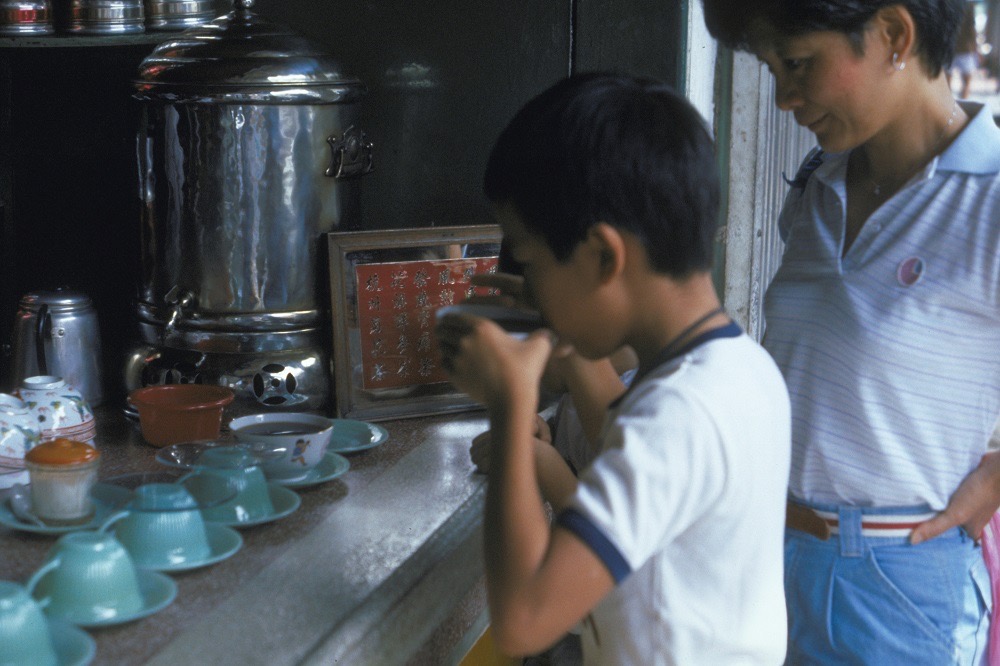 A boy drinking Chinese herbal tea from a shop in Chinatown. Courtesy of National Archives of Singapore.
Health and heat in Singapore after 1965
For many years, the scientific and CM views of heat existed side-by-side. Then, after Singapore’s independence in 1965, a serious national issue created a clear priority role for biomedicine. Starting in 1978, there was a rise in reports of injuries and deaths during National Service training.[6] Many these were caused by heat stroke. This made heat injury a serious and urgent matter for the young nation.
In the face of these life-threatening emergencies, both systems agreed on the immediate actions that was needed. When it came to first aid for heat stroke, the advice from both the medical community and CM practitioners were the same: move the person to a cool place, remove extra clothing, give them water if they are conscious, and most importantly, get professional medical help from a doctor or hospital. This was a significant moment. In public, CM practitioners distanced themselves from traditional CM-based emergency treatments, such as acupuncture for heat stroke. The job of managing an acute heat crisis was now seen as the role of biomedicine. This act of ceding the management of a health crisis to biomedicine is a clear example of the broader power dynamic in Singapore. Historically, biomedicine has always been the state-sanctioned, official system—a structure that was consolidated by the Traditional Chinese Medicine Practitioners Act of 2000, which affirmed CM’s supplementary role.
While they agreed on emergency treatment methods, their long-term strategies for prevention remained different. Biomedicine focused on improving the body’s physical ability to handle heat. The key strategies were:
- Acclimatisation and fitness conditioning: Structured, multi-week protocols to train the body to sweat more efficiently and, thereby, maintain a lower core temperature under heat stress, enhancing the body’s thermoregulatory capacity.[7]
- Hydration Science: Implementing specific regimens for fluid and electrolyte replacement before, during, and after heat exposure.[8]
CM’s approach to prevention was also a long-term strategy, but it was aimed at maintaining the body’s internal balance. This advice was often shared through Chinese-language media and passed down through family traditions. The key strategies were:
- Cooling Herbal Drinks: Chinese-language print media articles often recommended specific teas to help clear internal heat and get rid of dampness. These included bitter tea (kucha 苦茶), barley water (yimi shui 薏米水), honeysuckle tea (jinyin hua cha 金银花茶), monk fruit tea (luohanguo cha 罗汉果茶), chrysanthemum tea (juhua cha 菊花茶), and hawthorn roselle tea (shanzha luoshen huacha 山楂洛神花茶).
- Seasonal Diet: CM’s dietary advice played an equally significant role in its preventive narrative. Light and easily digestible seasonal congees were promoted as a popular choice during hot months. Specific examples included green bean congee (绿豆粥), sweet potato congee (番薯粥), lotus root congee (莲藕粥), and coix seed congee (薏仁粥).
- Holistic Lifestyle Advice: Emphasis is placed on “nourishing yin” (yang yin 养阴) and “clearing internal heat” (qing re 清热) through adequate sleep, proper diet, and gentle exercise. Notably, some CM practitioners advised limiting the use of air-conditioning to encourage the body to restore its natural self-regulatory functions.[9]
These two strategies rarely overlapped because they were addressing different issues and perspectives. The biomedical strategy was about building a stronger body to handle a tough environment. The CM strategy was about cultivating a healthier, balanced body that would not be so easily disturbed by that same environment. This meant that a person could follow the advice from both systems with minimal conflict.
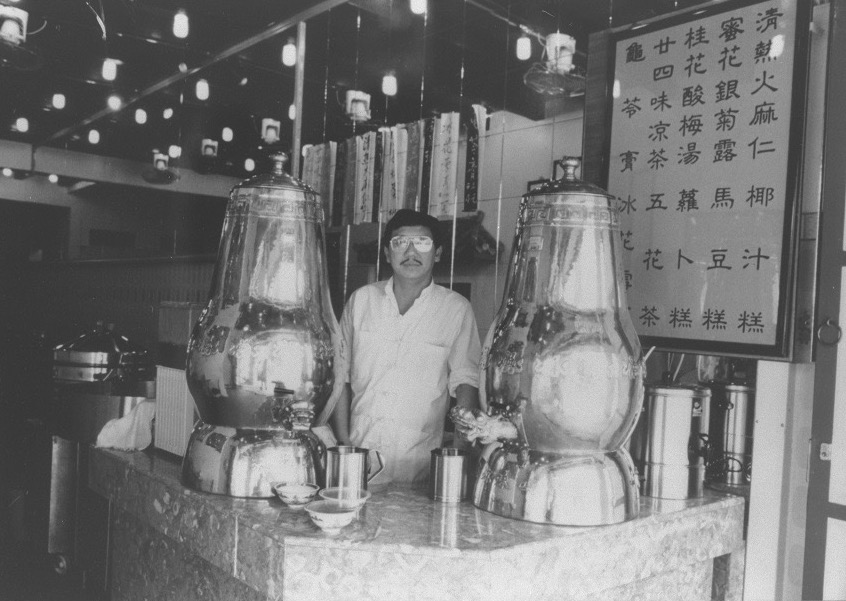 Herbal tea shop at Tanjong Pagar conservation area. Image courtesy of National Archives of Singapore.
Beyond iced or hot: the flexible health choices of a tropical nation
The evolution of Singapore’s heat-health history has led to a unique attitude and contextualized behaviour among its residents that moves beyond the conflict between two systems. The evolved attitude is not to judge which medical system is correct over others, but rather, “what does my body need in this specific situation”? This is seen most clearly in the everyday choices people make between iced and hot drinks.
The advice from biomedicine and CM on this topic seems completely opposite because it stems from two different scenarios: one is crisis management, while the other is long-term maintenance. Biomedicine uses the cold to restore balance in a time of bodily thermal imbalance. When your body is heating up from intense exercise, cooling the body as quickly as possible is one of the most important things. Using ice packs or cold water is a critical and effective action to lower the body temperature and prevent the situation from becoming life-threatening. Then, according to CM, practices such as limiting cold food and drinks intake, drinking the herbal tea, relying less on air-conditioning, and increasing exposure to natural heat enable the body to preserve its internal balance for the long term. This is similar to the biomedical concept of acclimatisation to the hot-humid environment.
Therefore, the choice is context-dependent. If the situation is an acute crisis, like heat exhaustion after exercise, the logic is primarily biomedical: cold water is a critical tool to rapidly lower body temperature. However, if the goal is long-term wellness or heat acclimatization, the logic primarily stems from CM: warm or hot drinks is preferred.
Ultimately, the relationship between heat and health in Singapore is contextualized and pluralistic. Here, biomedicine and CM coexist as two sources of knowledge. The public, in turn, do not treat them as mutually exclusive. The project “Establishing Heat Health History and Heritage: Practices and Beliefs among Singapore’s Military and Ethnic Chinese Citizenry” has interviewed 20 informants. 10 of them were recruited from military and others were CM users. 14 of 20 of them use both biomedical and CM ideas in practical ways, choosing the approach that fits the situation. It is a form of daily wisdom where residents act as integrators of health knowledge, creating a ground-up, resilient and flexible approach to living with heat.
This research was supported by the National Heritage Board’s Heritage Research Grant.
Notes
[1] ‘Scientists study heat effects’, Malaya Tribune, 19 August 1949, https://eresources.nlb.gov.sg/newspapers/digitised/article/maltribune19490819-1.2.38.
[2] ‘Heat Tests for Naval Men’, The Singapore Free Press, August 3, 1949, https://eresources.nlb.gov.sg/newspapers/digitised/article/freepress19490803-1.2.112.
[3] ‘Human guinea-pigs in the black box’, The Straits Times, August 20, 1951, https://eresources.nlb.gov.sg/newspapers/digitised/article/straitstimes19510820-1.2.109.
[4] R. K. MacPherson, Physiologic Responses to Hot Environments: An Account of Work Done in Singapore, 1948-1953 at the Royal Naval Tropical Research Unit, Medical Research Council Special Report Series, no. 298 (London: Her Majesty’s Stationery Office, 1960),177.
[5] ‘Nanyang chang nian ru xia you wei ti nei duo han you wei ti nei duo re (di yi ci bian lun hui), 南洋长年如夏有谓体內多寒有谓体內多熱热(第一次辩论会)(Southeast Asia is summer all year round, then the body is often cold or hot? (The First debate)’, Nanyang Siang Pau, June 30, 1947, https://eresources.nlb.gov.sg/newspapers/digitised/article/nysp19470630-1.2.103.1.
[6] ‘Two NS Men Died in Running Tests, Coroner Told’, The Straits Times, May 25, 1978, https://eresources.nlb.gov.sg/newspapers/digitised/article/straitstimes19780525-1.2.57;
‘NS Recruit Died after 5-Km Run’, The Straits Times, April 24, 1978,
https://eresources.nlb.gov.sg/newspapers/digitised/article/straitstimes19780428-1.2.71;
‘Soldier Trainee Dies’, The Straits Times, November 28, 1986,
https://eresources.nlb.gov.sg/newspapers/digitised/article/straitstimes19861128-1.2.26.4;
‘Officer Cadet Dies of Heat Stroke’, The Straits Times, September 19, 1986,
https://eresources.nlb.gov.sg/newspapers/digitised/article/straitstimes19860919-1.2.27.6;
‘Zhong shi lian pao shi dao bi xi yin zhong shu er bu zhi yan shi ting pan zhu yi wai sang sheng中士练跑时倒毙系因中暑而不治 验尸庭判属意外丧生 (The Sergeant’s Death during a Practice Run Was Attributed to Heat Exhaustion and Was Ruled Accidental by the Coroner)’, Nanyang Siang Pau, May 25, 1978,
https://eresources.nlb.gov.sg/newspapers/digitised/article/nysp19780525-1.2.14.8;
‘Can jia pao bu ce yan hun dao fu yi bing shi zhong shu sang sheng参加跑步测验昏倒服役兵士中暑丧生 (A Soldier Who Collapsed during a Running Test Died of Heat Stroke)’, Nanyang Siang Pau, September 26, 1979,
https://eresources.nlb.gov.sg/newspapers/digitised/article/nysp19790926-1.2.44.9;
‘Yan ting pan wei yi wai zhong shu fan hun fa shu fu yi qing nian jun ying nei pao bu chu shi验庭判为意外 中暑返魂乏术 服役青年军营內跑步出事 (The Trial Ruled That the NS Youngster Died due to Sun Stroke)’, Xin Ming Ri Bao, October 26, 1979, https://eresources.nlb.gov.sg/newspapers/digitised/article/shinmin19791026-1.2.17;
‘Yi jian xi jun guan pao bu hou zhong shu shen wang一见习军官跑步后中暑身亡 (A Trainee Officer Died of Heatstroke after Running) ’, Lianhe Zaobao, September 19, 1986, https://eresources.nlb.gov.sg/newspapers/digitised/article/lhzb19860919-1.2.12.9.
[7] Jermyn Chow, ‘SAF Is Winning the War against Heat’, The Straits Times, February 28, 2011; Bryna Sim, ‘Workers Need to Acclimatise’, The New Paper, August 3, 2011.
[8] Cheng Wee Teo, ‘High and Dry’, The Straits Times, April 18, 2004; Sher Maine Wong, ‘Drink Up’, The Straits Times, June 12, 2005.
[9] Liming Lin, ‘He leng yin chui leng qi ri jiu yang xu duo bing 喝冷饮吹冷气 日久阳虚多病 (Cold drinks and air-con: a path to yang deficiency and illness)’, Xinming Ribao, October 4, 2013; Jiahui Han, ‘Re tian yang sheng bao dian 热天养生宝典 (A health guide for hot weather)’, Xinming Ribao, August 8, 2017.