
TL;DR
White crystals found on skis and goggles from Singapore's first Antarctica Expedition turned out to be a sign of the equipment slowly breaking down. The plastic-like material used to make them had reacted with moisture in the air, causing rection products to migrate to the surface. Conservators addressed the humidity problem and are now monitoring the items closely.
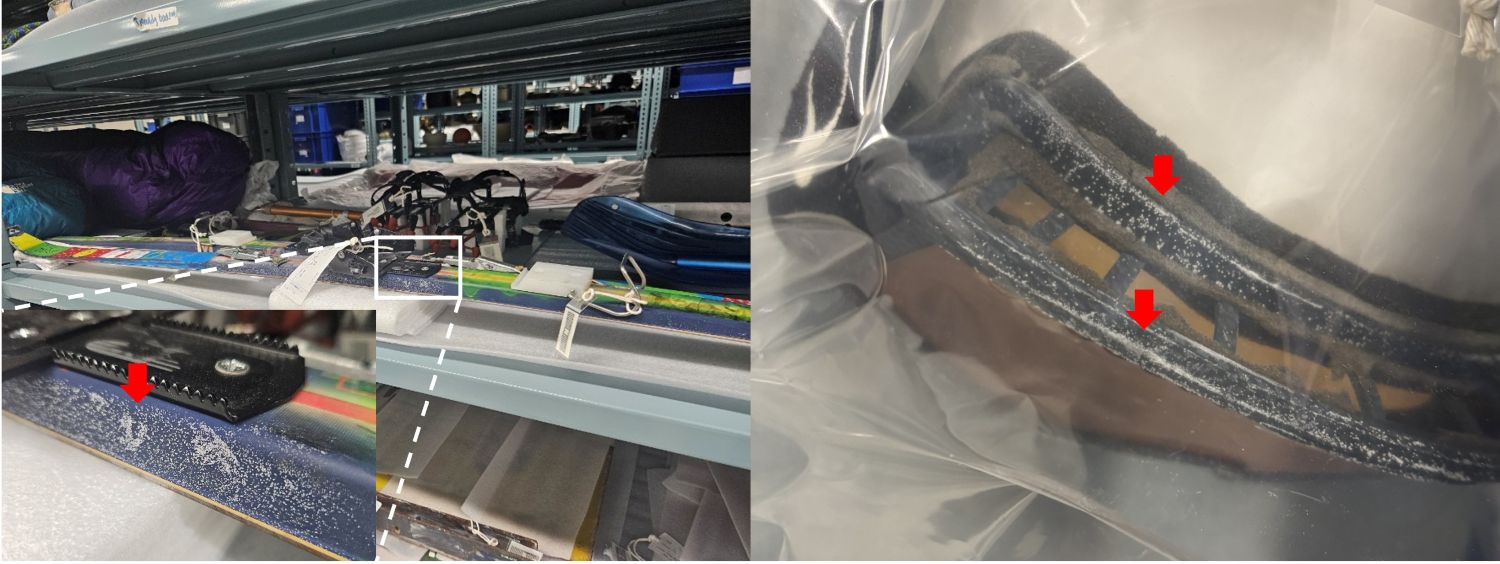
Figure 1. Conditions of the skis and goggles when the white deposits (red arrows) were first spotted during the store check.
Discovery
Early in 2025, white deposits were discovered on a pair of skis (2000-07455, National Museum of Singapore) and skiing goggles (2001-06117, National Museum of Singapore) during a regular store check at the Heritage Conservation Centre (HCC) (Figure 1). The skis and goggles, which were used by the team leaders in Singapore's first Antarctica Expedition in 2000, have been stored in HCC with no previous record of deposits since their acquisition in 2000 and 2001 respectively.
Synthetic Polymers in Skiing Gear
While early skiing equipment was largely made from natural materials such as wood and metal, the use of synthetic polymers became increasingly common from the 20th century onwards. As the name suggests, a synthetic polymer is a man-made compound that consists of many repeated small units joined together by chemical bonds. Compared to natural materials, synthetic polymers are considered to be more resistant to wear and tear.
Scientific Analysis
The skiing gear was then sent for scientific analysis. Under a digital microscope, the seemingly similar deposits showed three distinct morphologies: flat and waxy disks on the skis, powdery flakes and urchin-shaped crystals on the goggles (Figure 2).
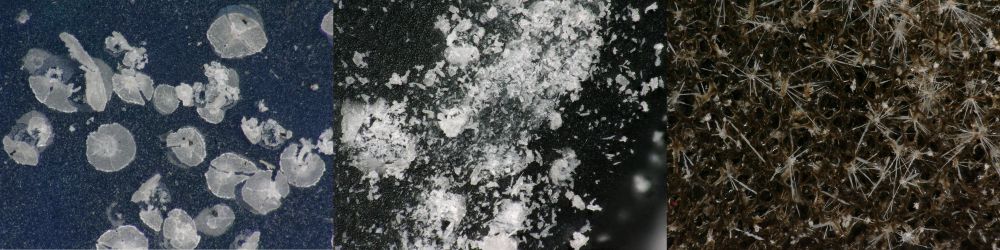 Figure 2. (Left) Flat and waxy disks found on the skis. (Middle) Powdery flakes found on the goggles. (Right) Urchin-shaped crystals found on the goggles.
To find out their chemical compositions, a small quantity of each type was then analysed with a micro-Fourier transform infrared (micro-FTIR) spectrometer, which is an analytical technique based on the interaction between chemical bonds and infrared radiation. All three samples showed a connection to the same chemical – adipic acid. The white disks on skis were identified to be poly(hexamethylene adipate), or PHMA for short (Figure 3), while the powdery flakes and urchin-shaped crystals on the goggles were pure adipic acid (Figure 4). Both adipic acid and PHMA are associated with the production of ester-based polyurethanes with enhanced flexibility at low temperatures, making them suitable for skiing equipment.
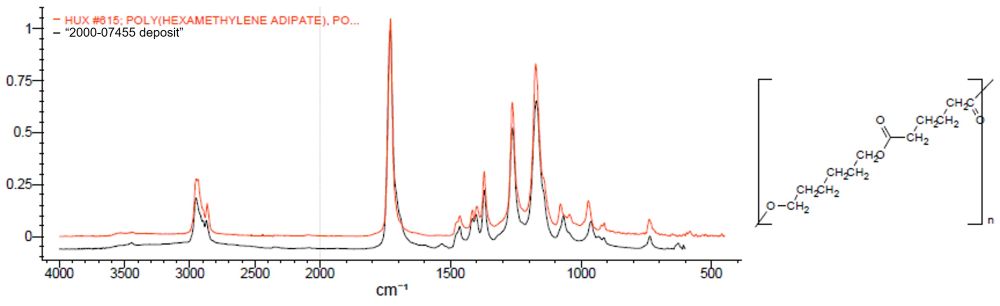 Figure 3. The FTIR spectrum of the disk-shaped deposits found on the skis showed a good match to that of poly(hexamethylene adipate).
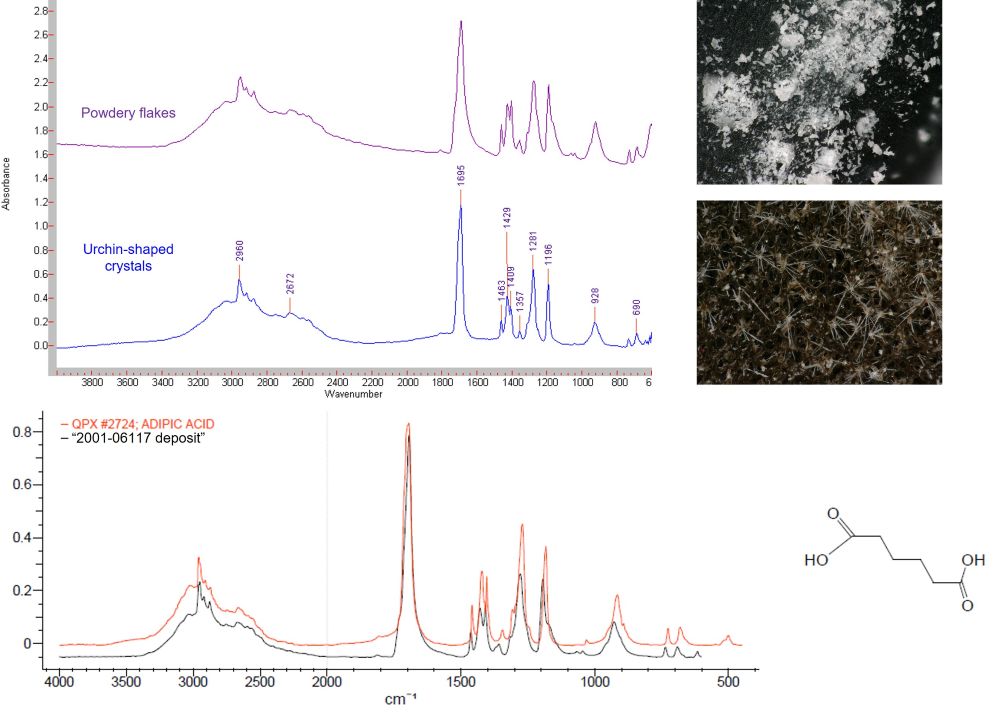 Figure 4. (Top) FTIR spectra of the powdery flakes (purple) and the urchin-shaped crystals (blue), both showing the same characteristics. (Bottom) The sample spectrum showed a good match to that of adipic acid.
Understanding the Deterioration: Blooming
The analysis revealed that the white deposits were not external contaminants but were linked to the polymeric materials themselves. Ester-based polyurethanes tend to deteriorate by hydrolysis whereby they are broken down into smaller molecules like polyols and adipic acid by reaction with water. These degradation products become more mobile and less compatible with the polyurethane matrix. As a result, they slowly migrate to the object surface, accumulating and forming white deposits. This process is known as “blooming”.
Cause, Conservation Assessment and Decision Making
Environmental data showed that the relative humidity in the store exceeded the upper limit of 60% on multiple occasions in the month prior to the discovery of the deposits. Together with the analytical findings and the known ageing behaviour of polyurethanes, which can range from a few years to a few decades, the increase in relative humidity might have accelerated natural ageing by hydrolysis.
As the polyurethane had become too fragile for active conservation treatment, little intervention could be carried out. After rectifying the humidity issue, the items were returned to storage without special treatment. No new deposits have been found in subsequent checks.
Looking Ahead
Considering the increasing number of synthetic polymer-based objects in the collection, understanding their long-term stability will remain an important area for future conservation research. Modern materials such as polyurethanes present particular challenges for conservation science: unlike traditional materials such as wood, metal, or stone, whose deterioration mechanisms have been studied over centuries, synthetic polymers are relatively recent additions to museum collections and their long-term behaviour is still not fully understood. They can degrade in ways that are difficult to predict or reverse, and the products of their deterioration — as this case illustrates — may themselves cause further damage to associated materials. Globally, institutions such as the Getty Conservation Institute, the Smithsonian Institution, and the International Council of Museums (ICOM) have identified the preservation of modern and contemporary materials as one of the most pressing challenges facing the conservation profession today. Research into polymer degradation, stabilisation, and storage is an active and growing field, and HCC's findings contribute to a wider body of knowledge that will be essential as collections around the world grapple with the inevitable ageing of 20th- and 21st-century objects.