
TL;DR
Singapore's World Trade Centre (1978–2026) served as a landmark hub for trade, exhibitions, and entertainment, embodying the nation's global city ambitions. Now HarbourFront Centre, it will be redeveloped as part of the Greater Southern Waterfront, continuing its legacy of connecting Singapore to the world.
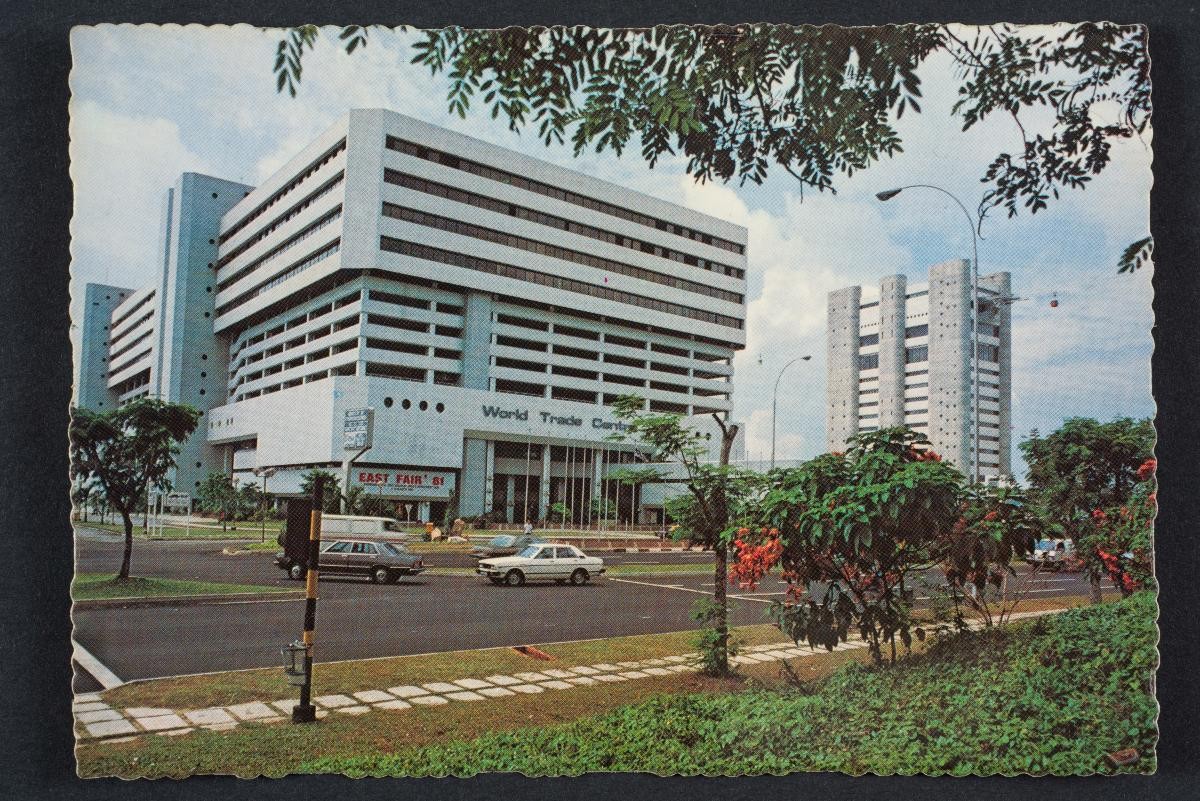
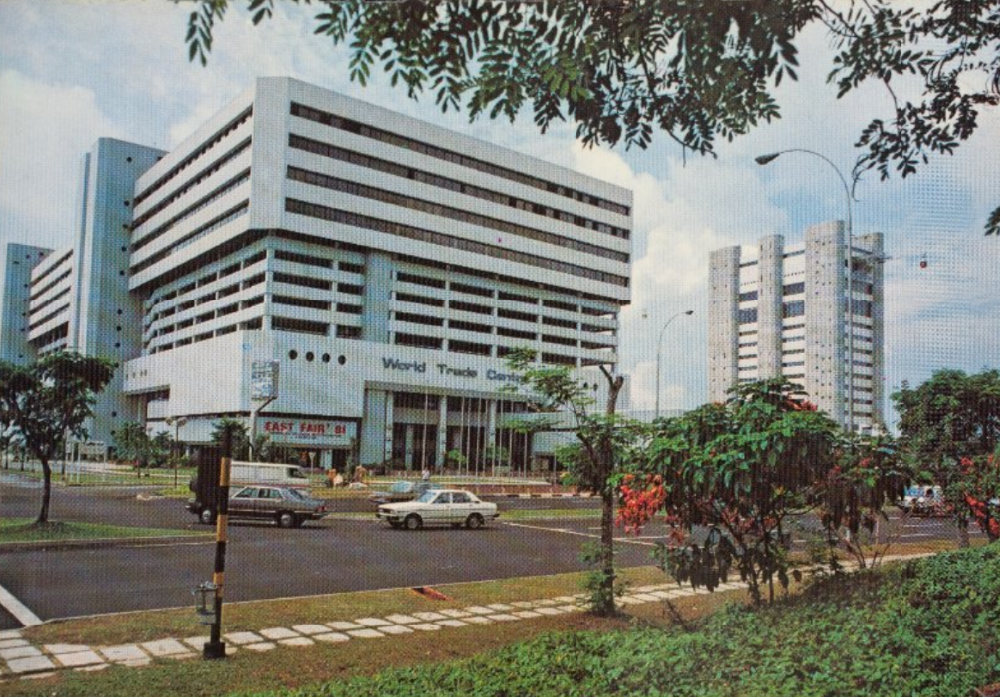
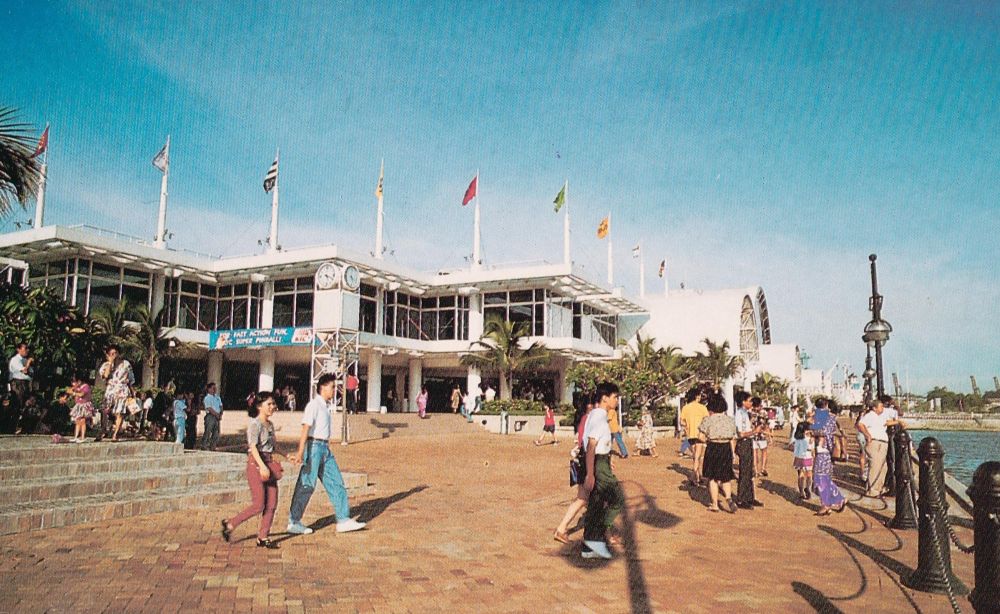
The Former World Trade Centre, c.1980s. The 12-storey building was first announced in 1973 by the Port of Singapore Authority, linking Singapore with an international network of World Trade Centres. Collection of National Museum of Singapore.
Speaking to journalists at the Singapore Press Club on 6 February 1972, S. Rajaratnam, then Minister for Foreign Affairs, injected a term into our national discourse – “global city.” This then novel concept, a response to naysayers of Singapore’s viability as a nation, would underscore Singapore’s economic strategy for decades to come. Providing a succinct overview of Singapore’s extant infrastructure, Rajaratnam argued that “our port is not merely a regional port but a global port. Our port makes the world our hinterland… all you need is a ship to get to Singapore.” [1]
And in 1972, there was nothing that embodied this notion better than the nascent World Trade Centre (WTC) building that was first mooted in early 1970. It was also the logical next step for the PSA which had successfully applied for membership in the New York based World Trade Centers Association in 1971. For the fledgling nation, it marked Singapore’s tentative forays into realising its vision of becoming a global city. [2]
Building A Window for the World: Realising the Global City Vision (1973 – 1978)
Designed by the Urban Development Team’s architects and developed by the Port of Singapore Authority (PSA), a model of the S$70 million building was published in The Straits Times on 30 October 1973. Described as “a window for the world,” the 12-storey building – located at the former Jardine Steps – boasted “580,000 square feet of office space, a carpark for 1000 cars…high-speed lifts and escalators… restaurants and shops…(and) 16,000 square feet of exhibition hall space.” With its distinctive architecture, WTC became a prominent landmark in Singapore’s port district, a hub that aggregated business services, place that provided maritime connections to Sentosa, the region and beyond.[3]
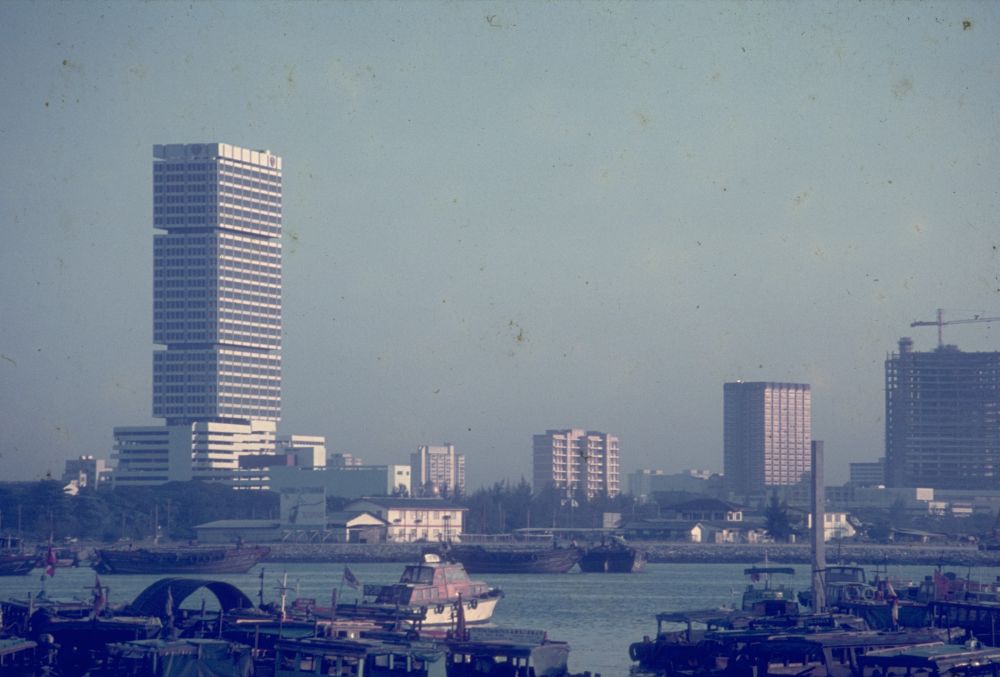 The World Trade Centre and ferry terminal in the 1980s. Courtesy of National Archives of Singapore.
Cavernous Halls and Shared Memories: The WTC Experience from the late 1970s to the 1980s
Yet it was the WTC’s exhibition spaces that bore special significance for Singaporeans of a certain vintage. It evokes certain memories – university examinations, book fairs, exhibitions, trips to Sentosa and the Riau islands, to name but a few. And it was the WTC’s events and exhibitions that made it particularly memorable, transforming it into a destination associated with specialised exhibitions, national milestones, and even a touch of stardust and showbiz.
WTC’s first exhibition, held from 25 August to 2 September 1978, was something close to Singaporeans’ hearts – cars.[4] The Singapore International Motor Show ’78 was the first of its kind here. 40 dream cars were put on display including the Ferrari 512S and Ferrari Rainbow, in those pre-COE days. Next was the Singapore Fair ’78, a 10-day event put on by the Singapore Manufacturers’ Association. Using the theme “Singapore for Quality,” it showcased Singapore’s industrial output – electronics, garments, textiles and heavy machinery.[5]
But these all paled in comparison to the blockbuster National Exhibition. Running from 16 November to 30 December 1984, it capped off the five-month long celebrations commemorating the 25th anniversary of Singapore becoming a self-governing state in 1959. The WTC’s cavernous exhibition halls were transformed into a living museum that told the story of Singapore’s achievements around seven themes – the port, political history (including foreign affairs and defence), education, economic growth, airport (including tourism development), physical development and people.[6] A standout highlight was the MRT display area which showcased a life-sized mock-up of a Mass Rapid Transit (MRT) station and a Kawasaki Heavy Industries train car. This gave Singaporeans a first glimpse into what it would be like commuting on the MRT, which would not begin operations for another three years.[7]
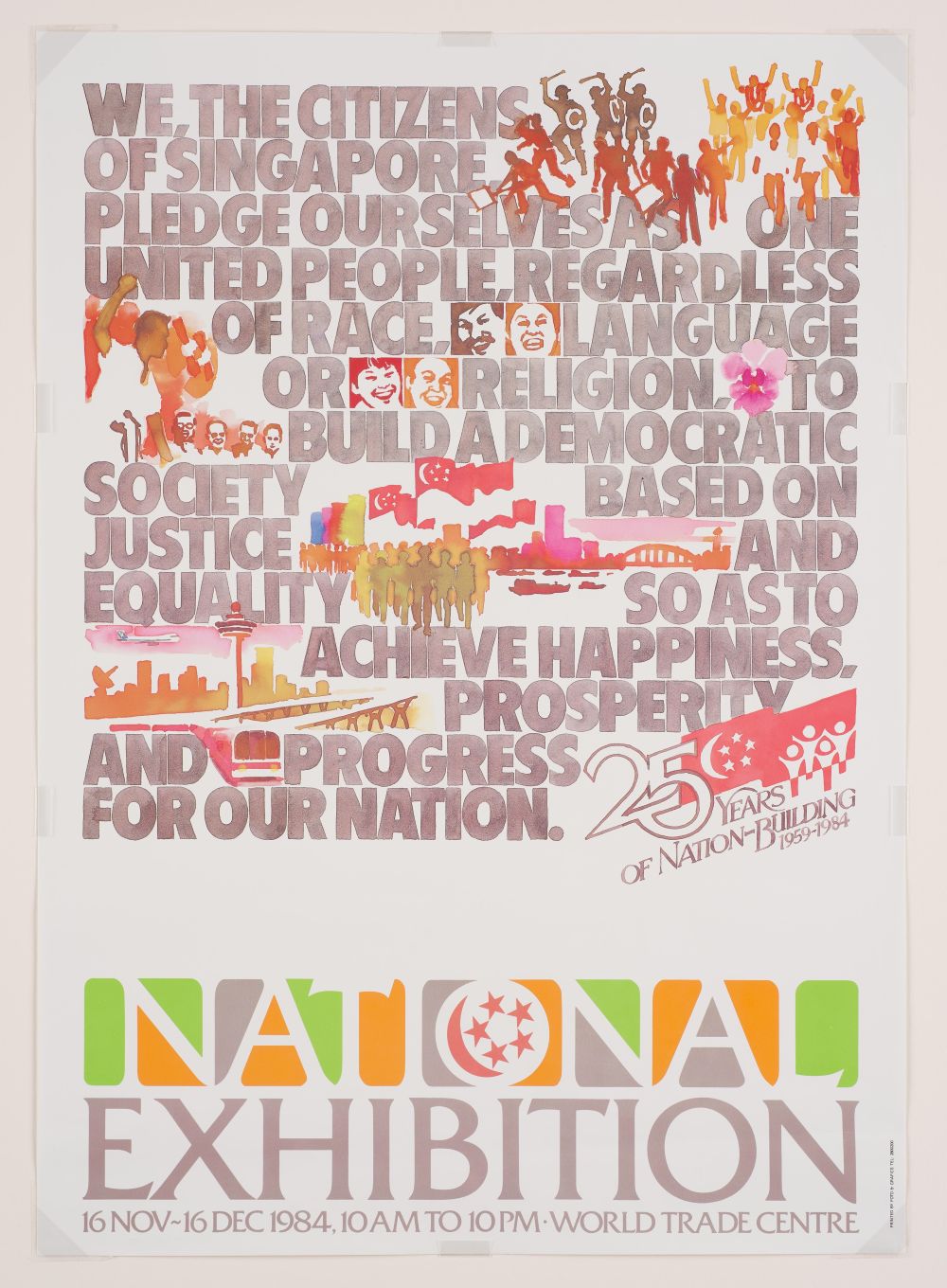 Poster from the National Exhibition (1984) with Singapore’s National Pledge. Collection of National Museum of Singapore.
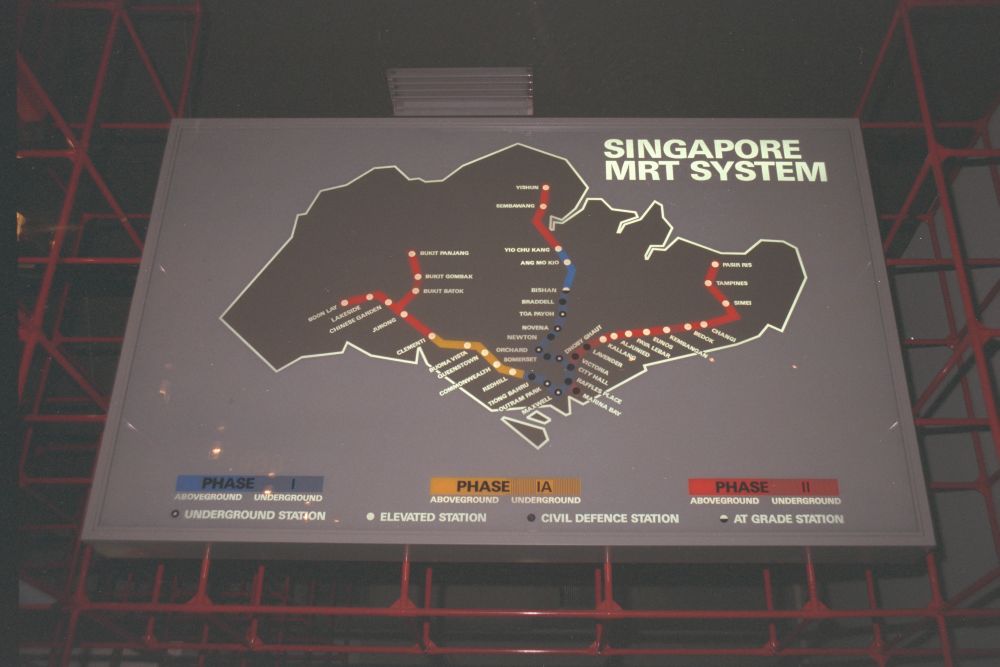 One of the MRT exhibits at the 1984 National Exhibition held at the World Trade Centre, showcasing the future MRT network. Courtesy of National Archives of Singapore.
Organised by the Ministry of National Development, it was a mammoth S$18 million undertaking that involved 50 government bodies and private organisations.[8] “Certain events (of the Fifties and Sixties) left deeper imprints on my mind,” wrote then Prime Minister Lee Kuan Yew, in the exhibition’s souvenir magazine.[9] He also lingered longest when touring the audio-visual artefacts at the political history section. In his opening address delivered on 15 November, he underscored Singapore’s founding DNA,
“If through the National Exhibition Singaporeans have a better idea of how we got where we are, then the money and time were well-spent. For we need to continue to be tolerant, not xenophobic; open-minded, not blinkered; eclectic, not ideological; in our unceasing efforts to improve ourselves. And we have to be perpetually vigilant.”[10]
For many Singaporeans who grew up in the ‘80s, WTC was indelibly associated with books and book fairs. In September 1979, the Singapore Festival of Books and Book Fair was held for the first time at WTC.[11] To get a sense of scale, the 17th Book Fair in 1985 took up 7500 square metres at Hall 4, showcased 1800 Singapore and overseas publishers, and featured 150,000 titles in English, Chinese, Malay, Tamil and other languages, including 2000 new Singapore titles. Half a million visitors to the event were expected.[12]
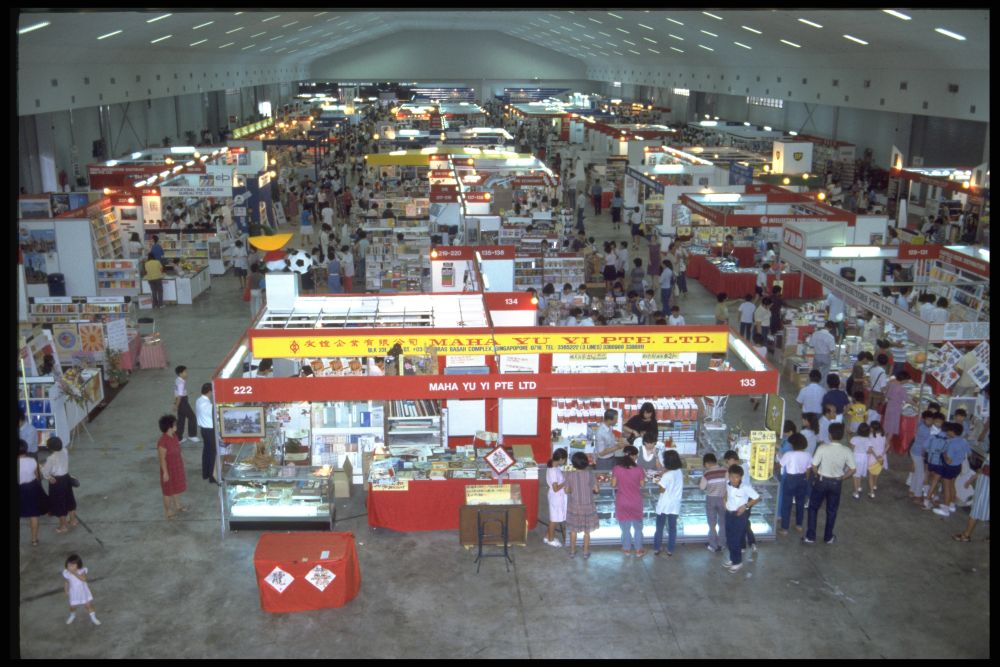 The 17th Festival of Books and Book Fair 1985 at World Trade Centre (WTC). Held from August 31 to September 8, the fair featured a wide-ranging display of about 150,000 titles in English, Chinese, Malay, Tamil and other languages. Ministry of Information and the Arts Collection, courtesy of National Archives of Singapore.
The WTC also had its share of glitz and glamour. Japanese teen pop group – Shojo-Tai – held five shows in July 1986 at the WTC’s auditorium. It was the group’s first tour outside Japan, which included stops in Bangkok, Kuala Lumpur and Jakarta.[13] In December 1987, Hall 4 resounded with the strains of Cantopop as Hong Kong singers, Anita Mui, Danny Chan and Leslie Cheung, took to the stage. To wrap up the year, Alan Tam, then the top Hong Kong vocalist, held five concerts from 26 December.[14]
Perhaps most memorably, Singapore hosted the Miss Universe pageant in May 1987, at WTC’s Hall 4, which had been transformed (once again) for the event. Costing $6.5 million, it bought prime time exposure for Singapore to showcase itself to the world. Outdoor shots of Sentosa, the Singapore Zoological Gardens and even parts of Chinatown were beamed “live” to the US on CBS at 9 pm on 26 May.[15]
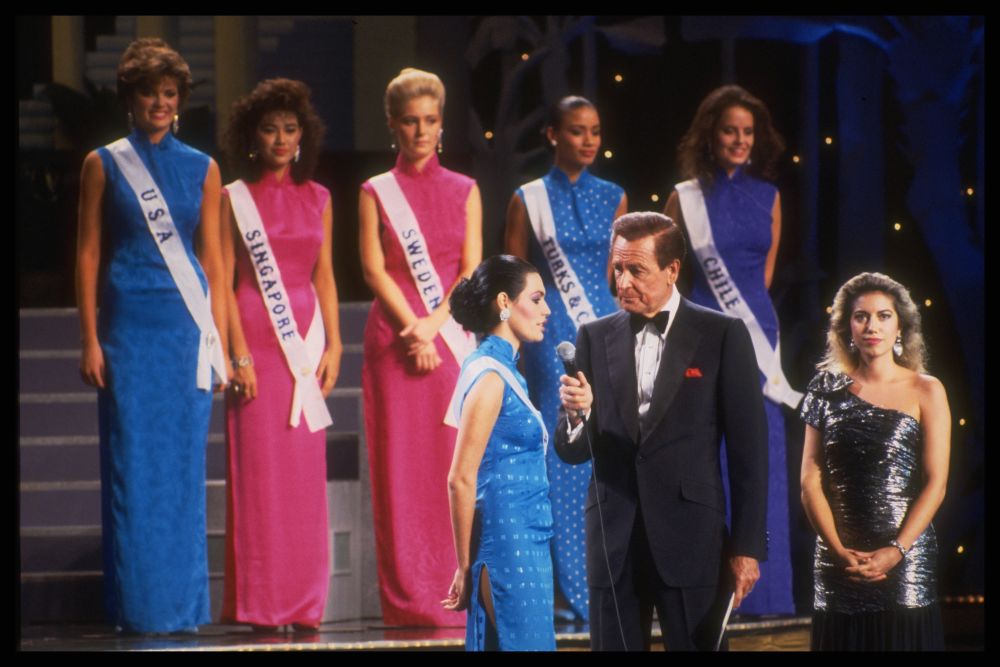 Selection round at the Miss Universe pageant finals held at the World Trade Centre in 1987. Miss Singapore is second from left in the back row. Ministry of Information and the Arts Collection, courtesy of National Archives of Singapore.
Expanding Horizons: Becoming a “Window to the Sea” in the 1990s
As Singapore moved into the 1990s, WTC underwent expansion as it responded to competitors in the economic landscape. The $166 million expansion plan, dubbed a “Window to the Sea” when announced in February 1990, saw “the shabby godowns…give way to a bustling world-class entertainment and commercial complex.”[16] In June 1992, the revamped complex – comprising the 5000-seater Harbour Pavillion, a 3300 square metre Singapore Maritime Showcase, an open air sunken Amphitheatre arena, three new exhibition halls bringing the total to six, and a 300-metre Harbour Promenade – was officially opened. A new Expo Gateway became the development’s focal point, connecting the exhibition halls to the main WTC building.[17] However, by 1997, two of its exhibition halls – Hall 1 and 2 – were closed to make way for the MRT’s North East Line. A competitor that would eventually supplant WTC’s exhibition role emerged – the Singapore Expo at Changi South.[18]
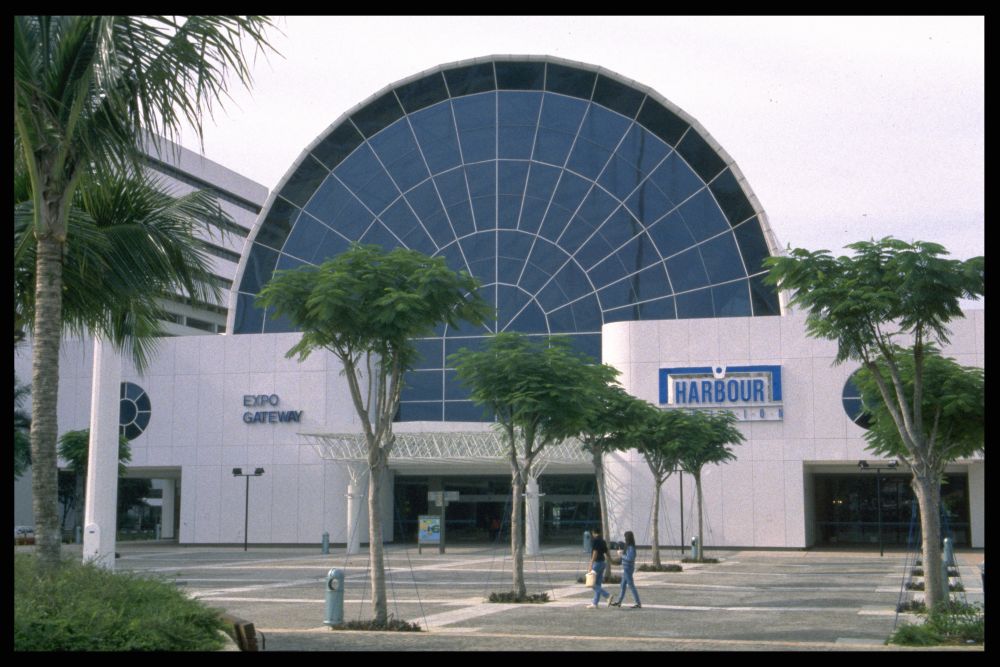 The Expo Gateway and Harbour Pavillion at WTC in the early 1990s. The Expo Gateway provided a sense of arrival to the WTC’s exhibition spaces. Singapore Tourist Promotion Board Collection, courtesy of National Archives of Singapore.
 Exterior view of the Harbour Pavilion (centre background) in the mid-late 1990s. It was commissioned by PSA as part of an upgrading project for the WTC complex, alongside the Expo Gateway and Expo Halls 5 and 6 (right background). The 5,000-seat multi-purpose hall was designed to host activities ranging from live concerts to stage productions and exhibitions. Opened in March 1992, the 3,822-square-metre venue was then the second largest event hall after the Singapore Indoor Stadium. The venue was officially closed in December 2000, eventually making way for subsequent development. Collection of National Museum of Singapore.
Beyond the Port: From Corporatisation to the Greater Southern Waterfront (1997 -2025)
Five years later, the PSA was corporatised on 1 October 1997 and renamed PSA Corporation.[19] Its non-port assets, which were not core to its primary business, were transferred to Temasek Holdings. To hold and manage these properties, Temasek Holdings established Mapletree Investments in 2000.[20]
Mapletree moved to redevelop WTC, and it was eventually relaunched as HarbourFront Centre – a pure retail space comprising 19,018 square metres spread over three floors – on 17 February 2003. This development was but “a prelude to The HarbourFront, the mega waterfront retail and lifestyle hub” boasting 1 million square feet of retail space, that was on the cards for the near future.[21] To realise this, both the Harbour Pavillion and Expo Gateway, opened only in 1992, were demolished. All that was left was the 300-metre-long harbour promenade, which was integrated into the new development – VivoCity.[22] Designed by Japanese architect Toyo Ito, the mall sported a bold wave inspired motif and remains Singapore’s largest shopping mall to date.[23]
As of 2025, the entire HarbourFront Precinct has been transformed per Mapletree’s vision. With VivoCity as its centrepiece, the precinct comprises Harbourfront Centre, HarbourFront Towers One and Two, Bank of America Harbour Front, Saint James Power Station and the Reef at King’s Dock. At 47, HarbourFront Centre, almost halfway through its 99-year lease and looked rather dated.[24] Shorn of its signature exhibition spaces and overshadowed in retail scale and offerings by its younger (and bigger) sibling Vivocity, it went from being a destination for families to a transitory space providing ferry services to the Riau Islands, the Singapore Cruise Centre and even bus operators.[25]
However, this transitory status and identity would turn out to be, as it was, transitory. Back in 2013, at the National Day Rally, Prime Minister Lee Hsien Loong announced the relocation and consolidation of all port services in Tuas, freeing up the coastline stretching from Tanjong Pagar to Pasir Panjang for redevelopment. In 2019, PM Lee announced an ambitious new project – the Greater Southern Waterfront. It would be “new place to live, work and play,” with 9000 public and private housing units, waterfront promenades, office and leisure spaces.[26]
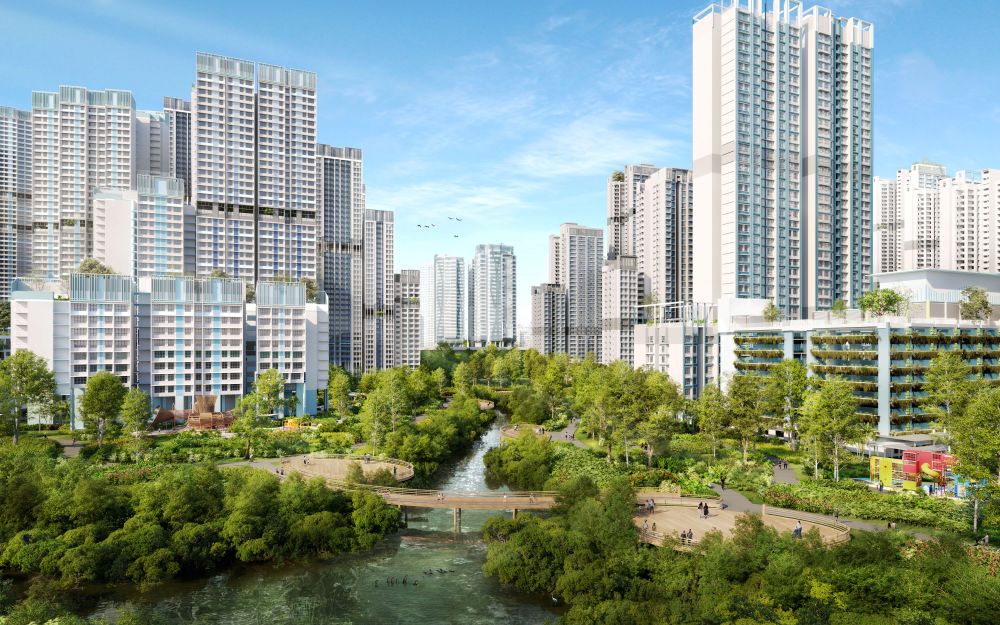 Illustration of future housing and recreational spaces at Berlayar estate (the former Keppel Club site). Artist’s impression for illustrative purposes only, actual developments may differ. Courtesy of the Housing & Development Board.
When seen in this light, Mapletree’s decision to close and redevelop Harbourfront Centre, which was announced on 28 October 2025, is unsurprising. On its site, a new 33-storey building housing office and retail spaces, and a 13,000 square metre elevated park, will be built. A new two-story cruise and ferry terminal will also be built to its west, retaining its role of connecting Singaporeans to the region and the world.[27] In the second half of 2026, the demolition of HarbourFront Centre will begin.
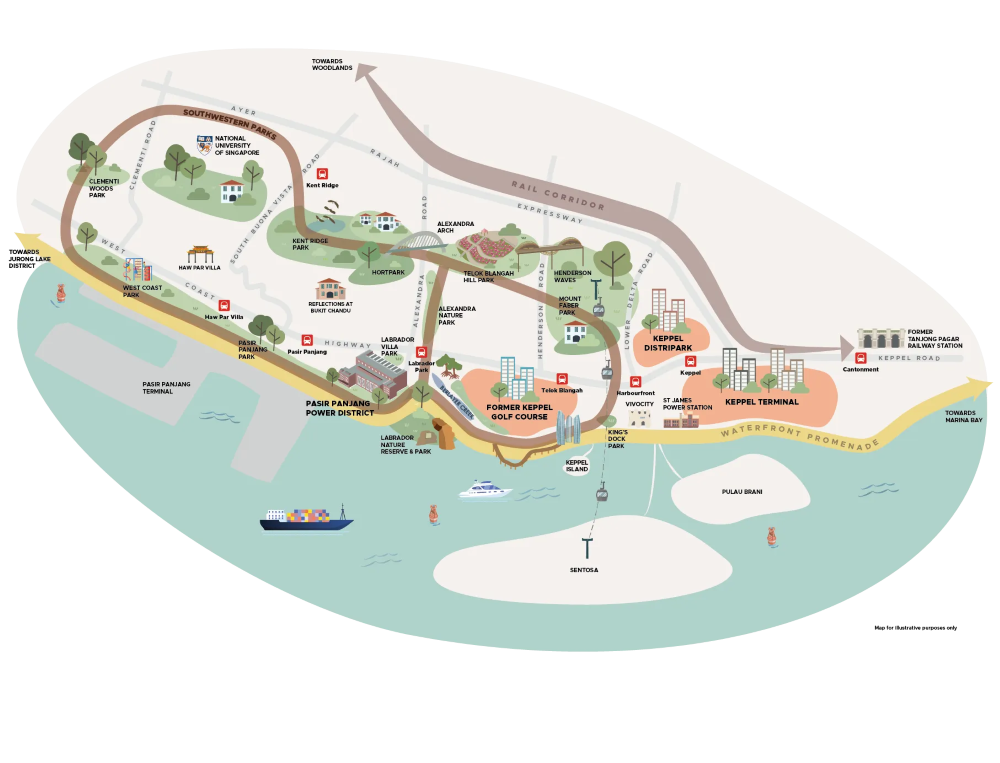 Illustrative map of the Greater Southern Waterfront. Running from Pasir Panjang to Marina East, in the west to Keppel Bay in the east, the GSW is envisioned to be a vibrant waterfront and gateway precinct along the southern coast. © Urban Redevelopment Authority. All rights reserved.
Conclusion
The redevelopment of HarbourFront Centre is a pivotal component of a larger national vision to reconnect Singaporeans to a waterfront that has historically been occupied by port operations. As the HarbourFront precinct moves into its next chapter within the Greater Southern Waterfront, it will connect people to a revitalised coastline and once again serving as a “window for the world” that reflects Singapore's enduring status and ambitions as a global city, which it first envisaged in 1970, as a young, newly independent nation.
Notes
[1] “Singapore: Global City,” Speech by S. Rajaratnam, Singapore Press Club, 6 February 1972, National Archives of Singapore, accessed on 21 April 2026, https://www.nas.gov.sg/archivesonline/speeches/record-details/fd2918de-3270-11e4-859c-0050568939ad
[2] “Window for the world—a $70m centre to boost trade,” Straits Times, 30 October 1973, 12.
[3] Ibid.
[4] “Futuristic cars to make debut here,” New Nation, 6 July 1978, 5.
[5] “Singapore Fair ’79 Opens on Friday,” Straits Times, 2 October 1978, 7.
[6] “National Exhibition,” Singapore Monitor, 15 November 1984, 20; “Imprints on my mind,” Straits Times, 16 November 1984, 1.
[7] “An idea of what MRT will be like for $1.3 m,” Straits Times, 11 October 1984, 9.
[8] “National Exhibition to cost about $18 m,” Straits Times, 14 November 1984, 44.
[9] “Imprints on my mind,” Straits Times, 16 November 1984, 1.
[10] Ibid.
[11] “The 11th Singapore Festival Of Books And Bookfair 1979 * World Trade Centre * 11am-9pm * 1-9 Sep 1979,” National Archives of Singapore, last accessed on 21 April 2026.
[12] “More elbow room at Book Fair '85,” Straits Times, 29 August 1985, 14; “A family affair,” Straits Times, 31 August 1985, 2.
[13] “Shojo-Tai to perform here,” Straits Times, 13 June 1986, 7.
[14] “HK 'biggies' steal the show,” Straits Times, 25 December 1987, 7.
[15] “All out bid to give Singapore maximum exposure at Miss Universe pageant,” Business Times, 21 April 1987, 1.
[16] “Window to the Sea,” Straits Times, 26 February 1990, 2 & 19.
[17] “People-friendly port designed to draw the crowds,” Straits Times, 18 June 1992,14; “WTC as family hub,” Straits Times, 1 July 1994, 2.
[18] Speech by Mr Lee Yock Suan, Minister for Trade & Industry and Second Minister for Finance, at the Ground-Breaking Ceremony of the Mega Exhibition Centre at Changi South Ave 1 on Fri 30 May 97 at 9 a.m., National Archives of Singapore, accessed on 21 April 2026.
[19] “Port of Singapore Authority (PSA),” National Library Board, accessed on 21 April 2026.
[20] “Mapletree at a Glance,” Mapletree Investments, accessed on 21 April 2026,https://www.mapletree.com.sg/about-us/.
[21] “World Trade Centre Retail Re-Opens With New Look and Name,” Mapletree Investments, https://www.mapletree.com.sg/newsroom/world-trade-centre-retail-re-opens-with-new-look-and-name/ ; “WTC is now HarbourFront Centre,” Today, 17 February 2003 (2nd Edition), 5.
[22] “Vivo City,” Singmalls, accessed on 20 April 2021, https://singmalls.app/en/malls/vivo-city/about.
[23] “Growing value across markets,” Straits Times, https://www.straitstimes.com/singapore/growing-value-across-markets.
[24] Ibid.
[25] “Stores/Category”, HarbourFront Centre,” accessed on 20 April 2021, https://www.harbourfrontcentre.com.sg/store.php?c=48&vt=Category.
[26] “Singapore unveils master plan for port, airport, waterfront,” Reuters, accessed on 21 April 2026, https://www.reuters.com/article/singapore-plan/rpt-singapore-unveils-master-plan-for-port-airport-waterfront-idINL4N0GK05120130819/; “Vibrant city living for all,” Urban Redevelopment Authority, accessed on 21 April 2026, https://www.uradraftmasterplan.gov.sg/regional-plans/central-region/vibrant-city-living-for-all/#315e64436e222a427735d63d6fb7b3e7; “National Day Rally 2019,” Prime Minister’s Office, Singapore, accessed on 21 April 2026, https://www.pmo.gov.sg/newsroom/national-day-rally-2019/.
[27] “HarbourFront Centre to close in second half of 2026 for makeover into 33-storey mixed-use building ,” Straits Times, accessed on 21 April 2026, https://www.straitstimes.com/singapore/harbourfront-centre-to-close-in-second-half-of-2026-for-makeover-into-33-storey-mixed-use-building.