
 (1).jpg)
TL;DR
ChakapBot is an AI-powered chatbot developed by Temasek Polytechnic, supported by The Peranakan Association Singapore (TPAS), National University of Singapore, and National Heritage Board to revitalise Baba Malay, an endangered heritage language. Built on authoritative linguistic resources and featuring authentic audio recordings, it offers an intuitive, accessible learning experience — helping younger generations reconnect with their Peranakan roots and keep the language alive. The article is written by prominent community member Baba Colin Chee, who was President of TPAS from 2018 – 2022.
Gua suka ni app.
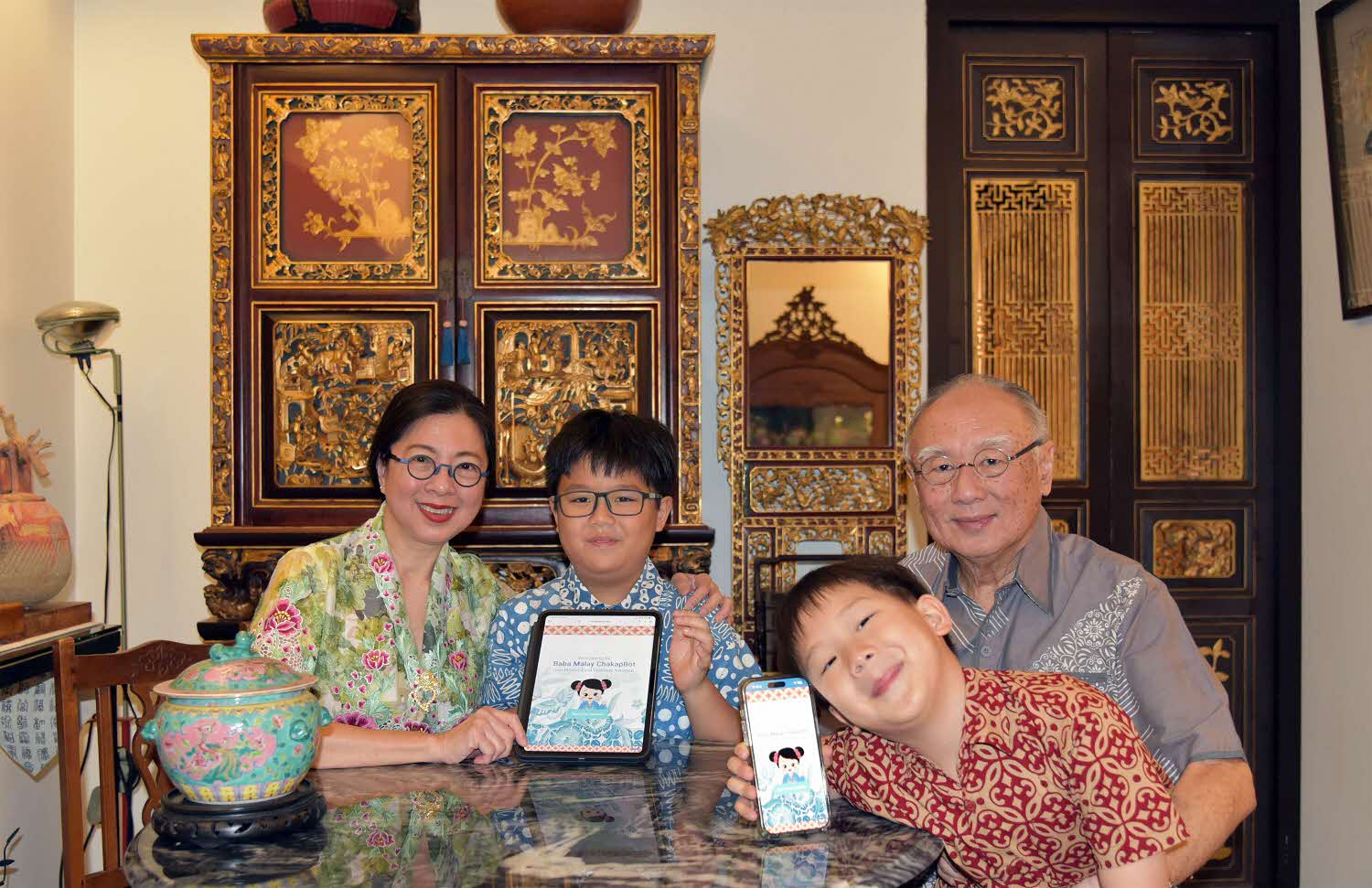
I made this remark at a forum in October 2025, presenting our chatbot for learning Baba Malay, my mother tongue. This short statement says it all. The ChakapBot application (app) is a technological milestone — a simply packaged, intuitive, fuss-free way to learn Baba Malay. Even my grandson, Micah, at eight years old, had fun using it. He declared with quiet conviction: “Baba Malay is our heritage. We must keep it alive.”
Why ChakapBot Is Important
ChakapBot was conceived and built by staff and students from Temasek Polytechnic’s School of Informatics & IT (TP), supported by The Peranakan Association Singapore (TPAS) and the National Heritage Board’s Heritage Research Grant. ChakapBot1 is built upon the late Baba William Gwee Thian Hock’s A Baba Malay Dictionary: The First Comprehensive Compendium of Straits Chinese Terms and Expressions,2 published in 2006; Mas Sepuloh3 published in 1993; Baba Kenneth Y K Chan’s Baba Malay for Everyone4 published in 2020; Chrita-chrita Baba5 published in 2019; and Nyonya Nala Lee’s A Grammar of Modern Baba Malay6 published in 2022.
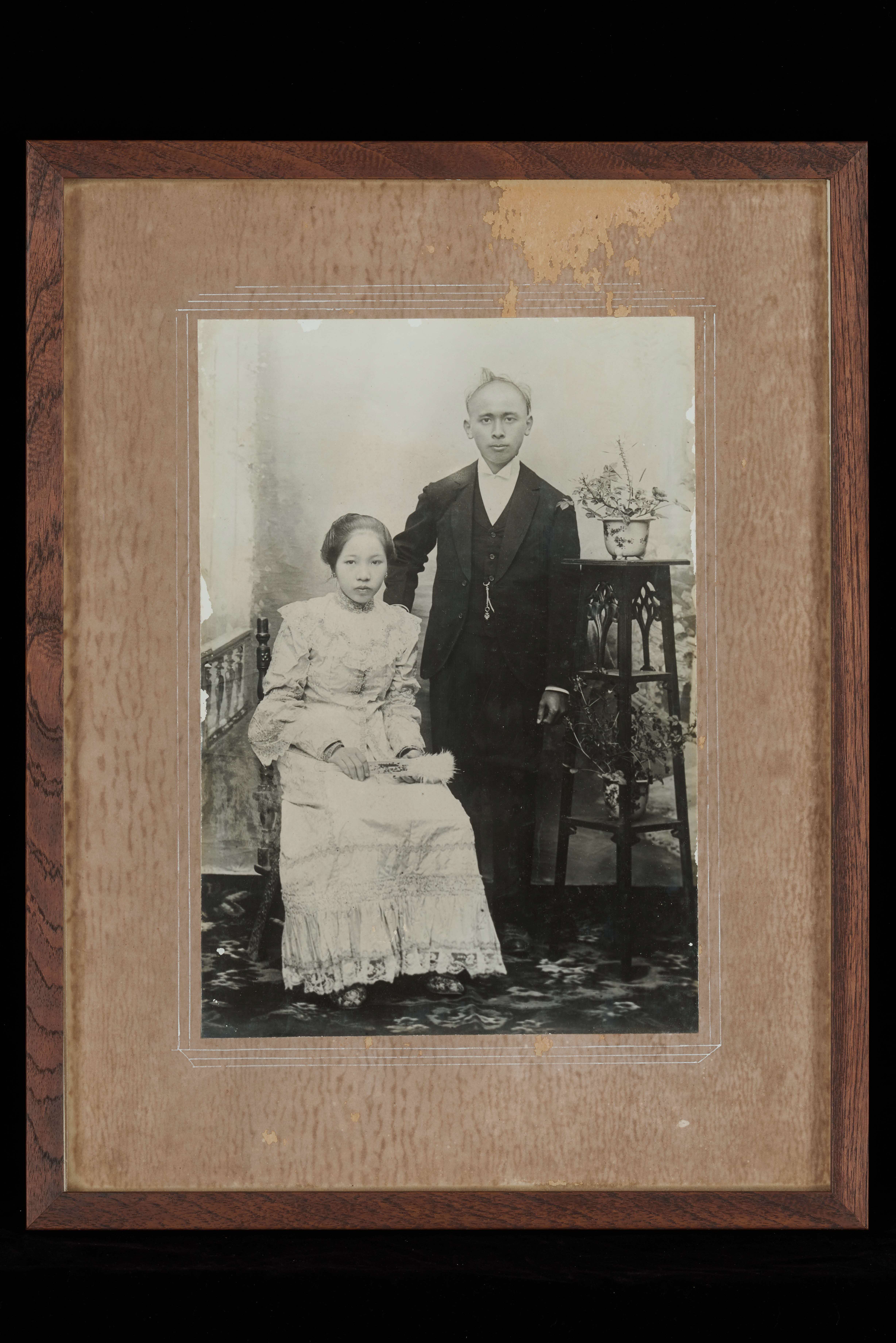
I am not conversant in Baba Malay because my family spoke only English. My late mother’s parents were Peranakans of Chinese and Dayak descent from Sarawak, and my late father’s parents both came from Fuzhou, China. Even after I married Linda Tan Gek Neo, a jati Nyonya born in 1957 to Baba-Nyonya parents from Melaka, we raised our two children, Olivia and Keith, speaking English for convenience.
Baba-Nyonya culture had such vibrancy — adhering to colourful traditions, customs, and practices in the Chinese calendar; watching bangsawan theatre; going for song and dance (ronggeng) parties; composing pantons (traditional Malay quatrains) and presenting them in mellifluous Dondang Sayang (love ballad) melodies; and reading chrita dulu kala (long ago stories) on the Chinese classics. However, Baba Malay is a pale shadow of its former self today. This project steps in to provide a powerful yet fun digital tool that is easily accessible and effective in helping us learn and speak Baba Malay.
.jpg?width=1000&height=707)
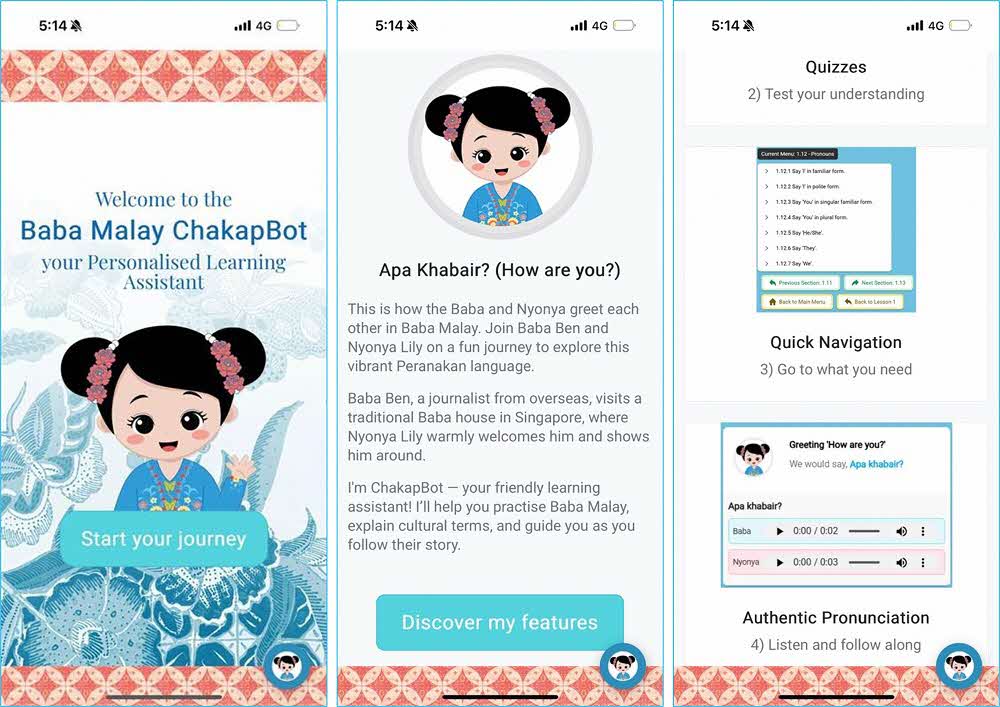
ChakapBot and its features. Image courtesy of Temasek Polytechnic, School of Informatics & IT.
Developing ChakapBot
As early as 2018, as the newly elected President of TPAS, my team and I sought to digitalise the association’s much-loved magazine, The Peranakan. The thought occurred that we could also digitalise Baba William Gwee’s classic, The Baba Malay Dictionary. We turned to Nyonya Josephine Tan, a member of our General Committee, to see if she could help with the digitalisation.
Nyonya Josephine, a senior lecturer at TP, did better. Together with Dr Nalaka Edirisinghe, Deputy Director, Academic & Student Development, she framed practical problem statements for final-year students at TP’s School of Informatics & IT, resulting in a proof-of-concept for a Baba Malay digital dictionary app in 20207. Unfortunately, further development was constrained by limited resources, energy, and the COVID-19 pandemic.
This “lost” project was eventually revived and rebuilt as a chatbot to teach Baba Malay with recourse to the developing Artificial Intelligence (AI) technology. It is also to TPAS’s credit, under my successor President Nyonya Peggy Jeffs, for supporting this groundbreaking project.
What is ChakapBot?
In simple terms, a chatbot is a computer programme that simulates human conversation through text or voice. ChakapBot is a chatbot built around the Baba Malay language.
Speaking on ChakapBot at Peranakan Sayang’s Virtually Peranakan Fest on 13 December 20258, Nyonya Josephine said: “Documentation alone is not enough. (It) stores the language, but it doesn’t help people use it. Dictionaries can’t teach intonation, expression or natural conversation. A language survives only when people speak it, not just read about it.”
ChakapBot was designed to be a “safe space” for youths and adult learners to practice without embarrassment, fitting into their lifestyle — anytime, anywhere, even for just five minutes. It integrates a curated, rule-based syllabus built around the authoritative texts mentioned earlier. Most significantly, every Baba Malay word and phrase within the chatbot is accompanied by a full aural recording, captured from a Baba and a Nyonya who were both home-raised in the mother tongue since childhood. The latter is especially critical in the teaching process as it gives app users the opportunity to hear how Baba Malay words and phrases are enunciated, capturing all the tones, pitch, lilts, trills, and nuances of the language in their full aural flowering of emotions, flavours, colours, and suggestiveness.
By deliberately building a chatbot that closely incorporates the lived experiences of real Babas and Nyonyas, the researchers have given it a certain authenticity and Peranakan Chinese-focused sensitivity that one would not find anywhere else.
.jpg?width=1000&height=766)
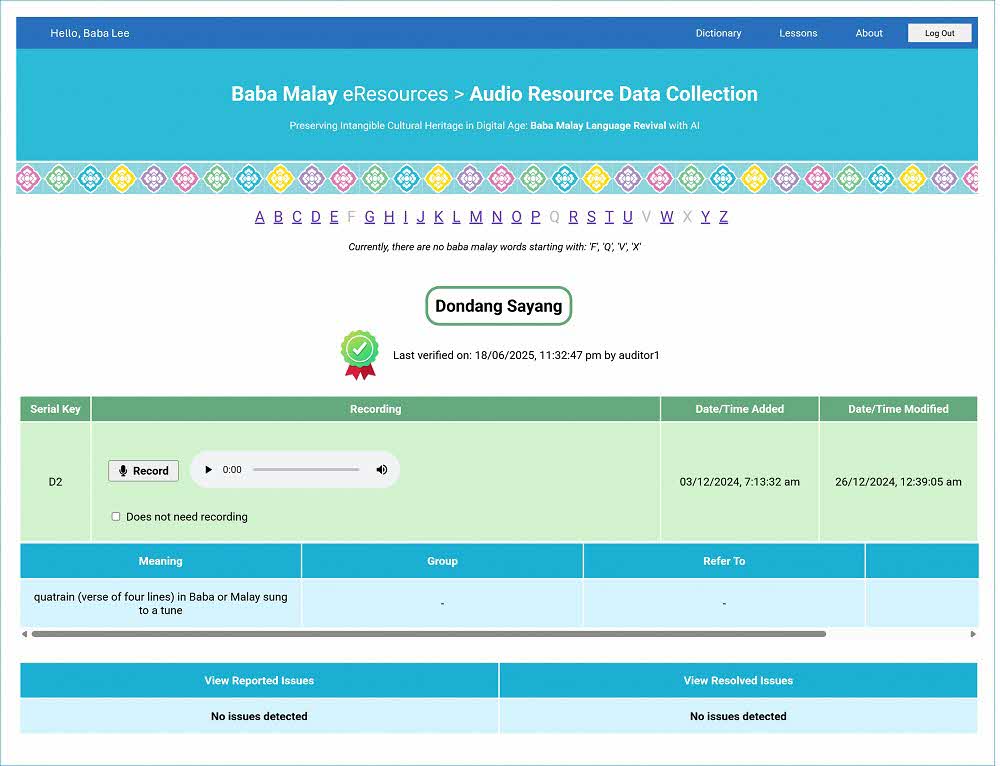
The Audio Resource Data Collection within the Baba Malay eResources platform that allows speakers of Baba Malay to record themselves. Image courtesy of Temasek Polytechnic, School of Informatics & IT.
Navigating the Headwinds
The journey of ChakapBot was a path fraught with scepticism and significant roadblocks. The initial proposal was rejected. Rather than a defeat, this provided a strong impetus for the IT team to refine their vision. They revisited the panel’s feedback with renewed determination, focusing on strengthening linguistic credibility and deepening community involvement.
The team also faced difficult questions from heritage custodians within the community itself. There were valid concerns about whether AI could faithfully capture the linguistic nuances of Baba Malay, and fears that relying on a machine might marginalise the community’s own role in preserving their culture. Doubts were also raised about whether generative AI – trained predominantly on widely spoken, well-documented languages – could handle Baba Malay, a language with a limited body of digital text and few existing training datasets, without producing cultural misrepresentation or translation errors that might put learners off.
To address these, the team adopted a “human-in-the-loop” philosophy. By bringing National University of Singapore Associate Professor and linguist Nyonya Nala Lee on board, they ensured that the AI was validated by human expertise. This partnership transformed the AI from a potential threat into a trusted, safeguarded complement to traditional learning.
Technical and operational setbacks further tested this perseverance. Recruitment for the pilot study was a challenge, with several participant withdrawals. The team responded by adhering to strict ethics-approved protocols and maintaining a waitlist to ensure the study’s size remained robust.
Perhaps the most shocking hurdle occurred just one month before the pilot study launch in June 2025, when the backend cloud services were shut down without notice. This could have been a fatal blow. Instead, the team refactored core components and rebuilt the infrastructure. The team took this crisis as an opportunity to upgrade the architecture to an advanced Generative AI model.
.jpg?width=1000&height=529)
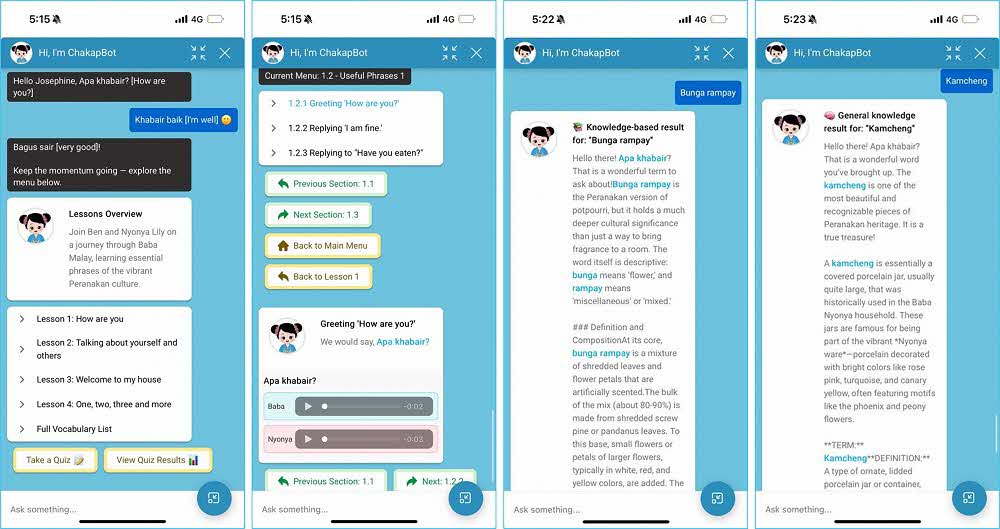
Learn Basic Baba Malay through four curated lessons or explore freely — ask ChakapBot anything about Baba Malay (GenAI-powered). Image courtesy of Temasek Polytechnic, School of Informatics & IT.
Designing for the Heart
Through fifteen user-acceptance testers — including heritage speakers and educators — the team went through over ten major iterations of ChakapBot to ensure optimal usage. They addressed diverse learning needs, such as lower digital literacy and sensory impairments, by adding adjustable font sizes and voice speeds. Distance was no barrier to authenticity either. While the Baba voice was recorded locally, our Nyonya voice talent was residing overseas. To facilitate this remote collaboration, the team developed a bespoke website specifically to capture the recordings. Andy Gwee, son of the late Baba William Gwee, vetted the spelling and pronunciation of the entire ChakapBot syllabus. His involvement ensured that the digital tool remained a faithful extension of his father’s landmark work. This platform will also enable future non-technical contributors to continue to record and validate thousands of Baba Malay words and phrases. Kept intuitive and fuss free, it allowed the community to focus on preserving authenticity so that the voices captured were not synthetic but lived and remembered.
Success in ChakapBot is not just about the code; it is about how users feel when they interact with it. As the UI/UX lead, Nyonya Josephine’s focus went beyond usability and accessibility towards creating emotional connection, making heritage feel approachable, familiar, and alive. This was shaped by her dual role at TP and TPAS, where cultural authenticity is deeply personal.
Designing for heritage, as the team discovered, is different from designing for convenience. It requires sensitivity, trust, and respect for what people hold close. ChakapBot was brought to life through a carefully crafted persona that resonates with the community, a fresh, youthful “anak Peranakan”, a young Peranakan child who feels warm, respectful, and relatable. This transformed the chatbot from a tool into a companion in the learning journey.
Across the chatbot and outreach materials, the experience remained approachable and consistent. Children engaged with ChakapBot as a friend, while older users saw reflections of their own heritage.
In many ways, design became the quiet bridge between technology and tradition. Because when people feel something, they remember it, and when they remember it, they carry it forward.
.jpg?width=1000&height=656)
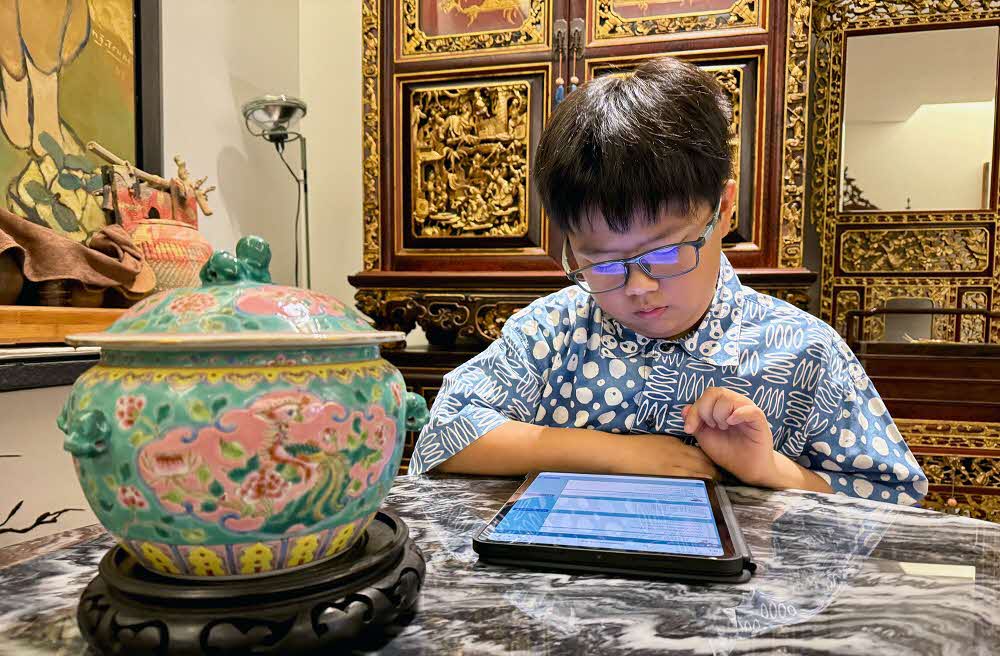
Micah focused, curious and learning at his own pace with ChakapBot. Image courtesy of Colin Chee.
Engaging the Next Generation
This chatbot has been designed to encourage participation among young learners. In their joint research paper on ChakapBot, Nyonya Nala Lee and the ChakapBot’s principal investigator Dr Zhang Huiyu wrote: “It was hoped that the inclusion of an AI chatbot component, capable of effectively and efficiently operationalising existing documentation materials, would appeal to younger learners and foster greater engagement than previous revitalisation efforts.”9
The pilot found that “the participants valued the chatbot for its flexibility, accessibility and low-pressure environment for independent practice, and perceived it as a complement to human-led instruction rather than as a replacement.” Participants also reported using Baba Malay beyond classroom settings, including in the home, workplace, and community events. This development was the most encouraging finding as participants said they have become more confident to use Baba Malay in their everyday lives.
Some touching comments from participants in the pilot include:
“(I) think it would be a good way to bond with the maternal side of my family and to preserve the language that I never got to learn.”
“(It is about) finding the heritage in my family. Understand that my great-grandmother is a Peranakan and wanted to be closer to my roots.”
“…it’s important for me to reconnect with my heritage and the language of my ancestors. Baba Malay is integral to that.”
These are the very objectives that ChakapBot was designed to fulfil. But its legacy reaches further still. In building ChakapBot, the team did not just create an app — they laid the groundwork for something larger: a rigorous, replicable blueprint for heritage preservation. It is a scalable model with room to grow, one that could one day be extended to other endangered languages across the region, from the Eurasian community's Kristang to the diverse mother tongues of the Orang Asli.
Conclusion
Nyonya Rosie Tay wrote the following in her all-Baba Malay book, Bibik-Ni Mak Nenek10:
“I love my Mother tongue — so rich, so clear and lively. It expresses our identity and depicts our rich cultural heritage. It is not difficult to learn to speak the Peranakan language. When I read my stories aloud I can almost hear my Mother, or my Mak-Koh or my Koh Chik.
“The anecdotes record a good example of emotionally loaded conversation which is steeped in idiomatic expressions.
“Unfortunately, the Peranakan dialogue cannot remain truly authentic if the stories are translated. Alamak — it will all be lost in translation! Mana Boleh!
“And so, for our Peranakan literature to be richer, truer, it has to remain pure in its form.”
I believe the ChakapBot team has provided a way for the language to remain pure in its form while finding new life for the next generation. May our Baba Malay language and our culture find renewed vigour and flower.
Edited by Linda Chee, Josephine Tan and Zhang Huiyu
Fact-checked by Ronney Tan
This is an abridged version condensed and adapted from a forthcoming full-length article on the revitalisation of Baba Malay. This project was supported by the National Heritage Board’s Heritage Research Grant.
Notes
- Temasek Polytechnic, National University of Singapore, & The Peranakan Association Singapore. (2025). ChakapBot: The AI chatbot reviving Baba Malay [Web application]. https://chakapbot.web.app
- Gwee, W. T. H. (2006). A Baba Malay Dictionary: The First Comprehensive Compendium of Straits Chinese Terms and Expressions. Tuttle Publishing.
- Gwee, W. T. H. (1993). Mas Sepuloh: Baba Conversational Gems. Armour Publishing.
- Chan, K. Y. K. (2020). Baba Malay for Everyone: A Comprehensive Guide to the Peranakan Language. Wolf et al.
- Chan, K. Y. K. (2019). Chrita-chrita Baba: A Collection of Short Stories in Baba Malay. Wolf et al.
- Lee, N. H. L. (2022). A Grammar of Modern Baba Malay. De Gruyter Mouton.
- Tan, J., & Edirisinghe, N. (2020). Major Project specification [Unpublished internal document].
- Peranakan Sayang. (2025, December 13). Al-yee! ChakapBot? Apa Tu? [Facebook post].
- Lee, N. H., & Zhang, H. (2026). ChakapBot: A generative AI-powered chatbot for the revitalisation of Baba Malay. In K. D. Harrison & L. Lim (Eds.), Innovative methods in endangered language documentation [Special issue]. Languages.
- Tay, R. (2021). Bibik-ni Mak Nenek. Wolf et al.