
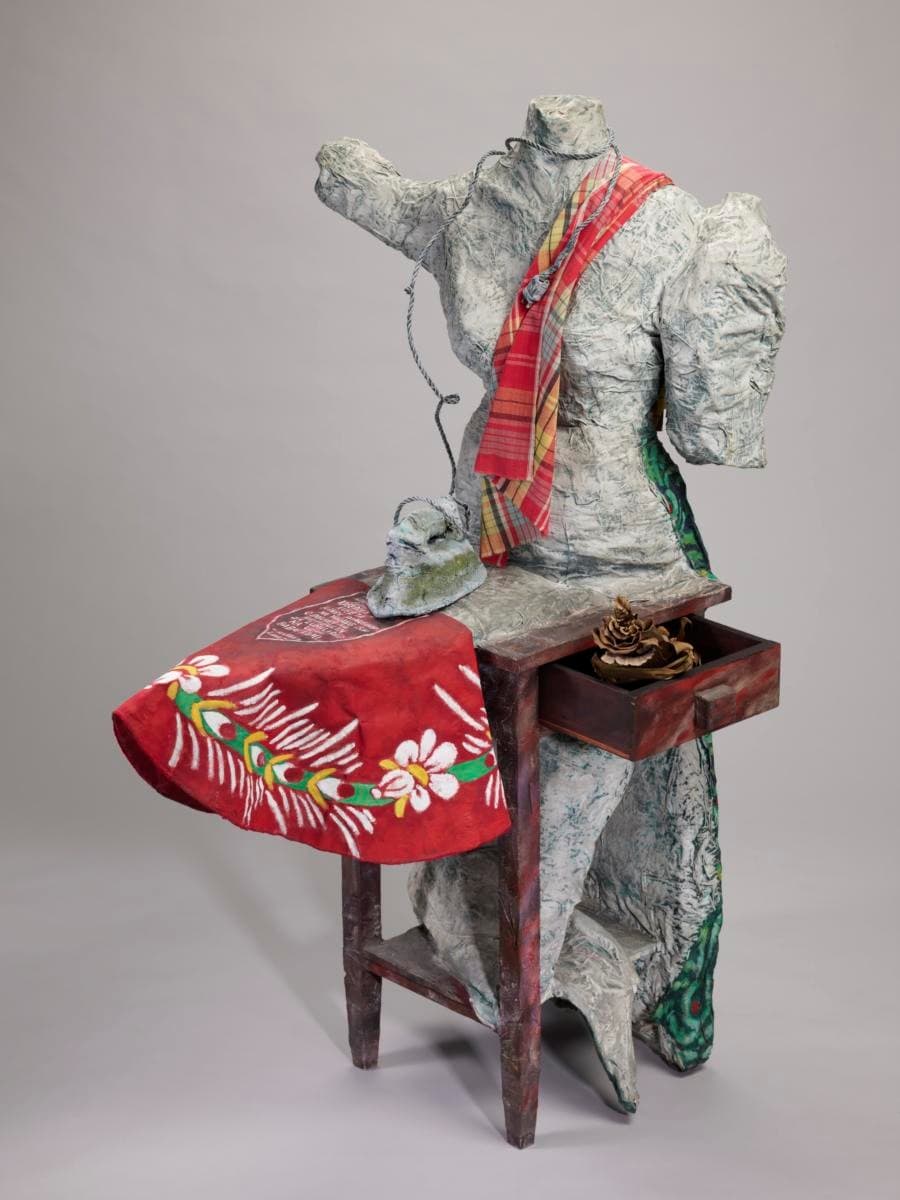
Sa Plantsahan ni Marra (1992), which reads ‘At Marra’s Ironing Board’ in tagalog, embodies the notion of female domesticity. It features a female bust grafted onto an ironing station, with the cord of the iron slung around her neck. These binds are emblematic of how women have been yoked to the domestic realm in Philippine society. Cajipe-Endaya employs the use of materials and patterns to represent the Filipino woman and speak of folk traditions that speak of the craft industry in Paete, Laguna. The figure is garbed in Filipiniana dress, with puffy half sleeves. However, the outfit is made of plasterbonded cloth, giving the entire work a rough-hewn materiality. The entire sculpture is completed by the inscription of Marra’s poem onto the ironing board. Placed within the imprint of the iron, the poem is a moving reminder of the agency of women in society beyond the confines of domesticity or the lens of patriarchy. The work is emblematic of Kasibulan’s commitment to recognizing the role of women in society in an unprecedented way at a time when the Marcos regime was overthrown by the EDSA revolution. First exhibited at the Cultural Center of the Philippines in 1992, this work is also testament to the way the CCP as an institution adapted to survive significant changes in political leadership occurring from the 1980s to the 1990s. Regarding the patterns on the ironing cloth and the rear of the skirt, Cajipe Endaya appropriated the flower and leaves motif from common folk art patterns painted on traditional papier mache toys which women folk do in her hometown of Paete, Laguna.The dress’s sleeves are taken from the Filipina baro’t saya (blouse with butterfly sleeves and long wrap around skirt) typical of native clothing during Spanish colonial times. While the shape and silhouette of the attire cuts across social class, the plaid textile called patadiong, which hangs over her shoulder, as well as the floral patterns all speak of common working class and farming folks.The banana leaves are not peculiar to Paete, but is common practice everywhere here to help smoothen or ease the ironing. The poem inscribed on the ironing board written in Tagalog translated into English reads: Babae Kami (We are Women)Also human, not robots, nor rags; Not casserolesNor toilet bowls,Not mindless dreams,Nor images chased in nebulae.We are women. - Marra Pl Lanot