
TL;DR
Often overlooked as a significant Chinese dialect group in pre-independence Singapore, the “Shanghainese” or Sanjiangren from the provinces of Zhejiang, Jiangsu, and Jiangxi were important players in the woodworking and tailoring industries. This article delves into the history of immigration from the Sanjiang region to Singapore under colonial rule, exploring the ways the Sanjiangren established livelihoods in their adopted homeland.
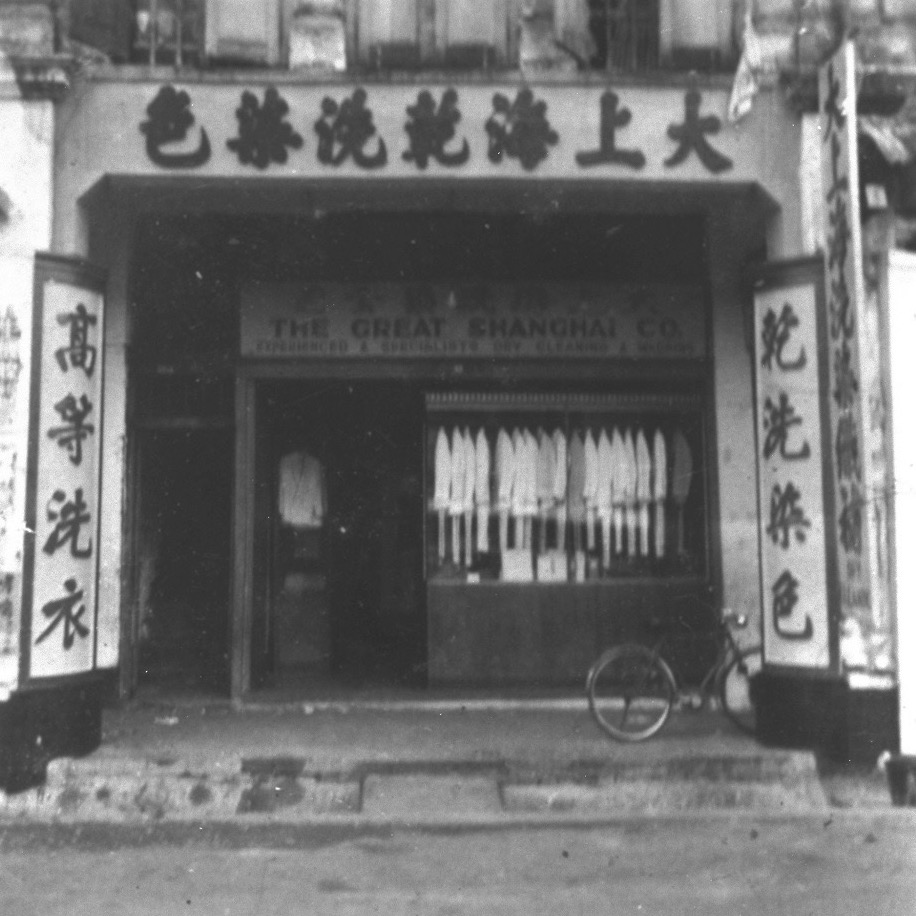
The Great Shanghai Dry-Cleaning & Laundy Co Pte Ltd. Courtesy of National Archives of Singapore.
Unpacking the "Shanghainese" Dialect Group
The Shanghainese were first listed as a distinct Chinese dialect group in the 1957 Singapore population census, with a population of 11,034.[1] Before that, their only mention was in the 1921 census under the category of “Race” as follows: “Chinese from Northern Provinces—Chinese from Shanghai, Pekin and the more Northern parts of China were tabulated under one head: they are chiefly tailors, washermen, and dealers in silk and in skins. They numbered 2,671 in all, 1,386 in the Colony, 977 in the Federated and 308 in the Unfederated Malay States.”[2] In the latest 2020 census—the sixth since Singapore’s independence, and the fifteenth since 1871—the Shanghainese community remains as a minority, with 22,503 individuals, or 0.75 percent of the total of 3,006,769 Chinese resident population.[3]
Unlike the dominant Chinese dialect groups in Singapore—the Hokkiens, Teochews, Cantonese, Hakkas, and Hainanese—the term “Shanghainese” is a misnomer. It refers to a group of Chinese who may not have originated from Shanghai. Known as Sanjiangren (三江人, sometimes Romanised as Sankiang), this group consists of non-southern Chinese that departed from Zhejiang (浙江), Jiangsu (江苏), and Jiangxi (江西). These provinces are located near Shanghai, along the Yangtze River.
Originally a small agricultural village, Shanghai became a treaty port in 1843 with a modest population of just 200,000. It subsequently experienced a significant influx of migrants from neighbouring provinces who were seeking employment or fleeing famine and war. By 1943, Shanghai's population had swelled to five million.[4] For custom officials, anyone departing China from the port of Shanghai was considered a native of Shanghai and referred to as Shanghainese, regardless of the actual place of origin.[5]
There were several waves of immigrants to Singapore from Shanghai. Oral history interviews reveal that many Shanghainese immigrants arrived in Singapore during the 1930s, with some returning to Shanghai to marry or bring their families over either before or shortly after the Second World War. With the establishment of the People’s Republic of China in 1949, another wave of immigrants left Shanghai for Hong Kong, Southeast Asia, and other parts of the world. Thereafter, emigration remained minimal during the 1950s until the late 1970s.[6] Early enclaves of the Shanghainese were situated in Tanglin, Orchard Road, Cavenagh Road, and River Valley Road.[7]
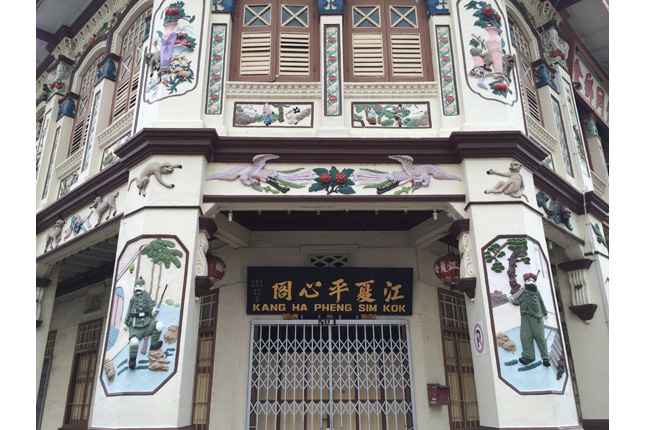
Intrestingly, while Sanjiang is not a place name in China, Sanjiang associations can be found in Japan,[8] New York,[9] Singapore, and Malaysia.[10] Generally, those who were not from Fujian and Guangzhou were often regarded as Sanjiangren. Singapore's Sam Kiang Huay Kwan (新加坡三江会馆) was first founded as the Sam Kiang Public Office in 1906, before adopting its current name in 1927. It serves as the umbrella association for nine related groups, formed according to their trade or place of origin: Shanghai Club (上海公会, 1899 or 1900–), Wenzhou Clan Association of Singapore (温州会馆, 1923–), Kiangsi Association (江西会馆, 1935–), Nanyang Hwa Pek Thung Hsiang Hoey (南洋华北同乡会, 1935–), Ningpo Guild (宁波同乡会, 1937–), Shanghai European Ladies Dress Makers Association (上海西式女服同业会, 1938–), Singapore Chinese Dry-cleaning Owners’ Association (星州华侨干洗公会, 1946–), Singapore Liang Hu Hui Kuan (Association) (两湖会馆, 1947–), and Nanyang Hupei Tien Men Association (南洋湖北天门会馆, 1957–).[11]
Before the establishment of the Singapore Liang Hu Hui Kuan (两湖会馆) in 1947, the community gathered in a few informal establishments. Many Malayan Chinese teachers hailed from Hubei, Hunan, and Zhejiang provinces. One of the earliest Hubei residents, Huang Zexin (黄泽新), arrived in 1921 and opened a clinic at Tanjong Pagar. His clinic, named 汉口药房 after Hankou, a major city in Hubei, became a popular gathering spot for fellow Hubei seamen. Hubei teacher Zhang Qinghe (张清和) set up a school, Huai Qin School (怀亲学校) at Tanglin. The school served a dual purpose: it functioned as a place of worship on Sundays, and as a gathering spot for fellow Hunan and Hubei Christians.[12]
Chinese occupational specialisations were often closely linked to provincial origins, with individuals from specific regions typically engaging in particular trades, industries, or commercial pursuits. The Shanghainese were particularly associated with trades such as carpentry, tailoring, dry-cleaning, piano companies, and bookstores.
Shanghainese Woodworkers
The Shanghainese were famed for their skills in making rosewood furniture. In a survey done by the Wenzhou Clan Association of Singapore in 1953, more than 90% of their members were in the woodworking industry. The majority of them came here as carpenters and they prayed to their patron saint Lu Ban (鲁班先师), who lived in the Warring States period and venerated as a master carpenter and inventor.[13]
Chen Laichang (陈来昌) from Ningbo was one of the earliest arrivals to the Straits Settlements, arriving in Malacca in 1903 before settling in Singapore and opening a furniture shop called Wan Xing Furniture Company (万兴木器公司). He also operated a trading company, Wan Xing National Products Company (万兴国货公司), promoting goods produced and/or manufactured in China.[14]
Shanghainese furniture makers could be found in Victoria Street, Upper Cross Street, and Orchard Road.[15] Cheng Meng Furniture, founded by a Shanghainese entrepreneur, thrived through contract work for the British Army, Public Works Department, offices, homes, and retail businesses.[16] Diethelm & Co. Ltd’s furniture department hired Shanghainese woodworkers. In 1963, these craftsmen worked over 70,000 hours at the furniture workroom off Balestier Road, producing locally designed furniture for the newly established Parliament of Malaysia. These included teak benches for the government and opposition parties, as well as mahogany administrative desks and chairs.[17] In 1966, Deithelm also secured export orders from the United States, Vietnam, and Japan, which were fulfilled by these skilled Shanghainese artisans.[18]
Between the mid-1950s and the early 1960s, there was an exodus of 400 Wenzhou woodworkers to the Netherlands. These artisans had previously lived in rundown two-storey buildings near Kallang Pudding Road, off Macpherson Road, where their carpentry workshops and business premises occupied the ground floor. Upon settling in the Netherlands, many ventured into other businesses, such as Chinese restaurants.[19] The traditional furniture trade met further challenges in the 1970s with the influx of cheap, mass-produced furniture into the consumer market. By 1984, the furniture shops in Victoria Street had been vacated, and the Shanghainese carpenters and craftsmen who once supplied these shops with teak furniture from their Geylang and Kallang workshops had either passed away or retired.[20]
.JPG) Furniture shops along Upper Cross Street. Urban Redevelopment Authority Collection, courtesy of National Archives of Singapore.
Furniture shops along Upper Cross Street. Urban Redevelopment Authority Collection, courtesy of National Archives of Singapore.
Shanghainese Dry-cleaners
In the early 1950s, over 75% of the 70 dry-cleaning businesses in Singapore were owned by Shanghainese who had received training in Shanghai. They had a reputation for their reliability and quality of work.[26] The earliest mention of a Shanghainese cleaner in the press was in 1918, when Ong Yiew Sun, a “Shanghai dhoby” reported the theft of fifty dollars' worth of clothing to the police.[27] Before the war, most of the Shanghainese dry cleaners’ customers were Europeans. They were also contracted by prestigious establishments such as the former Government House, the Raffles Hotel, Seaview Hotel, and Adelphi Hotel. When the Shanghai-based 1st Battalion, Middlesex Regiment was transferred to Singapore in 1935, an additional 32 Shanghainese dry-cleaners were hired to manage the increased workload.[28] However, the industry faced challenges over time. A lack of successors and the advent of faster and cheaper self-service machine washers, high rental costs, and expensive equipment, led to a rapid decline in the number of Shanghainese dry-cleaners.
Shanghainese Tailors
Xu Jinsheng (徐金生) was one of the earliest Shanghainese tailors to set foot in Singapore, with his apprentice Ding Ronghua (丁荣华) in 1923. The wife of the British General Manager of the Hongkong and Shanghai Bank was so impressed with his dressmaking skills that, when they were relocating from Shanghai to Singapore, she convinced him to follow them as well. Whenever Xu returned home for visist, he would bring along fellow tailors on his return trip to Singapore. Right before the war, there were about 400 Shanghainese tailors in Singapore, mostly working in Orchard Road, Killiney Road, Cairnhill Road, Stamford Road, and High Street. The tailors’ patron saint is the Xuan Yuan Emperor (轩辕黄帝), who according to legend was the inventor of farming, agriculture, clothing and music, among other things.[21]
Most Shanghainese tailors worked in backrooms, for only a few had their own shops. Some found work at departmental stores such as John Little and Robinsons, while others worked at High Street’s Indian dressmaking shops, like Chotirmall. They would share their earnings with their bosses at an agreed rate.[22] Being highly mobile, they would go whenever better job opportunities arose.
Shanghainese tailor See Kwei Sung was entrusted with a special task in 1953: to dress Elizabeth Choy, wartime heroine of Singapore, for Queen Elizabeth II’s coronation. He created an oyster-grey satin cheongsam embroidered with three purple-toned Chinese dragons and the Chinese characters “Long Live the Queen; may there be universal peace 女皇万岁 天下太平”.[23] By the 1980s, these Shanghainese tailors had become a “vanishing trade”, lacking successors and facing competition from fast fashion. Despite this decline, there were classes organised specifically on Shanghainese dressmaking for non-Shanghainese tailors. Some shops adapted to changing times: one turned to selling Chinese porcelain and curios when the tailor could no longer sew, while Shanghai Kwei Sung Tailor turned to selling tourist souvenirs when business waned in the late 1970s.[24]
One exception is CYC Shanghai Shirt Company, founded by Shanghainese tailors Chiang Yick Ching (CYC), and his wife, Mdm Foo Ah Neok in 1935.[25] The company remains famous for their custom-made shirts and corporate wear even to this day.
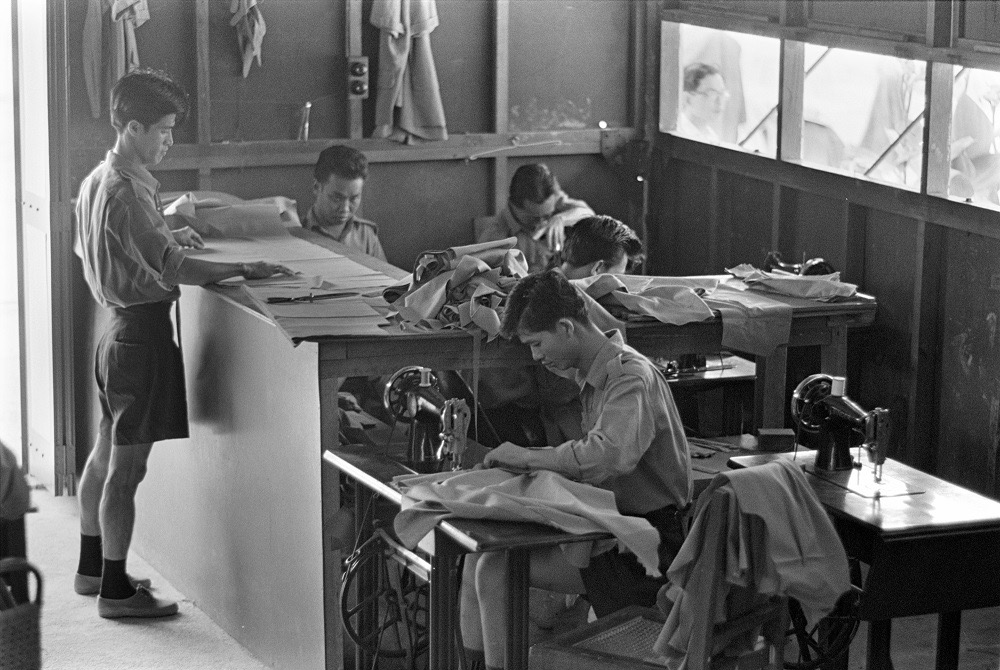 General view of tailors in a shop. Ministry of Information and the Arts Collection, courtey of National Archives of Singapore.
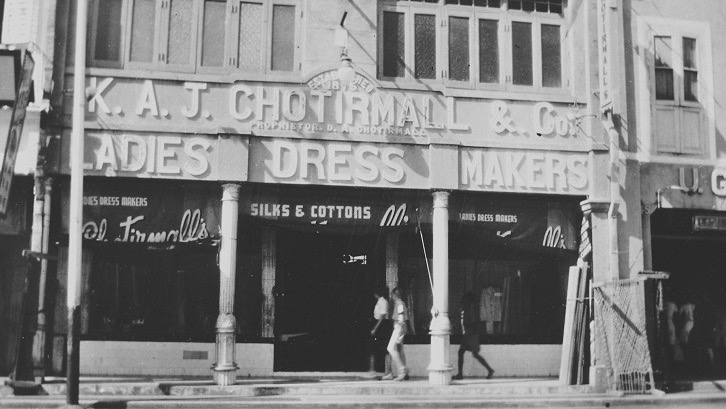
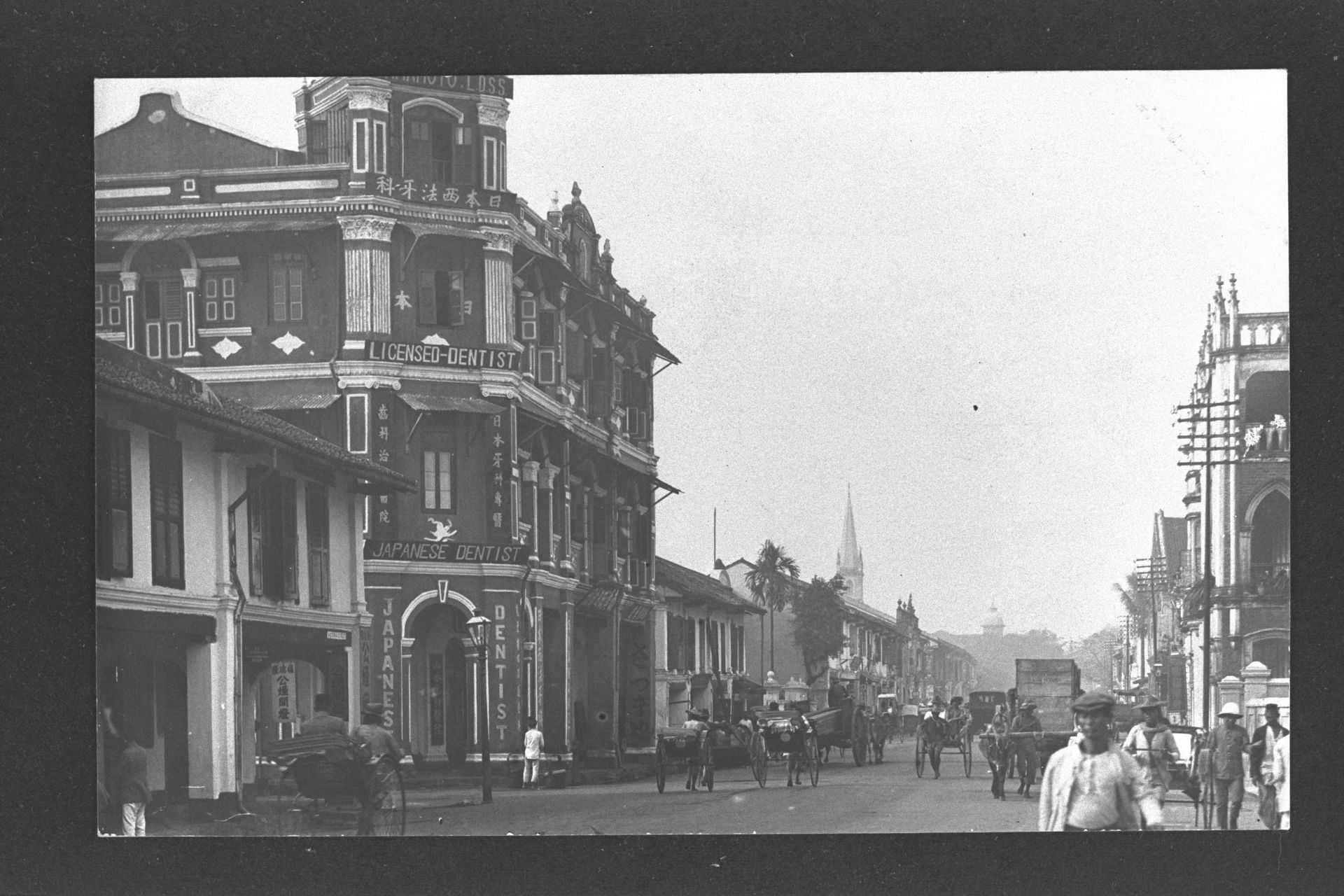
Chotirmall along High Street, c.1945. David Turner Collection, courtesy of National Archives of Singapore.
Other Shanghainese Trades
Historically, the majority of Shanghainese in Singapore belonged to the working class, with just a small number of businessmen among them. When they arrived, they would typically seek out friends and relatives for accommodation and jobs. Although they were closely identified with carpentry, tailoring, and dry-cleaning, Shanghainese immigrants were also involved in a diverse range of other trades.
The Shanghainese established various enterprises in Singapore, including trading companies such as Kiauw Hin & Co. Ltd. (侨兴国货有限公司) that sold national goods. At one point, the piano industry in Singapore was monopolised by the Ningboese. Some optical shops were also opened by Shanghainese. Chinese bookshops such as The Shanghai Book Company (上海书局) founded in 1925 by Shanghainese Chen Yoh Shoo (陈岳书) and Wang Shu Yang (王叔旸) played a major role in nurturing generations of students by providing Chinese textbooks and reading materials.[29] Before the war, The Commercial Press (商务印书馆) was affiliated with Zhejiang, and Chung Hwa Book Co (中华书局) was associated with Jiangsu. These bookshops were popular social gathering spaces for Shanghainese from the cultural and educational fields.[30]
Lea Hin Company established since 1935 by Ningbonese Woo Kai Lea (胡嘉烈), was not engaged in a traditional trade associated with the Shanghainese. It dealt primarily in kerosene stoves, pressure lanterns, pressure oil tanks and burners under their "Butterfly" trademark. The company has since diversified into other businesses and is still flourishing today.[31] The prominent Shaw Brothers, also from Ningbo, built a formidable movie empire in Singapore. By 1965, they owned 19 cinemas in the country.[32] In 1957, they established the Shaw Foundation, which has since distributed over US$150 million to support education, welfare, medicine, arts and heritage initiatives.[33]
Shanghainese enclaves gradually disappeared with urban redevelopment. Traditional businesses either diversified into new ventures or ceased operations as their owners retired. Clan associations continue to play an active role in unifying the Shanghainese through various activities.
Today, the descendants of the original Singaporean Shanghainese families continue to excel in their own fields, creating new Singaporean Shanghainese stories alongside a new wave of Shanghainese migrants. These diverse narratives contribute to the evolving tapestry of Singapore’s colourful cultural landscape.
Notes
[1] Singapore. Department of Statistics. (1964). Report on the census of population 1957. Singapore: Printed by Govt. Printer, pp. 155-156.
[2] J. E. Nathan, superintendent of the 1921 census, British Malaya. (1922). The Census of British Malaya: (the Straits Settlements, Federated Malay states and protected states of Johore, Kedah, Perlis, Kelantan, Trengganu, and Brunei), 1921. London: Dunstable and Watford, p. 84.
[3] "Census of population 2020 Statistical Release 1: Demographic characteristics, education, language and religion." Singapore: Department of Statistics, Ministry of Trade & Industry, p. 49. Last reviewed 13 November 2024.
[4] 姜龙飞. (2008). 上海租界百年. 上海: 文汇出版社, p. 2. (Call No.: R 951.132 JLF)
[5] Tham Yuen-C, “Shanghainese Enjoys Mini Revival in Singapore,” Straits Times, 26 January 2017, 8.
[6] Han Enze. (2024). The ripple effect China's complex presence in Southeast Asia. New York: Oxford University Press, p. 117.
[7] Choo Cheng Meng, oral history interview by Pitt Kuan Wah, 30 August 1984, transcript and MP3 audion, 27.22, National Archives of Singapore (accession no. 000472), 444.
[8] 张秋生, "历史与文化视域下江苏华侨华人史发展的基本特点探析," 国务院侨务办公室《侨务工作研究》编辑部, accessed 2 December 2024, http://qwgzyj.gqb.gov.cn/yjytt/230/3785.shtml
[9] San Kiang Charitable Association New York, "Special issue of the 90th anniversary of the San Kiang Charitable Association," accessed 2 December 2024, https://www.skcany.org/九十周年特刊
[10] Huatuan Online, "Sanjiang Malaysia," accessed 2 December 2024, https://www.huatuan.asia/my/clan/sanjiangmalaysia
[11] "三江会馆百年史," 三江会馆, accessed 19 December 2024, https://www.samkiang.org/?page_id=11
[12] 新加坡两湖会馆. (1967). 新加坡两湖会馆庆祝二十周年纪念暨筹募新会所基金游艺大会特刊. 新加坡: [出版社缺], p. 43.
[13] 新加坡温州会馆四十周年纪念特刊 = Wen Chow Wei Khan, Singapore, 40th anniversary, 1923-1963. (1963). 新加坡: 新加坡温州会馆, p. 40.
[14] 新加坡三江会馆慈善晚会纪念特刊. (1981). 新加坡: 新加坡三江会馆, p 40.
[15] The gregarious Chinese, Malaya Tribune, 2 April 1949, p. 5.
[16] The furniture king of Singapore, The Straits Times, 26 May 1985, p. 1.
[17] Malaysia's MPs will sit on S'pore-made seats, The Straits Times, 21 August 1963, p. 9.
[18] Export orders, The Straits Times, 20 April 1966, p. 12.
[19] T.F. Hwang takes you down Memory Lane. The Straits Times, 21 February 1987, p. 20.
[20] The end of Furniture Row, The Straits Times, 16 December 1984, p. 7.
[21] 侯仰军,“黄帝 中华“人文初祖”,” 《人民日报海外版》,2016年05月31日, 第 10 版, http://paper.people.com.cn/rmrbhwb/html/2016-05/31/content_1683774.htm
[22] 区如柏. 总督夫人身上穿一针一线缝出头, 联合早报 (Lianhe Zaobao), 15 May 1988, p. 38.
[23] A 3-dragon dress for the Coronation, The Straits Times, 1 May 1953, p. 7.
[24] A dedicated breed, The Straits Times, 10 February 1985, p. 10; Tailor now sells curios, grows bonsai, New Nation, 5 August 1980, p. 9; The last old Orchard row, The Straits Times, 9 February 1992, p. 2.
[25] CYC Made to Measure, "Tailors with a heritage," accessed 2 January 2025, https://cyctailor.com/pages/heritage
[26] Dry cleaners do big business — but their costs are high, The Singapore Free Press, 3 April 1951, p. 5.
[27] Untitled, The Singapore Free Press and Mercantile Advertiser (1884-1942), 25 February 1918, p. 4.
[28] 李秉萱,李国生和李玮编. (2001). 三江百年文化史纪念特刊. 新加坡: 三江会馆, p. 57.
[29] 李秉萱,李国生和李玮编. (2001). 三江百年文化史纪念特刊. 新加坡: 三江会馆, p. 76. (RSING q369.25957 SJB); Teo Han Wue, "How the Shanghai Book Company enlivened Singapore's cultural scene," Think China, accessed 4 January 2025, https://www.thinkchina.sg/culture/how-shanghai-book-company-enlivened-singapores-cultural-scene.
[30] 许云樵. 四十年前的書業, 新明日报 (Xin Ming Ri Bao), 11 April 1973, p. 8.
[31] Lea Hin Co. (Pte) Ltd. "Our story," accessed 4 January 2025, https://www.butterflyleahin.com/Our-Story
[32] Shaw Organisation, "Singapore, post war," accessed 4 January 2025, https://shaw.sg/postwar
[33] Shaw Organisation, "The Shaw Foundation," accessed 4 January 2025, https://shaw.sg/shawfoundation