
TL;DR
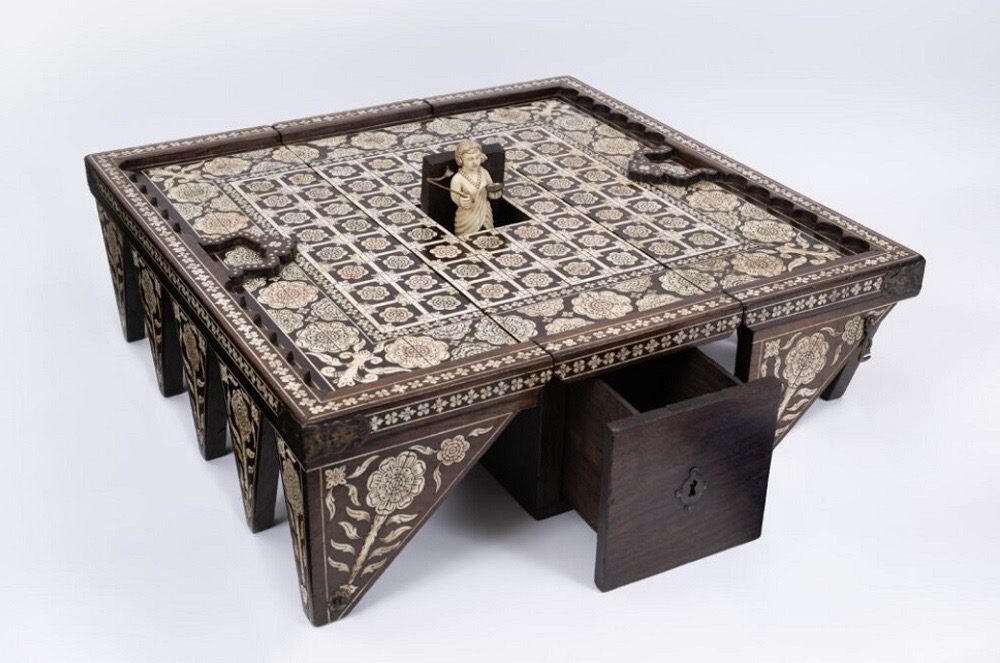
A six-sided bone die is at once a familiar and intriguing object at ACM’s newest special exhibition, Let’s Play—The Art and Design of Asian Games (5 September 2025 – 7 June 2026). Found in the remains of a 9th century Tang-era shipwreck discovered in the Java Sea, this unassuming object is at once a reminder of the antiquity, ubiquity and mobility of games across Asia. Featuring over 150 games and game-related objects, the exhibition explores the development, transmission, and design of board games that first emerged in Asia.Folding Games Board. Western India, second half of the 16th century, Indian rosewood, teakwood, ivory, coloured mastic, Asian Civilisations Museum, 2025-00617
Games and play are old as civilisation itself. They emerged as ways to pass time, test skill and foster connection. They have been metaphors for life, tools of diplomacy, and expressions of power and status. Games have been discovered in archaeological excavations across the ancient world—from China to the Indus Valley and Mesopotamia to Egypt. Over time, many games crossed borders and evolved into new forms, shaping global game traditions in ways still felt today. Although many ancient games are now lost, records suggest that they once served purposes as varied as divination, military training, and political commentary. The games in the exhibition are viewed through the many roles they played in society, how they were perceived in their social contexts and the impact they had on individuals and communities.
Games and gaming objects are also presented as works of art, embodying the finest of Asian craftsmanship and design. While the simplest materials—shells, seeds and stones—could be used for play, game boards and pieces also incorporated expensive woods, ivory and precious metals into beautiful, ingenious objects, transforming pastime into aesthetic encounter.
By bringing together works that are both familiar and unfamiliar, the exhibition reveals why play, in its many forms, remains a vital and enduring part of life.
The Pursuit of Thrills and Lessons in Morality
At their core, games are about fun. Games of chance and strategy, which are some of the oldest known games in the world, have captivated players for thousands of years. The rush of winning, the suspense of the next move, and the lure of uncertainty make these games thrilling, but also addictive. Poetry, literature and historical accounts warn of the dangers of these games, including the Gamblers Lament in the Rigveda (1000-600 BC) and the edict banning ban-sugoroku in Japan in 689 AD. Few stories capture this tension better than the Mahabharata’s legendary game of dice. When Yudhishthira, the noble Pandava king, wagers away his kingdom, wealth, and even his wife, the roll of the dice becomes a moral lesson on temptation and downfall.
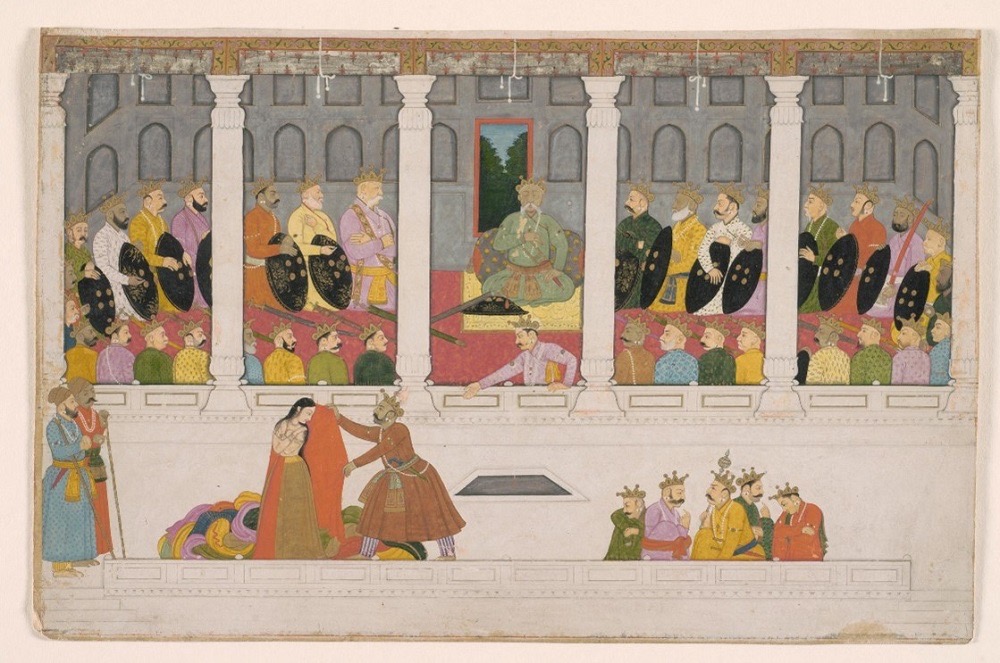 The Humiliation of Draupadi. India, Guler style, 18th century, Gouache on paper, Asian Civilisations Museum, 2009-01832
Despite this, most of these games, including various types of dice and card games, and race games like chaupar and backgammon, were popular among all social classes. Chaupar, for example, one of the most popular games of the Indian subcontinent, was a favourite of the Mughal emperor Akbar, and documented by court historian Abul Fazl in the 16th century. It was brought to England by the early 19th century, where it eventually became the well-known children’s game, Ludo.
The unpredictability of dice and cards conversely led to these games being associated with divine intervention. A lucky win would be viewed as a signal of divine favour; a loss, cosmic disapproval. The result of some games was also seen as divinatory, pointing the way to one’s future. Games like hulu wen,
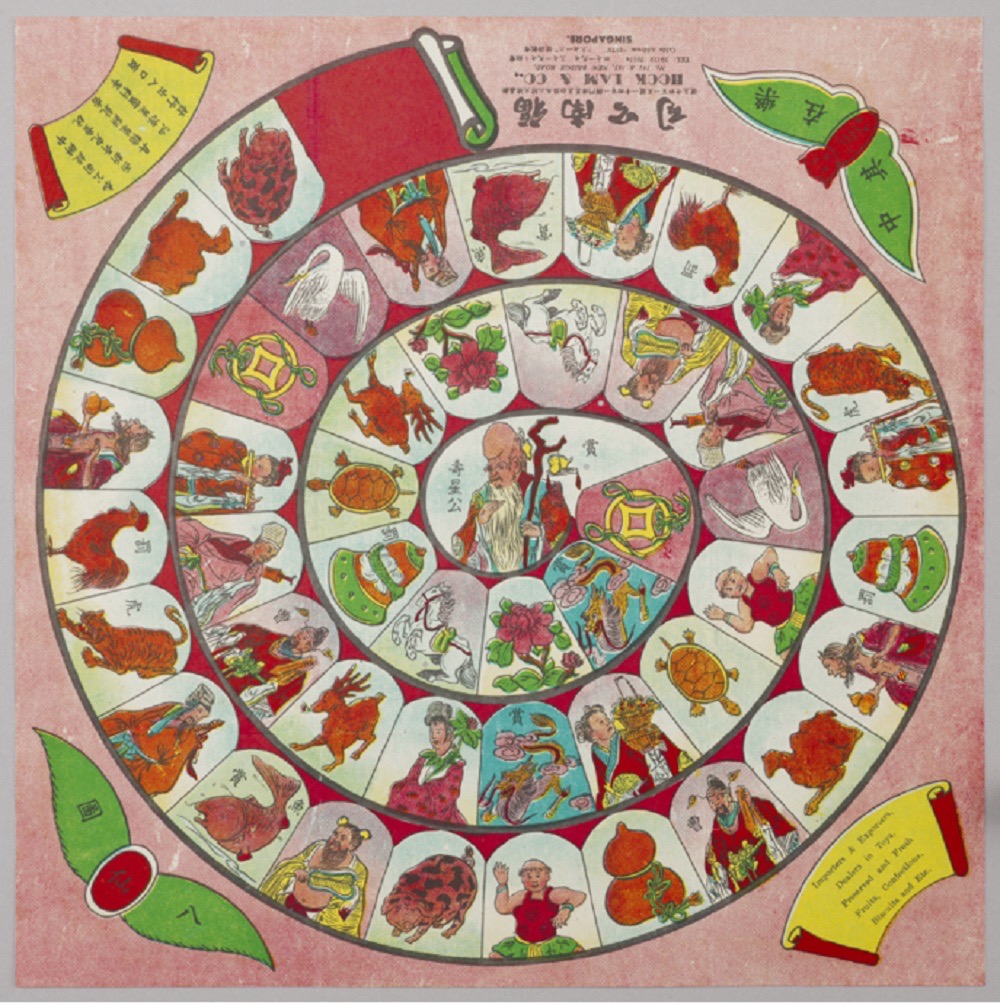 Hulu Wenboard. Singapore, mid-20th century, Paper, National Museum Singapore, 1995-01354
a race game where the winner is the first to reach the god of prosperity, were played during the Chinese New Year, as a way to foretell what the new year will bring. Some of these games also became educational tools. Gyan chaupar, the original form of snakes and ladders, was created by Jain and Hindu communities in Western India to teach moral lessons to the player. Each square of the board describes an attitude or action that can lead to an elevation to heaven through a ladder, or demotion to hell via snake bite. The game board serves as a metaphor for life, reflecting its uncertainties and rewards. Whether played for amusement, fortune-telling, or moral education, these games encapsulated the human experience in all its contradictions.
Cultivating the Self
Beyond the quirks of luck and skill, many games were prized for their role as instruments of learning and self-cultivation. Board games such as weiqi, chess, and xiangqi have long been well-regarded as tools for training intellect and strengthening character. Conceived as models of military strategy, these games transformed the playing surface into a space of contemplation, where each move tested foresight, balance, and restraint.
The earliest of these games is weiqi, also known by its Japanese name, go. Originating in China between 2500 and 4000 years ago, weiqi became one of the “Four Arts” of the cultured gentleman, alongside calligraphy, painting, and music. Played with black and white stones on a grid of intersecting lines, its simple geometry hides infinite depth. Each game unfolds like a meditation on balance, discipline, and restraint. As weiqi spread to Korea and Japan, it evolved into a cornerstone of courtly and samurai culture, eventually institutionalised under state patronage. Weiqi soon transcended the gaming board to become a cultural motif. Scenes of players in gardens, painted on lacquerware, porcelain, and in printed books, evoked ideals of retreat, companionship, and scholarly refinement.
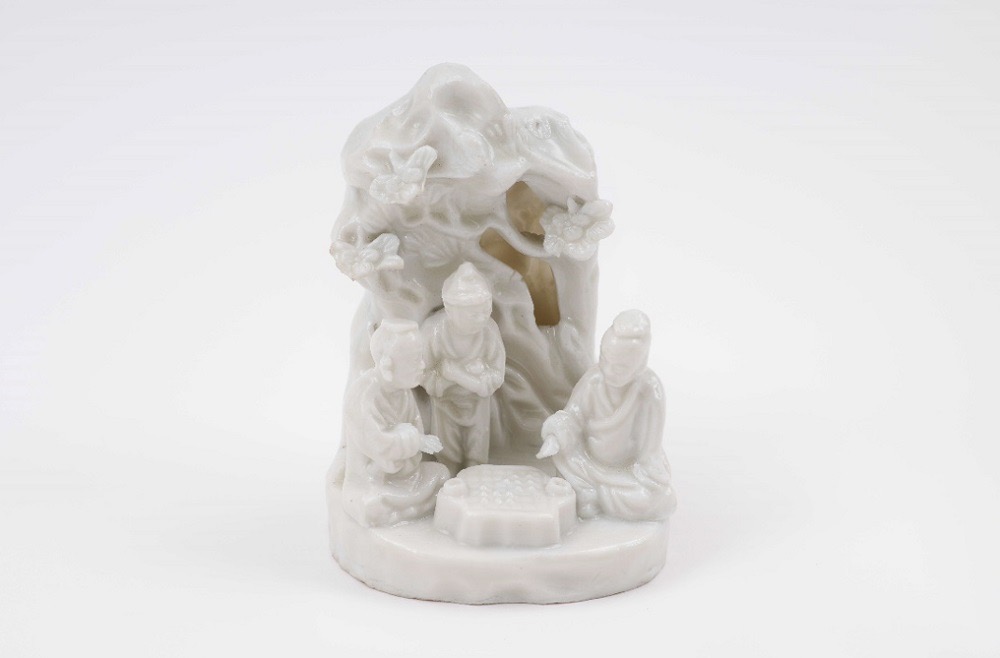 Chess players in a grotto. China, Dehua, Qing dynasty, 18th century, Porcelain, Asian Civilisations Museum. Gift of Frank and Pamela Hickley, 2000-03375
Further West, chaturanga—the precursor of modern chess—originated in India by the 6th century. A didactic war game whose Sanskrit name referred to the army’s four divisions of infantry, cavalry, elephants, and chariots, it was adopted as shatranj in Persian courts by the 7th century. From there it travelled westward to North Africa and Europe, and eastward through Central and Southeast Asia to China and Japan, evolving into local forms such as catur, shatar, makruk, and shogi. From the beginning, the game was played on an 8 x 8 grid, but piece names, rules and strategies evolved to reflect local contexts. Design, too, adapted: in the Islamic world, pieces were abstracted into aniconic forms,
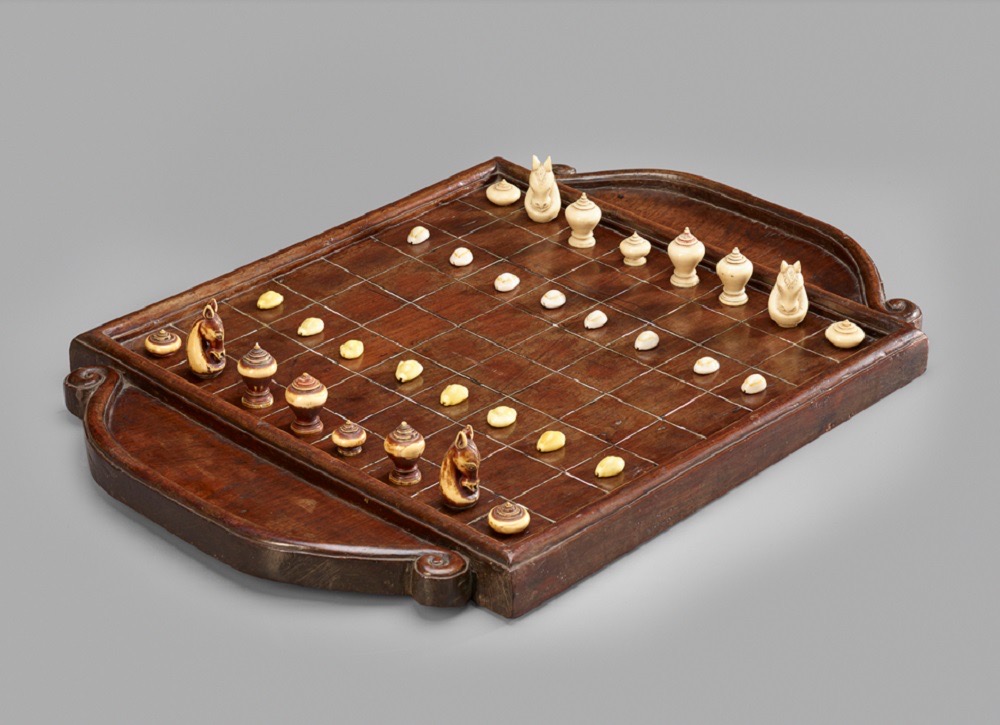 Ouk chatrang (Cambodian chess) set. Cambodia, 19th century, Wood, mother-of-pearl, shell, Asian Civilisations Museum
while in South and Southeast Asia, figural sets continued to be carved and even exported, testifying to the game’s dual life as both an intellectual discipline and an object of artistry.
Xiangqi (Chinese chess), sometimes called the “Elephant Game” after a lost manual attributed to Emperor Wu Ti (Northern Zhou, 557–581), is a two-player war game. While the earliest reliable reference dates to the Tang dynasty, the game’s modern form was established during the southern Song dynasty. Played on a 9 × 10 grid divided by a central “River” and flanked by opposing “Palaces,” the board evokes the Chu–Han Contention—a civil war that followed the collapse of the Qin dynasty in 206 BCE. Unlike most other chess variants, xiangqi’s pieces are discs of the same size, differentiated by inscribed or painted characters.
Weiqi, chess, and xiangqi are games of pure strategy, where victory depends on foresight and intellect rather than chance. These games have become some of the most widely played in the world, both competitively and as tools for intellectual mastery.
Design and the Future of Play
Throughout history, games have adapted to shifting cultural values, living conditions, and technologies. Designers across Asia continue to reinterpret traditional games through contemporary materials, digital tools, and modern sensibilities. In Singapore and beyond, a new generation of creators draws on regional heritage to craft innovative, globally resonant games, from Jakarta Traffic, a wry nod to urban chaos, to Steam Up, a joyful celebration of dim sum culture.
The future of play is also being shaped by technology. The 2016 defeat of world go champion Lee Sedol by Google’s AlphaGo marked a turning point – the moment machines proved capable of surpassing human intuition in even the most complex strategic realms. Yet rather than ending the game, it opened a new chapter: humans now study AI’s moves, learning from it and evolving with it. The exhibition engages these questions directly through robots equipped with AI that can play go and chess against visitors.
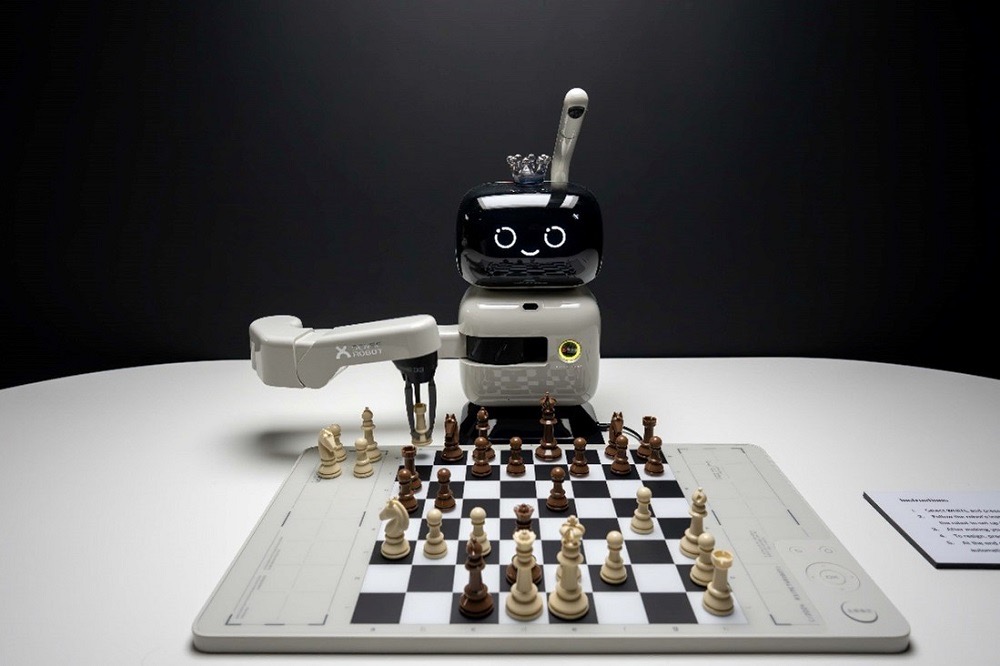 AI-powered chess robot on loan from the Singapore Chess Federation
As Let’s Play reminds us, the story of games is the story of humanity itself—of creativity, competition, and connection. Whether carved in wood, painted on silk, or coded in algorithms, every game is a metaphor for the human experience, one that continues to invite us, across time and culture, to sit down, take our turn, and play.
Let’s Play! The Art and Design of Asian Games is open at the Asian Civilisations Museum from 5 September to 7 June 2026.
Games and Community
Many games are a part of the rhythms of daily life, played at home, during festivals, or at gatherings that bring families and communities together. Games like congkak in Southeast Asia became a beloved communal pastime, deeply associated with this region, its traditions and memories. However, like many others, it was a product of cultural exchange and migration. Originating as mancala in the Arab world and East Africa, congkak travelled along Indian Ocean trade routes, taking root from south India and the Malay world to the Philippines, becoming firmly established by the 17th century.
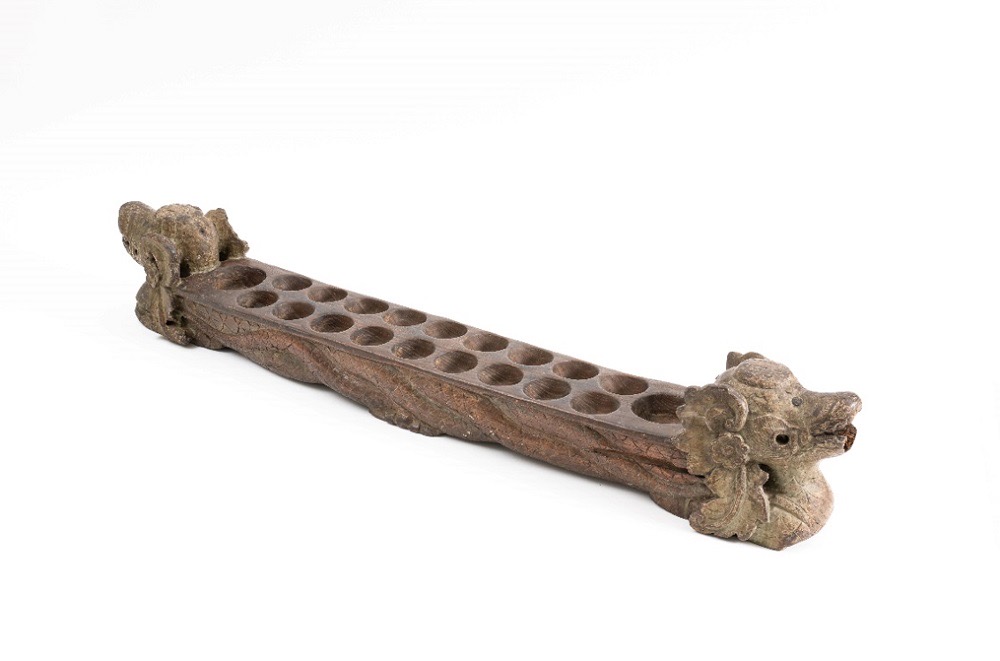 Congkak board. Sumatra, Batusangkar, probably 20th century, Wood, Asian Civilisations Museum, XXXX-10902
Despite its many names (congkak, dakon, sungka, pallanguzhi), the essence remains the same: players move shells or stones across carved wooden boards, gathering and redistributing them to emerge victorious.
Meanwhile, mahjong emerged in 19th-century southern China and soon became a cultural phenomenon, played in teahouses, nightclubs, and family parlours. By the 1920s, it had swept across the world, sparking a “mahjong mania” in the United States so fervent that animal bones were shipped back to Shanghai to meet demand.
Playing games together has also shown to have myriad benefits, from social cohesion to cognitive health. Games test the mind and memory as much as reflexes. Japanese matching games, such as kai-awase (shell matching)
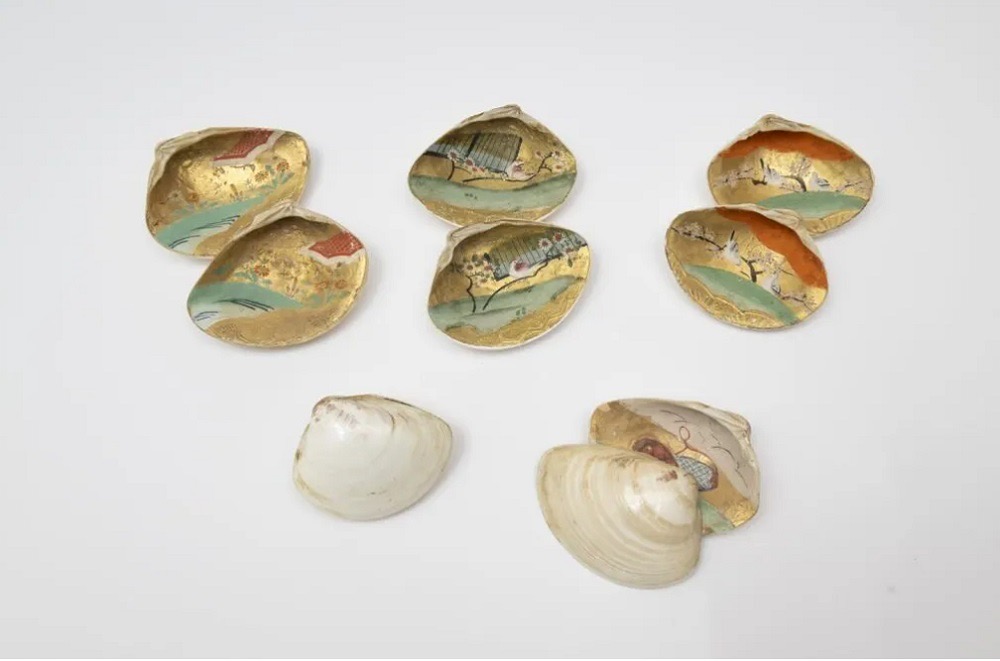 Kai-awase shells. Japan, Edo period, 19th century, Shell, Asian Civilisations Museum, 2025-01053 to 2025-01057
and Hyakunin isshu karuta (“one hundred poems, one poet each”) combine a knowledge of literarature, art and performance. Players must find matches of images in the case of kai-awase, and poetry, for hyakunin isshu, relying on their recall and speed to win. Carrom, popular across South and Southeast Asia, is associated with the pleasures of home and community, where skill and precision striking of discs across a polished board is balanced by teamwork and camaraderie.