
Taoism, Buddhism and Community Rituals in Chinese Funerary Practices
Birth, marriage, and death mark the 3 major milestones in life for many cultures, and for the Chinese, death is paradoxically taboo. It is almost always associated with bad luck and treated with caution because death carries with it the danger of pollution. Despite this, death rites and rituals are performed with great care to ensure continuity for the deceased loved one and the living family members, reinforcing the belief that the proper treatment of the dead is as important as the treatment of the living (事死如事生 shi si ru shi sheng).
Influenced by Buddhist and Taoist precepts, most Chinese death rituals reinforce karmic laws and Confucian principles of filial piety (孝 xiao) and ritual propriety (礼 li) that instruct individuals on their conduct at home, in society, and even in their afterlives. These elaborate rituals are observed and performed in strict accordance not only for the dead to successfully transition into a revered ancestor, but also for their descendants so that they may return to their community after the mourning period.
Geographic Location
The tenets of Confucianism guide the maintenance of order both at home and in society, and the emphasis on filial piety and order means that some form of ‘universal’ standard of death rituals is to be expected, with room for some regional variations across mainland China. These variations, along with the basic or non-negotiable set of death rituals, then become ways for many early Chinese migrants to Singapore to retain their sense of self and identity even as they are separated from their families in faraway lands.
For many of them, mutual aid from clan associations and informal communities formed among language or provincial groups ensured that essential rituals (and any notable regional variations) were performed when they passed on. In Singapore, “Sick Receiving Houses” and “Death Houses”, most famously found on Sago Lane up till the 1960s, offered the less affluent migrants some form of palliative care and later, funeral services.
Associated Social and Cultural Practices
Death Rites and Rituals
Across Taoism, Buddhism and Chinese folk religions, death rites and rituals comprise the following (and more) across these broad stages:
- Preparing the body
When a death has occurred, family members begin to stop all clocks in the house and proceed to cover all mirrors and reflective surfaces to prevent the deceased’s soul from catching their own reflection. Any deities on the household’s altar are to be covered with red paper to avoid exposing the gods to death and disrespecting them.
Preparations for the funeral begin and the body of the deceased is bathed, embalmed, and clothed. The deceased is then robed in a burial garment 寿衣 shou yi, and a pearl is left between their lips to ensure their safe passage. Meanwhile, 2 pairs of white lanterns (a big and a small) are purchased and hung at the threshold or at the wake to signal that death has occurred in the household, with the deceased’s age written on the larger lanterns. Due to the desire and preference for longevity, a common practice 死人灯笼抱大数 si ren deng long bao da shu by many Chinese is to increase the age by 3 years.
In the meantime, the wake venue is prepped for the casket to be displayed, and ritual objects and other funeral paraphernalia are arranged in the void deck or funeral parlours.
- Commencing the funeral 开丧 kai sang
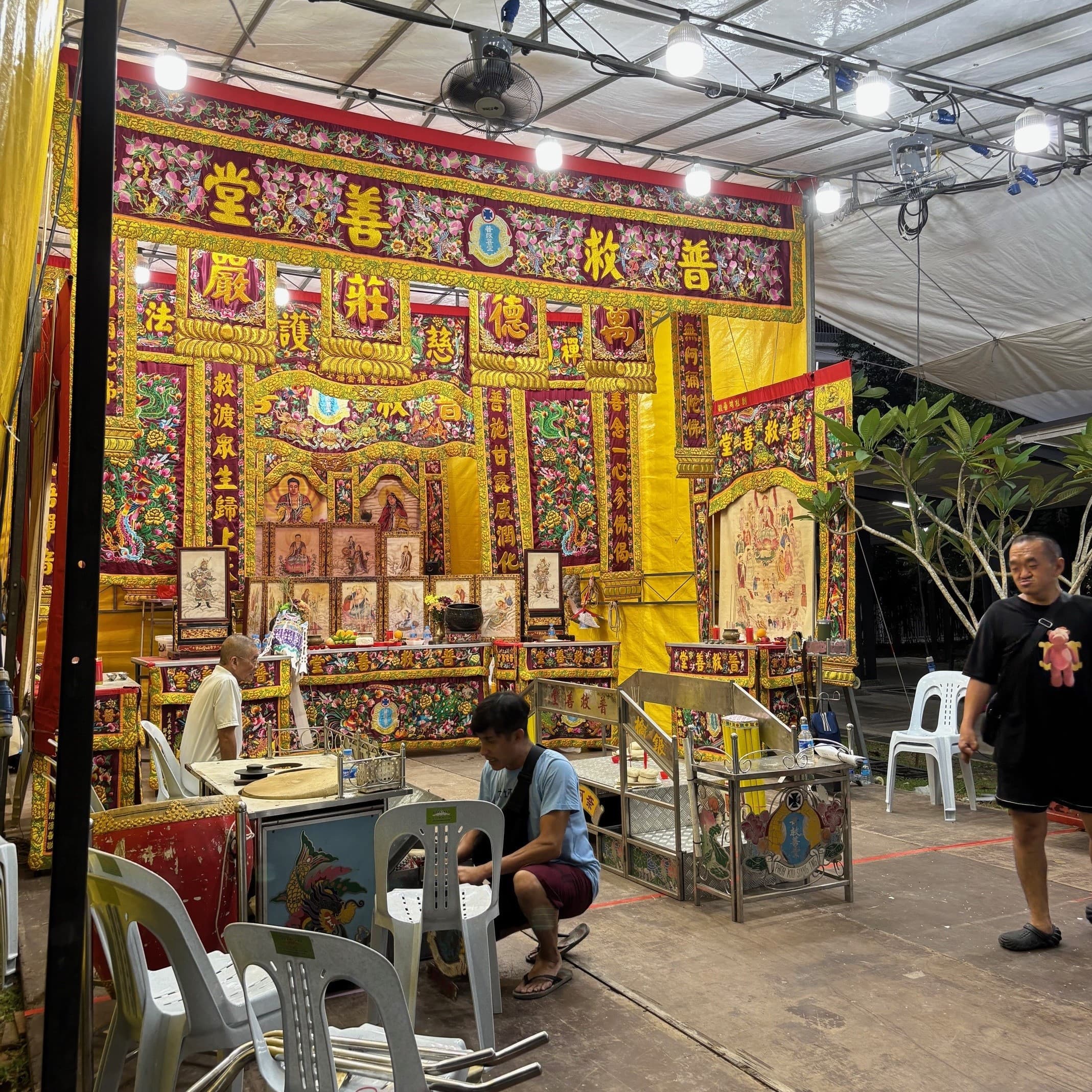
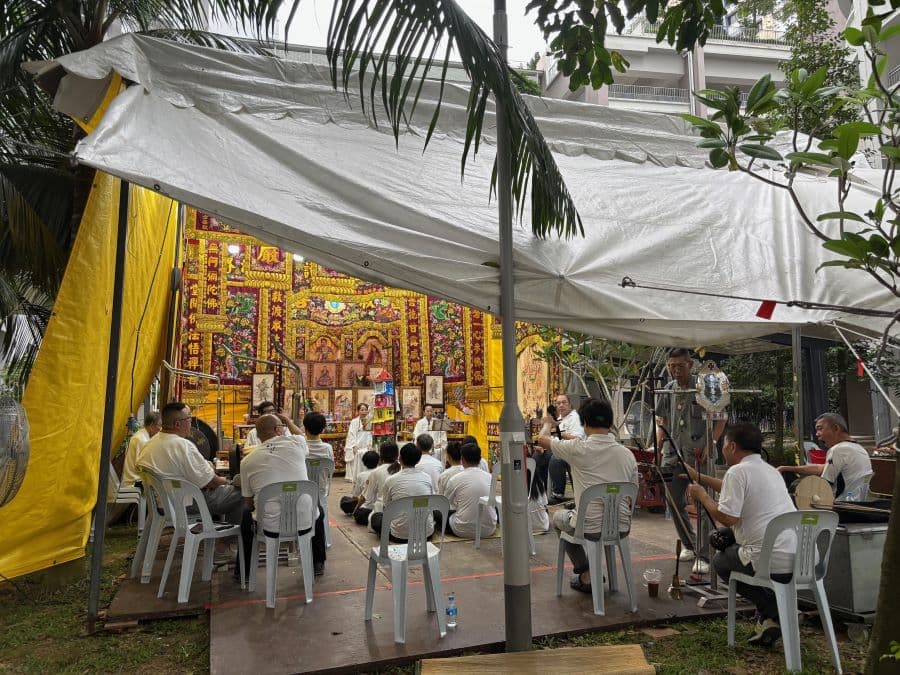
Once everything is in order, ritual specialists, with the aid of experienced funeral directors, commence the funeral and mourning officially begins. The Taoists, for example, would engage a priest or what many refer to as 喃呒佬 nam mo lo to perform “开路”kai lu, a ritual to “open” the road to the netherworld. He calls on the spirit to attend the wake and begins a series of salvation rituals conducted over several days to ensure the soul of the deceased finds their way to their ancestors, emphasising the maintenance of familial ties and obligations even in death. 倒头经 dou tou jing is usually chanted by the priest on the first night of the funeral to help the deceased realise what has happened, and to be able to begin their transition journey.
- Keeping vigil 守灵 shou ling
Bound by their duties to care for the deceased whose death is not yet finalised (since the soul may not yet realise the demise of its body), family members keep vigil during the 3-7 day wake to ensure the body is protected from harm, and to serve the deceased as if they were still alive. Sons and daughters are tasked to put together basic toiletries and offer food and drinks to the deceased daily, prepare paper offerings for the final send off, and participate in the performance of certain rites to guide the deceased safely through the Ten Courts of Hell/underworld so that they can be reincarnated or transit into an ancestor successfully.
The scriptures (or sutras for the Buddhists) recited in many of the religious rites and rituals often carry with them lessons on morality and filial piety, and they serve to remind descendants of the sacrifices the deceased parent has made for them. Many of the Taoist rites and popular rituals are performed in dialects due to regional variations brought over by the early migrants.
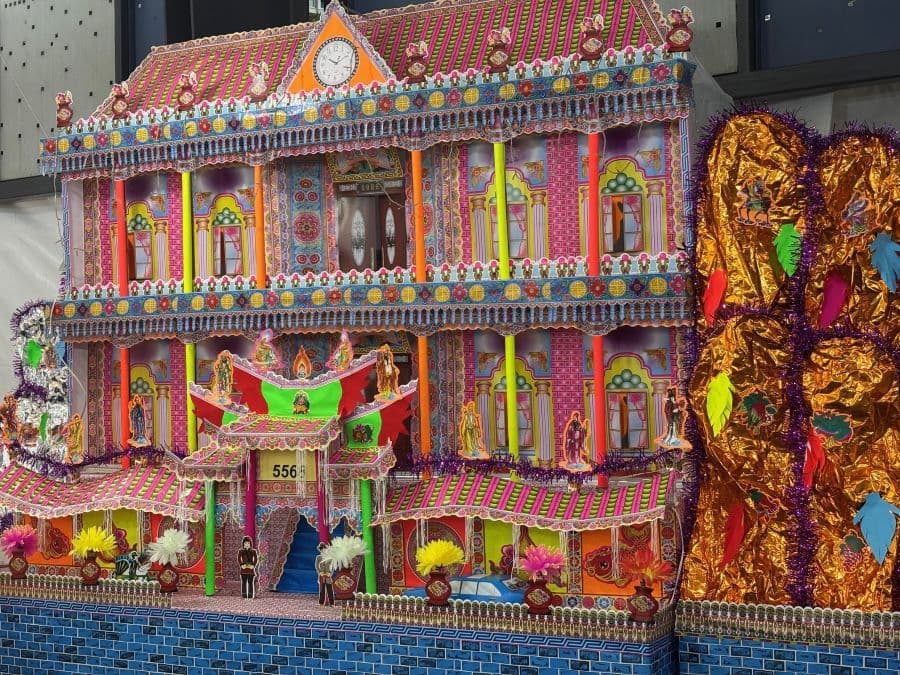
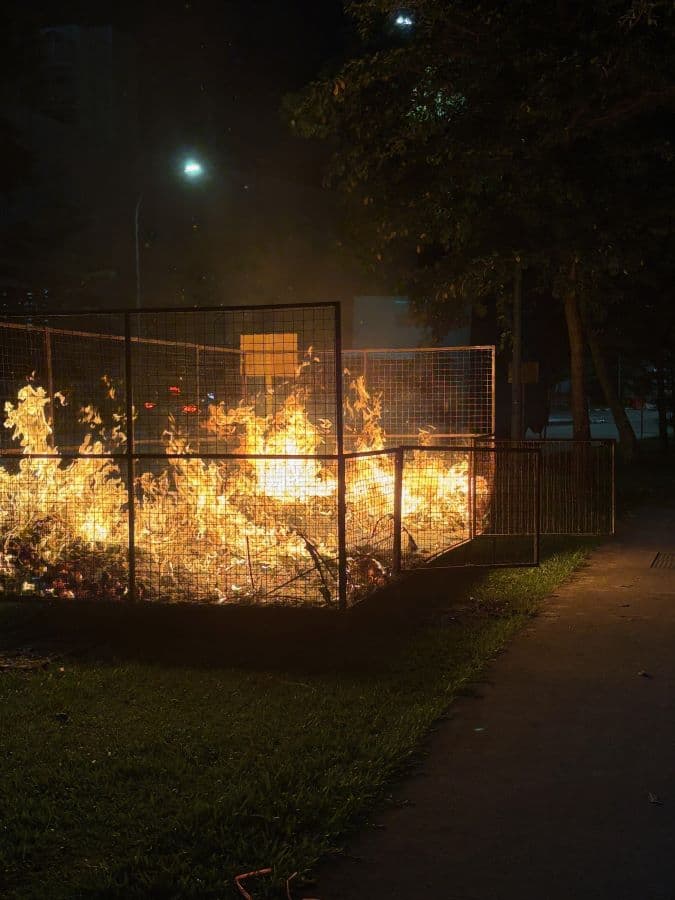
For individuals who died untimely or violent deaths, a special ritual known as Hell-breaking 破地狱 po di yu is performed to free their souls from being trapped in the Court of Unjust Deaths 枉死城 wang si cheng. This ritual is physically and mentally demanding as the priests ‘free’ the trapped soul from a paper model of the Court of Unjust Deaths through a series of sprints and jumps over a huge fire, and this is no doubt the most spectacular death ritual. While the Hakkas practise this ritual with large sand dragons, Hell-breaking is mostly associated with the Cantonese and is still practised regularly in Malaysia, Hong Kong, and Taiwan alongside still being practiced, though less commonly so, in Singapore.
- A grand procession to burial or cremation grounds 风光大葬
On the day of burial or cremation, relatives and friends pay their final respects before the casket is moved onto the hearse, with each of these actions guided by the funeral director and ritual specialists. Descendants follow the hearse as it makes its way to the burial ground or crematorium, and are lined according to their gender and rank in the household.
Unlike the rest of the death rituals and religious rites that are kept private, the funeral procession invites public viewing.
Another element of the funeral procession is the raising of the son-in-law banner 女婿旐 nu xu zhao in the 起旐 qi zhao ritual. Except for the Teochews, this ritual is practised by most Chinese dialect groups in Singapore. At the start of the procession, a 9 ft long red banner tied to bamboo poles is raised by the son-in-law of the deceased, and they, together with this banner, lead the hearse and fellow mourners to the burial ground or crematorium. Pasted on this son-in-law banner are wordings (in black if the deceased is below 100 years of age, and gold if above) that detail the name of the deceased and the merits they had earned while alive.
Traditional hearses, also referred to as 纸灵车 zhi ling che, were lorries decorated with papier máche flowers and other decorative elements. A lion at the top of the hearse signals to onlookers that the deceased was male, and a crane for female. For Buddhist funerals, a lotus flower may be used regardless of the deceased’s gender. These hearses are themselves a visual spectacle, and when accompanied by funeral bands, performers such as “flower girls” 提花蓝 ti hua lan, dancing mascots (also known here as 大头娃娃 da tou wa wa), and stilt walkers, ensure the deceased is sent off on their final journey with glory and their descendants earning approval for this public display of filial piety.
As the hearse reaches the burial ground or crematorium, rituals specific to burial or cremation are performed, and the body of the deceased is lowered into the ground or sent for cremation, marking the end of the funeral. The descendants set up a temporary altar at home for the next few weeks and continue to offer food and incense to the deceased as they complete the process of death and transition.
- The soul returns 回魂日 hui hun ri
Many from the Chinese community believe that the deceased’s soul returns to the world of the living on the seventh day 头七 tou qi of their passing. The Cantonese, however, believe that the deceased’s return differs according to their date and time of birth and death.
The family prepares a feast, ensuring the rice container is filled to the brim and the house is in order on 回魂日 before they retire for the night. The abundance of food is meant to assure the deceased that all is well at home and that they can reincarnate without worry. Some families would scatter flour or ashes on the ground in the hope of detecting ‘footprints’ that confirm the deceased had indeed returned.
Ritual Objects
Ritual objects are integral to the successful performance of death rites and rituals. In particular, the often seen paper money and offerings are used by many in the Chinese community. Paper money, such as the 金银纸 jinyin zhi, ‘river money’ 溪钱 xi qian, 往生钱 wang sheng qian with printed Buddhist scriptures to guide the deceased are burned to help them pay for a safe journey through the underworld in order to successfully reincarnate or even better, break the cycle to achieve true liberation. The offerings of material needs such as houses, cars, and clothes allow for an easier transition into life after death, where one is allowed to continue to exist with familiar material objects.
Everyday objects also take on special significance in death rituals. Take, for example, the comb that is used in the comb-splitting ceremony 分梳 fen shu conducted for when a young couple is involved. For this ritual, the young widow breaks the comb that is symbolic of the marriage and connection between husband and wife. Most expect the widow to keep her half of the comb and express her unchanging connection to her deceased husband and his family. The widow who wishes to remarry in future will instead leave both pieces in the coffin to signal that the union ends at this moment. The comb that gains significant meaning during the hair combing ceremony for the young couple at their wedding now becomes a symbol of their connection even after death.
Since death carries with it the danger of ‘pollution’, many assume that all ritual objects and paraphernalia are ‘tainted’ and therefore should be treated as dangerous too. However, certain ritual objects were considered otherwise. For example, the funeral notice 丧耪 sang pang that informs mourners of important information about the deceased and some specifics of the funeral. Putting up the 丧耪 signals to all that the funeral has commenced and descendants are notallowed to remove their mourning clothes until the deceased has been buried or cremated. However, because this piece of paper has been handled by a Taoist priest, it was thought to have healing properties. Ailing individuals of lesser means would visit funeral parlours on Sago Lane in the past to ask to tear off a piece of the 丧耪, burn it and mix the ashes with water for consumption in the hope that they would find relief from their illness.
Another ritual object that carries with it positive qualities is the son-in-law banner used in the 起旐 ritual. While the Hokkiens do not retain the banner after the funeral, the Cantonese would bring the red banner home (sans the printed wording) to use as a swaddle or carrier for babies as they believed that the banner brings with it good intentions and blessings for the descendants. Some, however, do not continue with this practice and would depend on the funeral directors to dispose of the banner.
Communities Involved
In Singapore, these rituals, rites and funerary practices are mainly observed by believers of Taoism, Buddhism and those who continue to practise ancestor worship. Supported by an ecosystem of ritual specialists (Taoist priests, Buddhist monks, ‘Vegetarian aunts’ 斋姑 zhai gu) and industry professionals such as funeral directors or advisors, many Chinese in Singapore continue to care for their dead while balancing the need to preserve their cultural and regional heritage and adapting to changes in modern day living.
Experience of a Practitioner
Teochew Lor Kor refers to the art of brass drums bands as performed at Taoist funerals, specific to the Teochew dialect group (with versions from other groups being known as Hokkien Lor Kor, for example) and was brought over to Singapore from Chaozhou, China. Lor Kor itself translates to ‘drum’, and the beating of the drum serves two purposes. Firstly, to ward off evil, and secondly, to provide an appropriately grand sendoff for the departed, in celebration of their life.
The practice has been preserved, performed and taught by the Bao Sheng Fu association, founded in 2015 by Gerald Tan, who have carried on their practice from 2018 till today – steadfastly adapting to the challenges and opportunities of the increasingly urban nature of Chinese funerary practices. For instance, adapting to Singapore’s urban density by putting on shorter performances to maintain volume levels within residential areas. Alongside Teowchew Lor Kor, the association also regularly trains in and performs Lion Dance and Dragon Dance. However, the latter two cannot be performed at funerals.
Mr Tan and his troop’s dedication to Teochew Lor Kor stems from service to the community. The temple and worship services maintained by the association eventually saw members of the community who wanted to send off their relatives and loved ones with the Teochew Lor Kor as part of their death rites and funerary practices. The troop consists of 30-40 members on average, and in efforts to ensure the longevity of the troop, Mr Tan has invested his time into training the next generation of practitioners and opening up the practice by welcoming trainees from any community or religious group. The association has also evolved the practice both materially and substantively – utilising LED lorries, for instance, and incorporating Teochew Lor Kor into Shen Jiang (a Taoist funerary ritual) practices to keep young people engaged.
One such youth trainee is Kishore, a Sec 1 student from Jurong Ville Secondary School currently training with the Bao Sheng Fu association, having felt warmly welcomed by the troop after being introduced to it by a friend. Kishore’s guidance under his master has taught him not just about Teochew Lor Kor, but also similarities between his culture and that of his teammates – for instance, similarities in faith, as both Taoism and Hinduism believe in gods for Hell and gods for Heaven, as well as similar figures across both cultures, such as those of the monkey god. To Mr Tan, such cultural exchange is key to keeping the Teochew Lo Kor practice alive.
Watch: The Last Journey
Viability and Future Outlook
Production of Ritual Objects
The emphasis on a respected, if not grand, funeral alongside the extensive use of ritual objects also means that Chinese death rites and rituals direct the ritual economy (such as the production of paper offerings, buying and selling of religious and ritual items) in Singapore. Death, with its rituals and practices, thus involves a wider community of practitioners and crafts persons.
Urbanised Funerary Practices
In the past, most death rites and rituals were conducted in the privacy of the home. Funeral parlours were not popular sites for wakes as they were perceived to be where the destitute or ill-fated (the poor, the unmarried, young children) were laid to rest, as they either had no family to undertake rituals on their behalf or were unable to arrange for a decent funeral prior to their passing. The urbanisation of Singapore, with smaller household sizes and enmeshed community life within HDB estates, has since eased the community into the practice of holding the funeral wake at the housing block’s common void deck or multipurpose halls. Undertaker practices and professional funerary service providers have also become increasingly standardised, so it is no longer shameful for the wake to be held in funeral parlours or, otherwise, in public.
The changing landscape also meant that some of the traditional rituals have to be adapted to the modern ways of living. Most notable is the adaptation of the 买水 mai shui or 担幡买水 dan fan mai shui ritual which involves the chief mourner (usually the deceased’s eldest son) carrying the 幡 fan (a lantern with an attached white banner used to guide the soul) to a river to ‘buy’ water from the river god so that he may use the water to clean the deceased’s body. The lack of access to a river was circumvented by going to the village/kampung’s standpipe for water, and later, to the common tap installed at the HDB void deck. This ritual of buying water is now mostly performative, as cleaning and prepping the deceased’s body can only be done by a licensed embalmer.
Changing family demographics and multiculturalism have also shifted the approaches to understanding and practising death rituals. Religious freedom, in some cases, has resulted in family members within the same household practising different faiths. This diversity drives the demand for more neutral and simpler funeral set ups, even when the rituals are religious. The increasing number of individuals who do not identify with a particular religion has also driven demand for ‘free-thinker’ funeral packages and services that include essential and secular death rituals. Yet, even as the preferences for types of funeral and death rituals change, the concept of filial piety and propriety remains constant for many Singaporean Chinese – resulting in the mixing of secular and religious practices.
References
Reference No.: ICH-107
Date of Inclusion: March 2026
Content Contribution
Principal Investigator: Dr Lye Kit Ying
Co-Investigators: Dr Janice Kam Foong and Dr Terence Heng
With video contributions from Republic Polytechnic (RP) School of Technology, Arts, Media and Design
Students involved: Lim Kantaphon, Jay Wang Zi An, Duru Chima Anurika and Farizz Ridzhuan Bin Shaiful Azman
References
Lye, K.Y., & Heng, T. (Eds.). (2024). Death and the afterlife: multidisciplinary perspectives from a global city. Routledge. https://doi.org/10.4324/9781003344858