
Making and Wearing of Tanjak
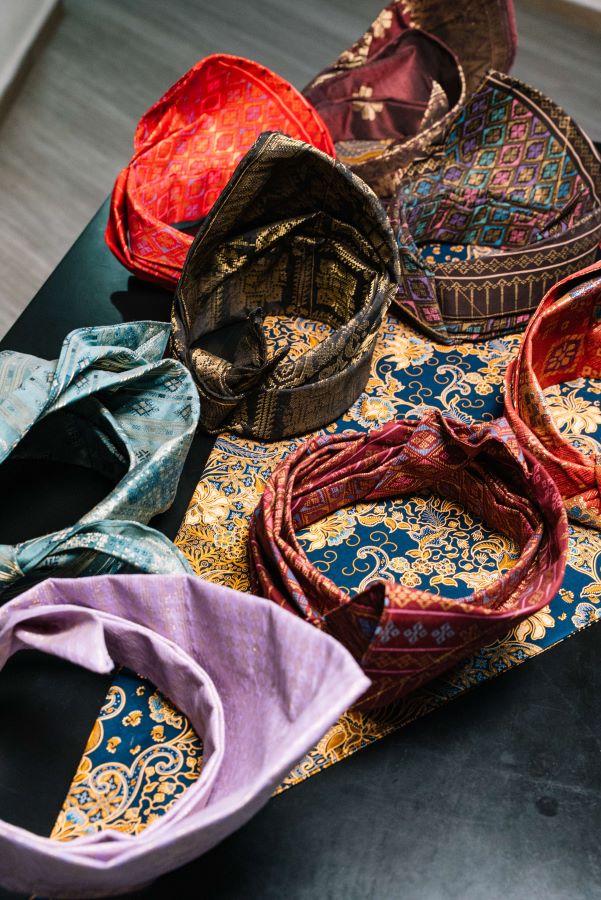
The Malay tanjak (also known as tengkolok or destar) is a traditional Malay headgear, made by folding and tying a piece of songket or woven cloth. Each tanjak style is known as a ‘Solek’. The tanjak is believed to have originated under the Malacca Sultanate during the 15th century. Its origin is tied to its usage, as the tanjak was first worn by kings. Wearing the tanjak was also mandatory for all men at official functions or royal ceremonies during the Malacca sultanate.
The tanjak (particularly the wave-like Suluk/Solok tanjak, from Negeri Sembilan, Malaysia) was especially popular amongst the Riau Malays, and the Malay tanjak eventually influenced the creation of later regional forms such as the Palembang tanjak in the 18th century. Today, tanjak styles vary across the peninsula, and even within countries, as each state builds on their own legacies of making and wearing of tanjak, influence by each state’s historical character. For instance, the state of Perak, as a ‘warrior’ society, depends on avian imagery of the chicken (Solek Ayam Patah Kepak – “Chicken with a Broken Wing”) and the eagle to reflect the wisdom (Solek Lang Menyusur Angin – “Eagle Following the Wind”) and bravery (Solek Lang Menyongsong Angin – “Eagle Facing the Wind”) of their warriors.
There also exist historically significant types of tanjak made known through their wearers, usually monarchs or aristocracy of renown, such as the Pancung Tak Bertanya (”Uncompromising Punishment”, though translates literally to “Beheading Without Asking”) tanjak, signifying power, authority, and ruthless justice, worn and characterised by Sultanate-era prosecutor Datuk Maharajalela, and the Semangat Bugis / Sumangek Ugik (Strength of the Bugis/Ugik) tanjak, representative of the strength of spirit of the Bugis community itself.
Geographic Location
Presently, the tanjak remains an integral part of ritual and ceremonial functions across the archipelago in Brunei Darussalam, Indonesia, Malaysia and Singapore.
Associated Social and Cultural Practices
Wearing of Tanjak
Originally, the tanjak was worn first and foremost by kings, warriors and noblemen. The tanjak acts as a wearable honorific – connotating title and/or status, attributable virtues and community functions of the wearer reflected through the design and positioning of the tanjak.
For example, the Dendam Tak Sudah, a style of tanjak from Negeri Sembilan, Malaysia, was initially created only to be worn by the Sultan and is recognised by its sharp, dramatic lines. Today, this tanjak is worn by the Di-Pertuan Agong of Malaysia. While the name is literally translated as ‘“Unending Resentment” or “Never-ending Resolve”, the endlessness referred to in the name refers to the dedication of the wearer. Some interpretations say this tanjak is worn by those who have demonstrated commitment in looking after those under their care – children, community, etc., – while others reflect on it as sheer persistence toward some honourable goal. This may reflect variation in values or circumstances between regional communities, or an evolution in its meaning and usage. The tanjak thus reflects both community and personal values, as behaviours communally seen as honourable are identified and showcased through the headdress.
The finished tanjaks are worn in specific ways that relate to the class and social function of the wearer. Sultans wear the tanjak two finger-lengths above the eyebrows, with the ‘knot’ positioned above the right ear such that the tanjak ‘lawi’ (end-flap) slants downwards to the left, while everyone else wore it the opposite direction, at least during and within the Malacca Sultanate. The position of the tanjak is also reflective of the activity of a community, as seafarers from the Bugis community would adorn the ‘Bugis Tak Balik’ (translating to ‘Bugis Not Returned’ and pointing to the left ear) when travelling and the ‘Bugis Peranakan’ style (pointing to the right ear) when returned home and newly married.
The tanjak is, today, worn most often at ceremonial, social and cultural events of community or official importance. Cultural events where the tanjak would be worn include weddings and performances of traditional Malay dance or other performing arts (e.g. gamelan, kompang/rebana). The tanjak is also a distinct cultural feature of events or festivities of religious significance. For instance, devotees in pre-1964 Singapore would don the tanjak as part of the processional Maulid, commemorating the birth of the Prophet Muhammad.
Making of Tanjak
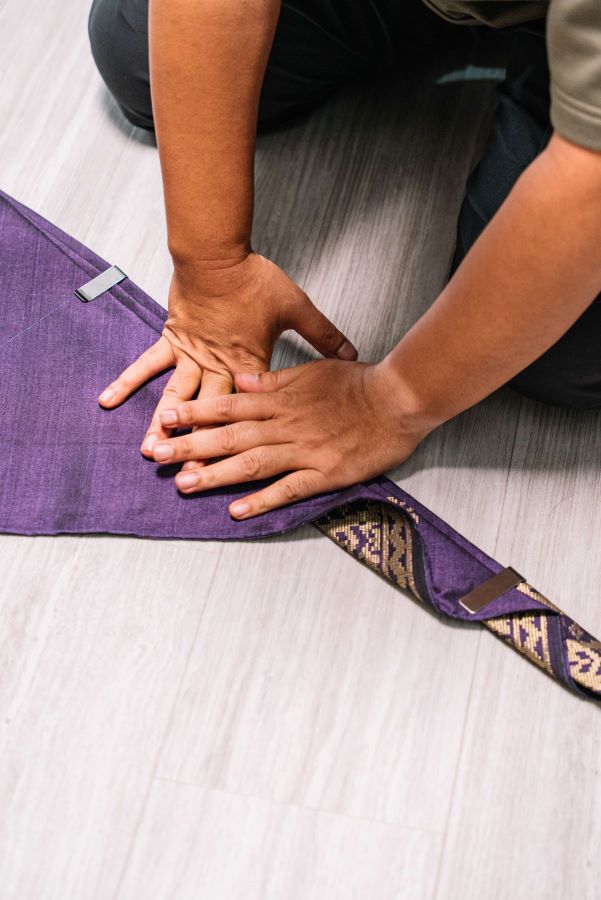
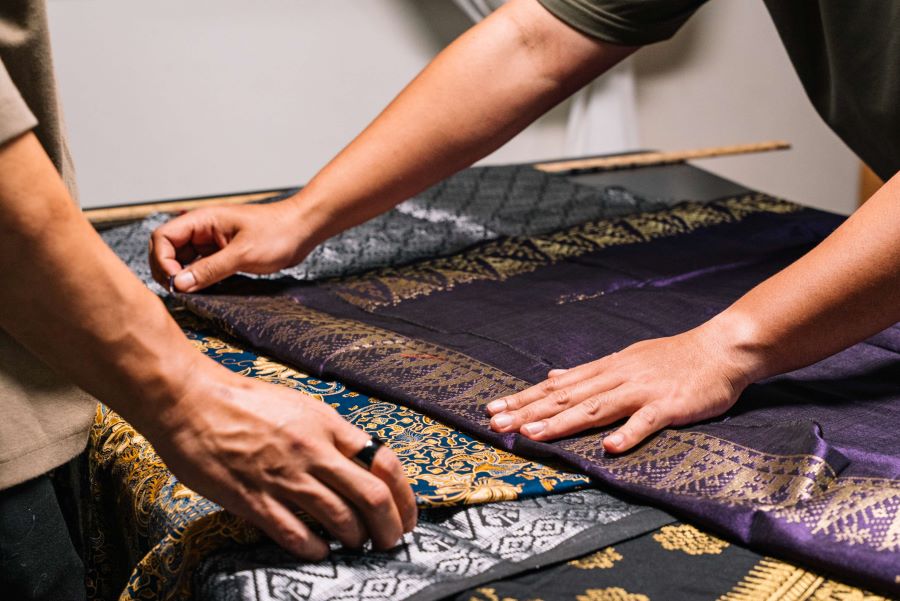
The making of tanjak requires scientific (and mathematical) precision. Kain songket, a woven Malay textile, is most often used to make tanjak given its rigidity, thickness and resistance to shrinkage. The cloth is then precisely measured to fit the head of the wearer, known as the Kain Gam (main fabric base) and folded into two triangular pieces that are perfectly symmetrical. The tanjak is then constructed through the Kaki Kain (Base Edge of the Cloth), the Tapak (Base Structure) which is the first folded section, and the Bengkong (Head Band) which is the subsequent fold. The Kertas Minyak (oil or wax paper) is then inserted between fabric layers to stiffen and a Kain Gam (stiffened fabric) is fused on with glue.
The tanjak can also be made with cloth decorated using the Telepuk (traditional gold-leafing) method, most often on Kain Tenun, and the preparation of the cloth for gold-leafing involves such tool as cowrie shell, beeswax, the trunk of Kayu Cermai (Cermai wood), and Kayu Nibong (Nibong wood). This method is believed to have been introduced in the 17th – 18th century by Bugis traders from Celebes and also relies on naturalistic imagery (flora and fauna) for its cultural symbolism. Arabic calligraphy is also sometimes incorporated, a notable example of which is the “Muhammad Timbal Balik” – the calligraphy of the Prophet Muhammad’s name. These designs are carved into wood then stamped onto fabric.
Communities Involved
In Singapore, the tanjak is mainly associated with the Malay/Muslim community.
Though Singapore has no remaining monarchy, the tanjak is often worn at formal events, weddings (by the groom) and other important ceremonies, similarly to the songkok. As is also true of the songkok, only men wear the tanjak.
Experience of a Practitioner
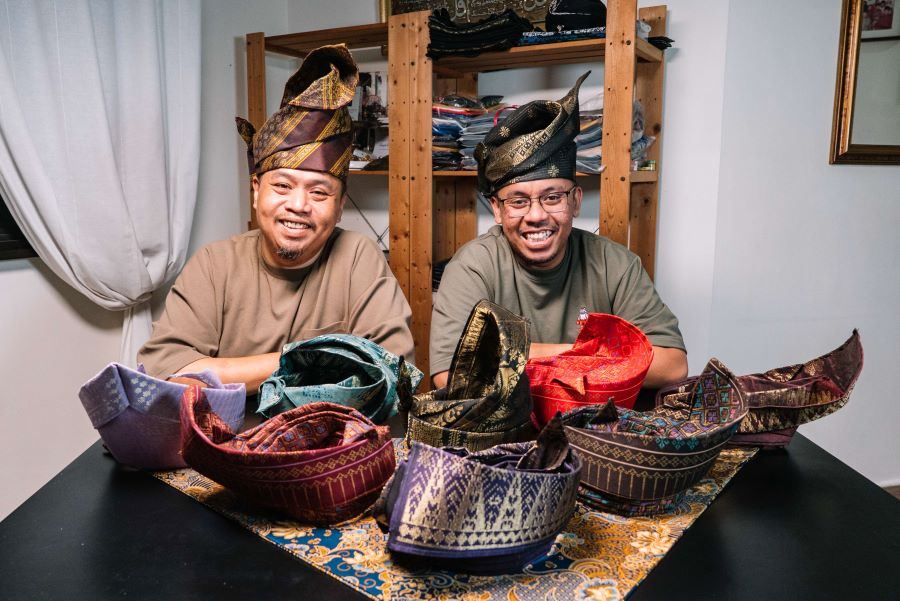
Mr Muhammad Fairuz Bin Zazali dedicated himself to practising the craft of tanjak-making in 2018, eventually leading to him founding BinMansor.sg. His passion for the craft led him to teaching, in an effort to transmit the skills required of this traditional craft to future generations of craftsmen. Mr Fairuz has organised community tanjak-making workshops with renowned practitioners from Malaysia, and his stake in both the regional practice of tanjak making and mentorship spurred his participation in NHB’s piloted ‘Heritage Apprenticeship Scheme’.
Viability and Future Outlook
Mr Fairuz’s apprentice, Saidrudy Muhamaed Buang, received one-on-one tutelage from Mr Fairuz on the cultural significance and history of the tanjak, alongside practical lessons on each step of the making of tanjak. Supported by the NHB’s pilot apprenticeship programme for six months, Saidrudy learned from Fairuz not just the technical requirements of the craft, but the evolution of traditional tanjak-making methods into modern forms (switching from Kain Gam to stiffer materials, for instance), and the associated cultural meanings of distinct tanjak Solek. Most of all, Saidrudy learned his mentor’s principles of patience, practice and dedication – and a pride in the tanjak as an element of Malay heritage rich in cultural symbolism and knowledge, instilling a love both of craft and of culture in the next generation of tanjak practitioners.
References
Reference No.: ICH-108
Date of Inclusion: March 2026
References
Azmi, Ulul, Essy Syam, and Qori Islami Aris. "Pengenalan Pemakaian Tanjak Melayu Pada Mahasiswa Sastra Daerah Fakultas Ilmu Budaya." Bidik 1, no. 1 (2020): 1-12.
Buang, Saidrudy Mohamed. "Collected Learning Reports on Tanjak-making from NHB 'Heritage Apprenticeship Scheme'." National Heritage Board, 2025.
Febrian, Febrian, Puji Astuti, and Susanti Susanti. "Ethnomathematics in Creating Tanjak from Tanjungpinang." In ICOME 2021, November 03-05, Tanjungpinang, Indonesia. EAI, 2022. DOI 10.4108/eai.3-11-2021.2314833.
Syarifuddin, Syarifuddin, Supriyanto, Tita Amalia, and Khovivah Ananda Putri. "The Existence of Tanjak as a Cultural Heritage That Must Be Preserved." Local Wisdom Scientific Online Journal 14, no. 2 (2022): 148-161.