

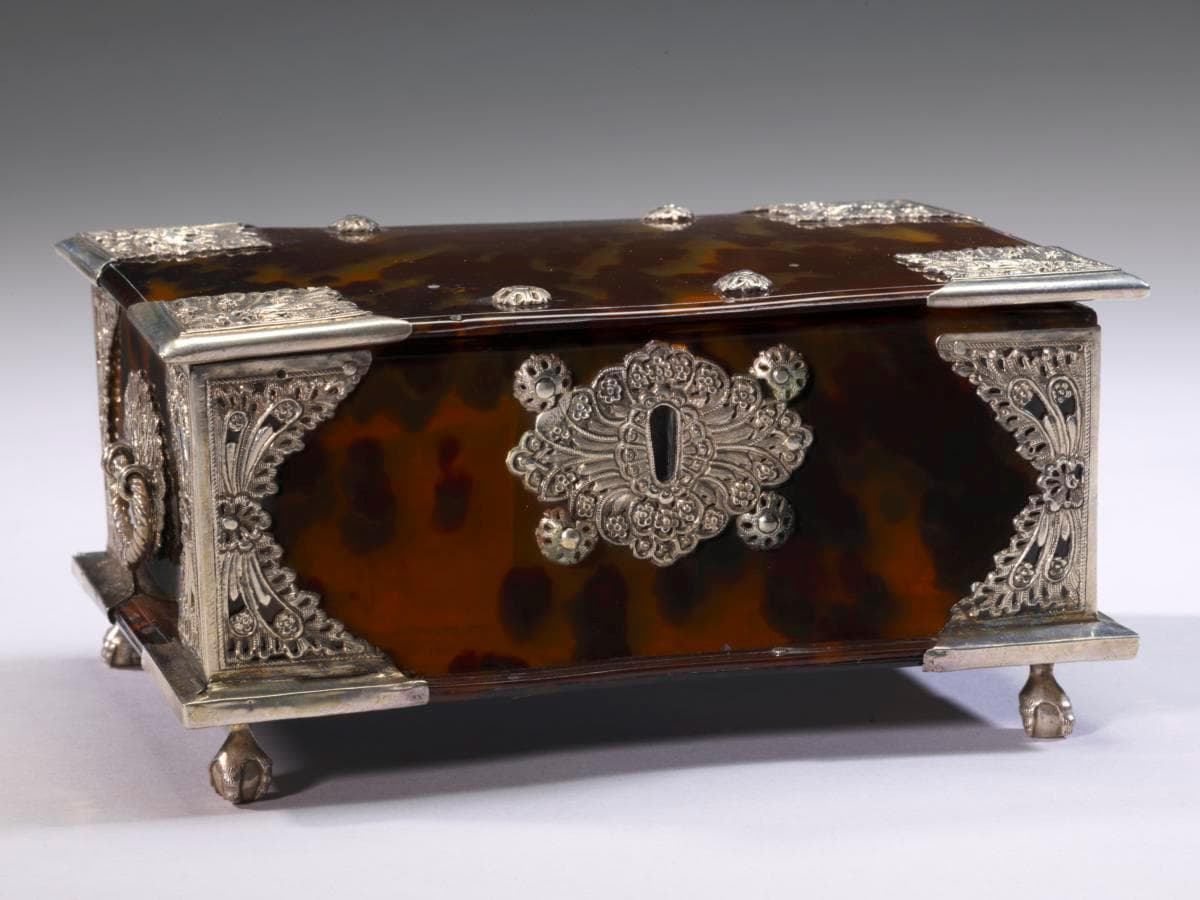
The tortoiseshell, the most valuable of which was sourced from the hawksbill turtle, was known to the Dutch as karet, a word with roots in Western India. Seaweed or agar-agar and tortoiseshell were amongst the most sought-after marine products sourced from Southeast Asia and tortoiseshell was sourced from parts of via Makassar from Sulu and Borneo, from, Java and Sumatra, the Malay Peninsula and further north to Thailand from as early as the fifteenth century. When the Dutch East India Company or the Vereenigde Oost-Indische Compagnie entered the Asian trade network, the Dutch used tortoiseshell as barter for metals in Japan and textiles at textile centres like Surat and Masulipatnam in India as early as the seventeenth century. Betel boxes in Batavia ranged from pocket to notebook size, and were usually made of tortoiseshell, amboyna wood, and less frequently of ebony and sandalwood. These were fitted with silver hinges, decorative elements, and clasps. Brass was also used, but this was the humbler alternative as were boxes made entirely out of brass. Exotic materials like ivory and mother of pearl were fitted with gold but these were far less common due to the value they commanded. This is a superior example of a box made in Sumatra, Indonesia. It is a box made of light brown tortoiseshell that has been ornamented with silver fittings. Such a box would have been used as a betel or sirih container; betel-leaf chewing was a practice common in the Malay world as well as one that was adopted by the Dutch. But this box is an anomaly due to the beautiful lining contained inside the box. Malay tekat or embroidery with scrolling and interlacing floral patterns or bunga has been used to embellish the yellow velvet cloth container, with elaborate metal thread work and miniscule red, orange, blue and pink glass beads. Due the raised embroidery, the container would not have been practical for the storage of jewellery which would easily get caught with every retrieval and storage attempt. What is more probable is that this highly decorative box was customized for the storage of a small and personal Quran, perhaps one that could have been used for travel or pilgrimage.