

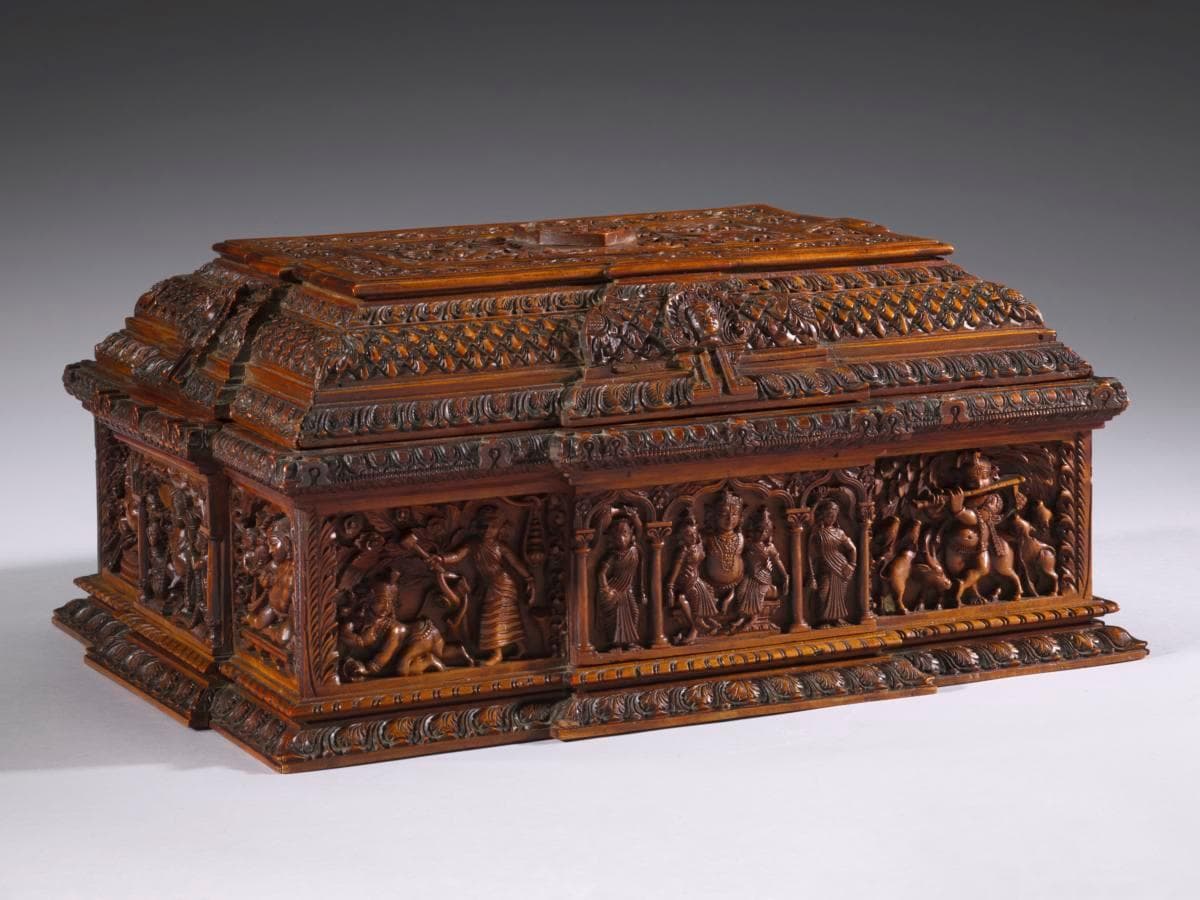
This South Indian carved box, originating from Mysore, Karnataka, is a remarkable example of Hindu religious art, featuring intricate carvings that depict scenes from Hindu mythology, particularly episodes from the life of Lord Krishna. The box is further embellished with animal and floral motifs, along with strong architectural elements reminiscent of South Indian Hindu temples.This carved box is deeply rooted in the Vaishnavite traditions of South India, particularly in the Kingdom of Mysore, where devotion to Lord Vishnu and his avatars was widespread. Each side of the box is divided into three panels, narrating significant episodes from Lord Krishna’s life, emphasising his divine playfulness and heroic acts. These include depictions of Balkrishna (young Krishna) as the Makanchor (butter thief) and being fed by his mother Yashoda, Krishna playing the flute among cows as Govardhan and Krishna subduing the serpent Kaliya—all central themes in Vaishnavism and Krishna worship. The city of Mysore, part of the state of Karnataka in South India, has historically been home to numerous Krishna temples, reflecting the region’s strong Vaishnavite influence. The temple-like structure of the box and presence of Deva Koshta-style niches suggest that it was inspired by or commissioned for religious use. The object may have served as a ritual casket to store sacred items, offerings or religious manuscripts. Beyond its functional use, the intricate carvings celebrate Lord Krishna’s divinity and serve as a portable form of temple architecture, allowing devotees to carry or display a miniature representation of sacred spaces within their homes.Stylistically, this carved box reflects the rich woodcarving and artistic traditions of Mysore and South Indian temple art. The panels depicting Lord Krishna’s life are framed by pillar-like structures, reminiscent of Deva Koshtas - the niches in Hindu temples that house deity sculptures. The central raised tiered lid adorned with floral carvings, mirrors the symmetry and structure of South Indian temple architecture, particularly the gopuram - the elaborately ornamented tower of Dravidian temples. The meticulous attention to religious iconography is further evident in the front niche which features a carved deity’s face, as well as the three-dimensional representation of Krishna, Yashoda and other mythological figures. The alto-relievo carving technique, characteristic of Mysorean woodcraft, is showcased through the intricate detailing of expressive gestures, flowing drapery and lifelike depictions. The artistry is attributed to the Gudigars, Karnataka’s master woodcarvers, whose name derives from gudi, meaning “temple” in the Kannada language. Karnataka is home to vast forests rich in indigenous timber, particularly sandalwood and rosewood, making woodcarving a significant intangible cultural art form in the region. The Gudigars have played a pivotal role in preserving this art form through their expertise in crafting religious and decorative objects, including wooden lintels, temple columns and deity sculptures. The box is likely crafted from high-quality sandalwood or rosewood, prized for their fine grain, durability and fragrant properties.