
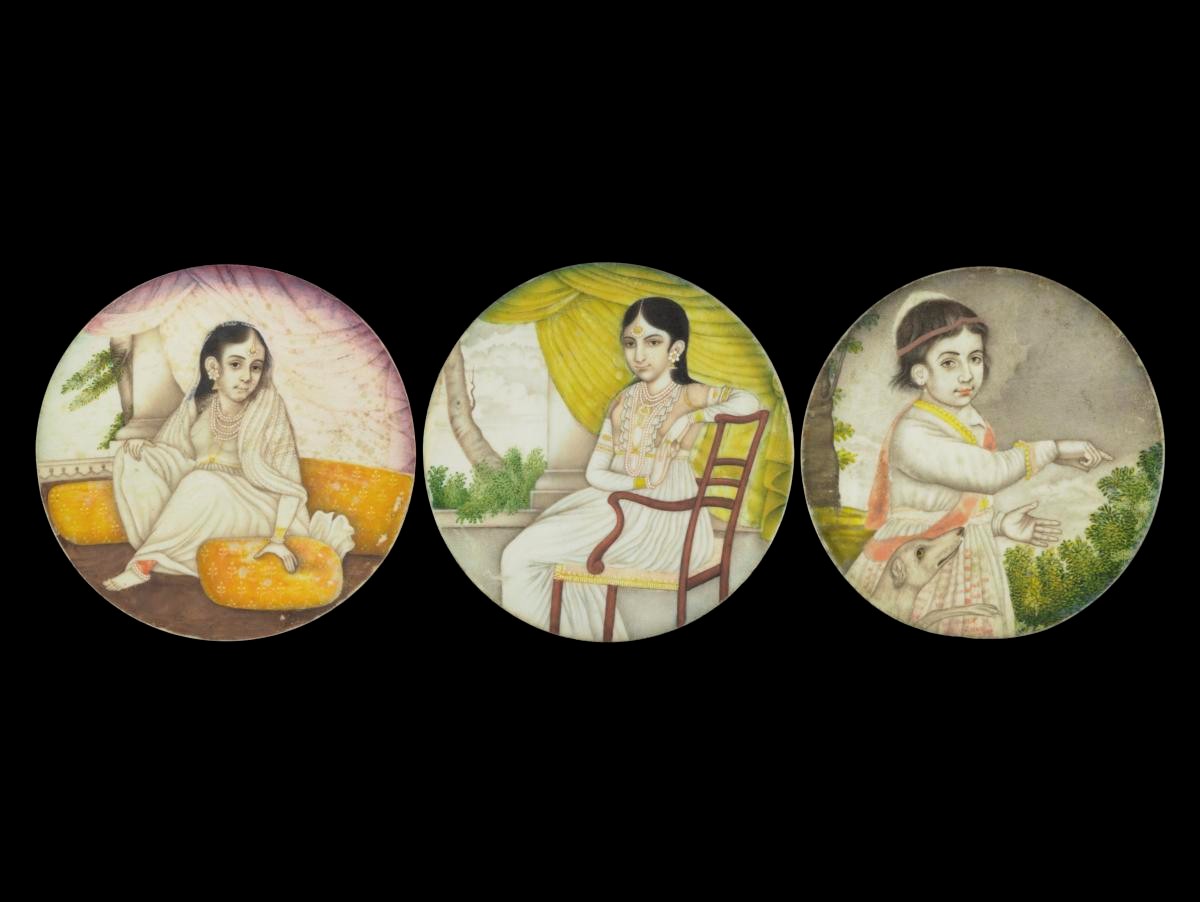
Unlike typical miniature paintings depicting historical figures such as Mughal emperors and royal ladies, or religious icons, this set of three ivory portrait miniatures depicts upper-class Indian children, offering valuable insights into the tastes and social dynamics of 19th-century Indian high society under British colonial rule. The children’s varying ages, traditional Indian attire reminiscent of Rajput and Mughal courtly dress and hairstyles are juxtaposed against European-style elements, such as columns, a pet Saluki and an Anglo-Indian caned chair. This suggests that the portraits were likely commissioned by a member of Indian high society to celebrate their children in a style influenced by colonial tastes.These miniatures showcase a fusion of Indian and European aesthetics, with Indian subjects depicted in European-inspired poses and settings. They highlight the cross-cultural interactions of the era, demonstrating how Indian elites adopted and adapted European artistic conventions to express their evolving identities and aspirations.This set reflects the tradition of portrait miniatures in India, which began in the 17th century when English diplomat Sir Thomas Roe gifted a similar canvas to the Mughal Court. Imperial Mughal artists adopted this practice, producing limited numbers of bust-length, oval portraits of royalty, including depictions of Jahangir, Shah Jahan and Mumtaz Mahal. These portraits, often worn as pendants or turban ornaments, served as courtly displays of personal allegiance.In the 18th century, ivory replaced parchment as the preferred medium for portrait miniatures. By the late 18th century, professional British artists working in India mastered ivory-painting techniques, popularising ivory portrait miniatures among East India Company officials and their high-ranking Indian patrons. This art form remained popular until the latter half of the 19th century, when photography gradually replaced it.