
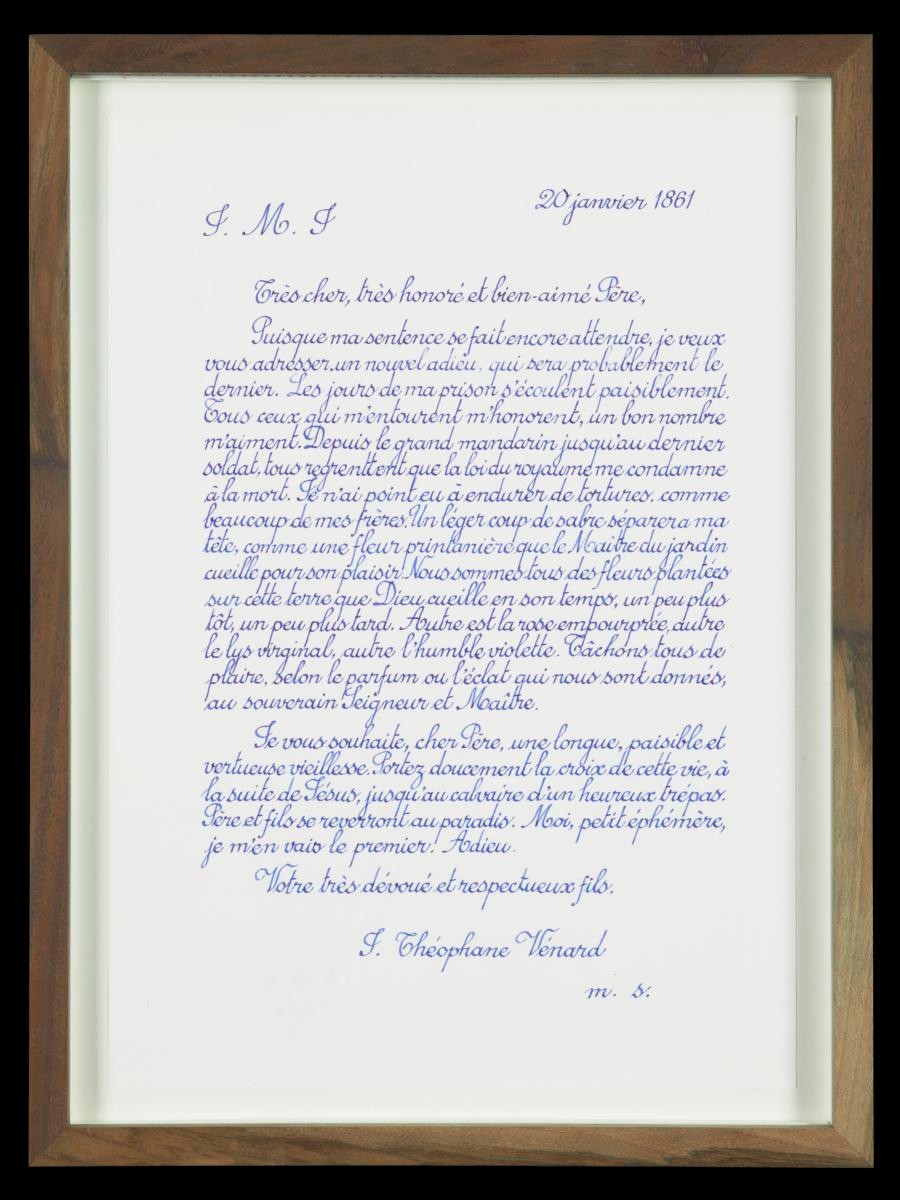
2.2.1861 takes the form of a handwritten letter by Phung Võ, the artist’s father and a skilled calligrapher. The text is copied word-for-word from the last letter the French missionary Jean-Théophane Vénard wrote. Vénard was executed in Tonkin, Vietnam, and was only recognized as a saint by the Catholic church more than a hundred years after his death. The title of the work references Vénard’s execution date. As a fervent Catholic himself, the artist’s father sees this as a devotional and meditative act, despite not being able to speak or read English and French. The artist’s father copies the letter meticulously several times a week without fail, and has set out to continue doing so until his passing.This work also draws on the transformative potential of wood, and how it might serve as a carrier for latent historiographies. The material’s storied pasts demonstrate Võ’s interest in converging different scales of influence: in this case, how geopolitical maneuvering intersects with the personal across generations. 2.2.1861 is framed with the wood of black walnut trees from Robert McNamara’s estate. McNamara was the U.S. Secretary of Defense from 1961 to 1968, during which he presided over—and has been credited with designing—the catastrophic Vietnam War. Võ purchased personal assets from Robert McNamara’s estate in 2012 and incorporated them into some of his works. McNamara’s only son, Craig McNamara, encountered these works, and the two formed an ongoing correspondence. This culminated in the younger McNamara ultimately inviting Võ to visit his family’s diversified farming operations in California. On the farm were an orchard of slowly maturing black walnut trees, which were highly coveted by the gun industry as they were of just the right height for crafting gun stock. Instead of turning these trees into weaponry for a sizeable profit, the McNamaras decided to clear the land for regeneration and planting instead. This wood was then made available to Võ, who used the material in a series of works, including the frame of this edition of 2.2.1861, imbuing the work with a layer of material significance as it considers the transformative potential of wood itself.