

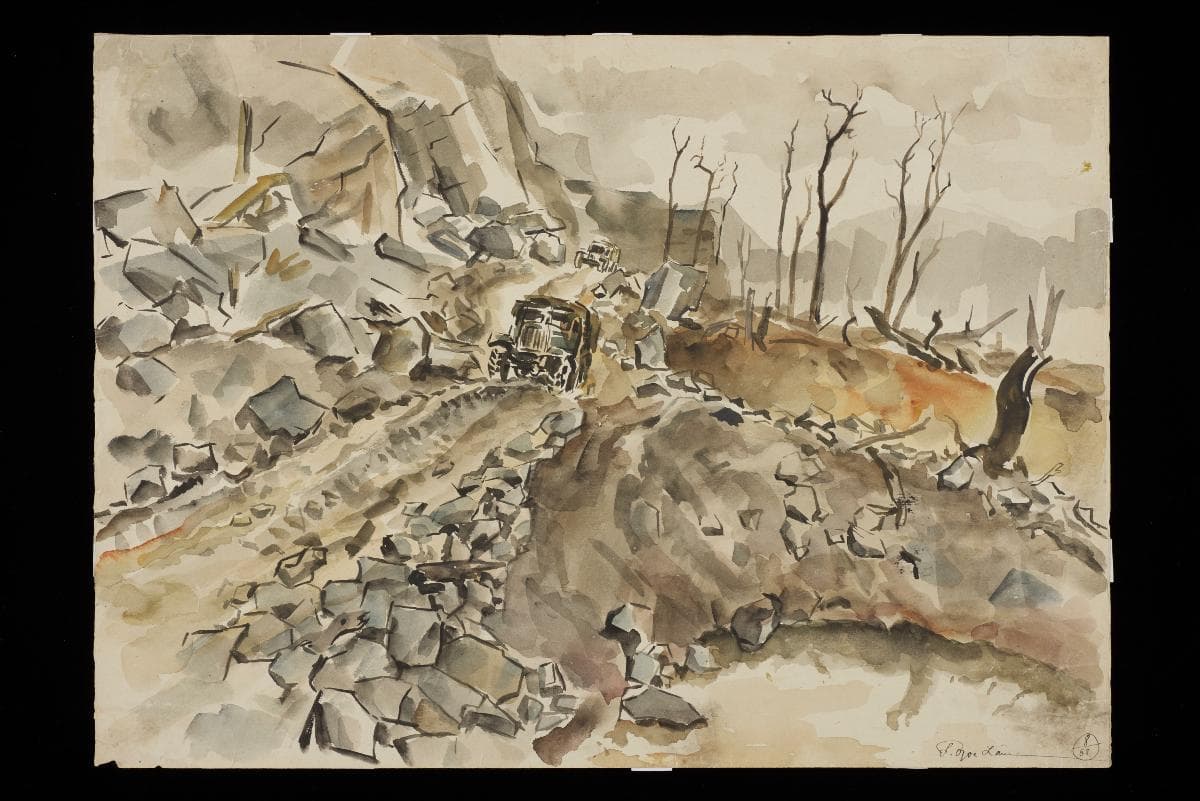
Artists from Vietnam played an integral role in both the First Indochina War (1946-1954), where they fought for independence from French colonial rule, and the Second Indochina War (commonly known as the Vietnam War or the American War), which continued until 1975. Artists documented conditions for soldiers in the battlefields, as well as for civilians in the cities and the countryside. They also created propagandistic and sometimes romantic images to articulate and advocate ideological positions. In the Democratic Republic of Vietnam (DRV or North Vietnam), artists were employed by the military or the state; sometimes their works were created as personal mementoes, and sometimes they were exhibited or published during the wartime. According to interviews with the artist, the location depicted in this work is the Trường Sơn Trail between Quảng Bình and Laos. Intensive bombing had substantially destroyed this section of the forest, creating a bare landscape of stone. The Trường Sơn Trail (also known as the Ho Chi Minh Trail) was the collective name for a network of trails and routes through the Trường Sơn mountains in Eastern Laos and Cambodia, via which the North Vietnamese army was able to clandestinely move into South Vietnam and transport vital supplies.While most art in the DRV followed a realistic style, as mandated by the official guidelines on art production, Bùi Quang Ánh's work nonetheless gives the impression of a defined personal style, characterised by angular, almost cubistic, use of line. This image uses the artist’s typical style to convey the extent of the devastation of the landscape. For this artwork, Bùi Quang Ánh collaborated with his driver, Mr Lâm, who helped to make preliminary drawings for the work. Mr Lâm’s signature also appears on the artwork.This artwork is part of a significant collection of drawings, sketches, paintings, posters and photographs in Singapore’s National Collection. These works reflect the diversity of artistic production during the First and Second Indochina Wars among artists affiliated with the communist side of the conflict. Many key figures active as war artists during this period have also had a lasting impact on the development of modern art in Vietnam and beyond.