
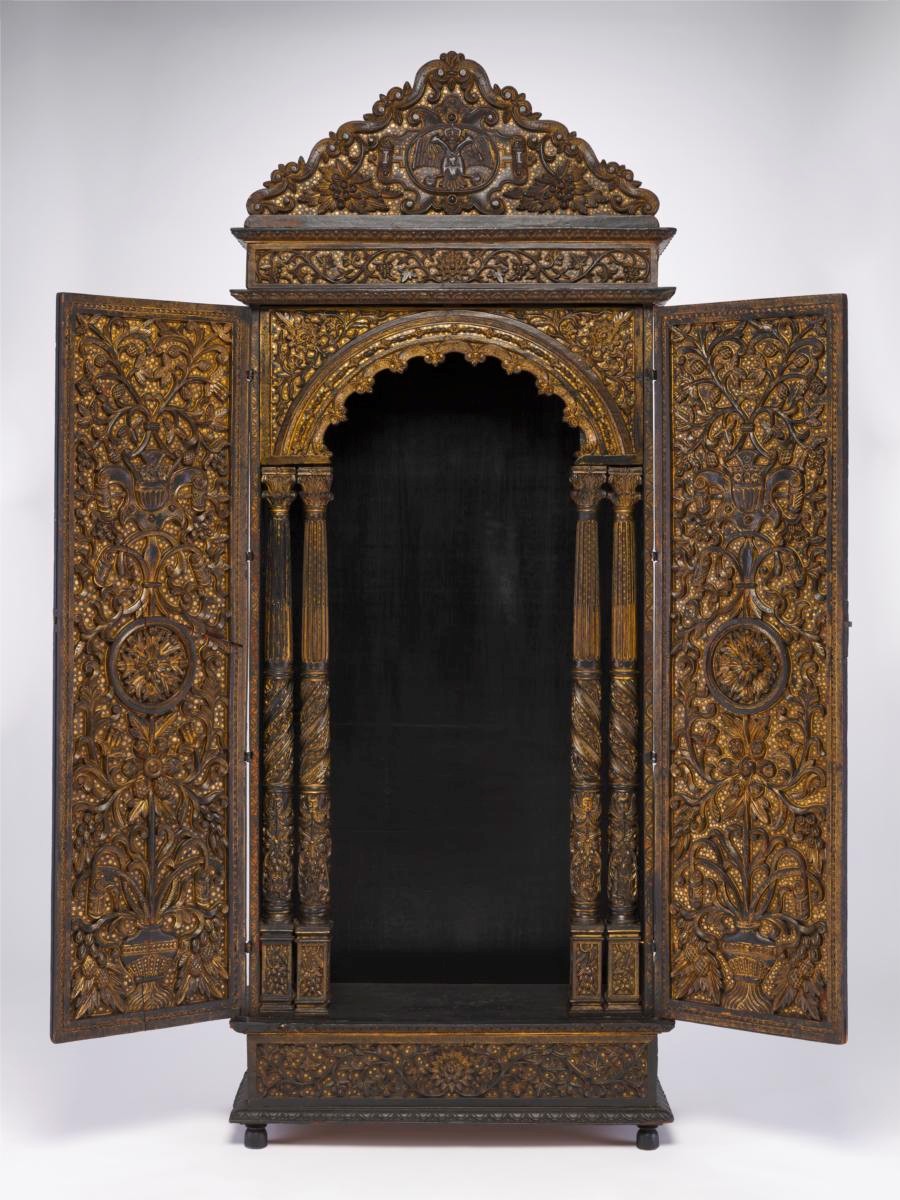
Following the shape of a European altarpiece, this shrine, for private devotion, once housed a religious figure, probably a crucifix or a Virgin and Child. The crowned, double-headed eagle with heart pierced with arrows, in the centre of the triangular pediment, is a motif long associated with the Habsburg dynasty. It is found throughout the Spanish empire, and in Portugal, which was under the Habsburg rule between 1580 and 1640. It also appears as a popular decoration on all manner of both Asian and Western decorative arts for the Spanish market. The motif was granted by King Philip II of Spain (1527–1598) for use by the Augustinians in association with the heart pierced by arrows. The grapevine is another popular motif used in Christian art. The Augustinians – Catholic Order of Saint Augustin – established several monasteries in Mexico, the Philippines, and Macau in the 16th century. One of the earliest records of Augustinians in Portuguese-ruled Macau, is from Spanish friars from the Philippines around 1589. This shrine was probably commissioned by that monastic community, around the first half of the 17th century.